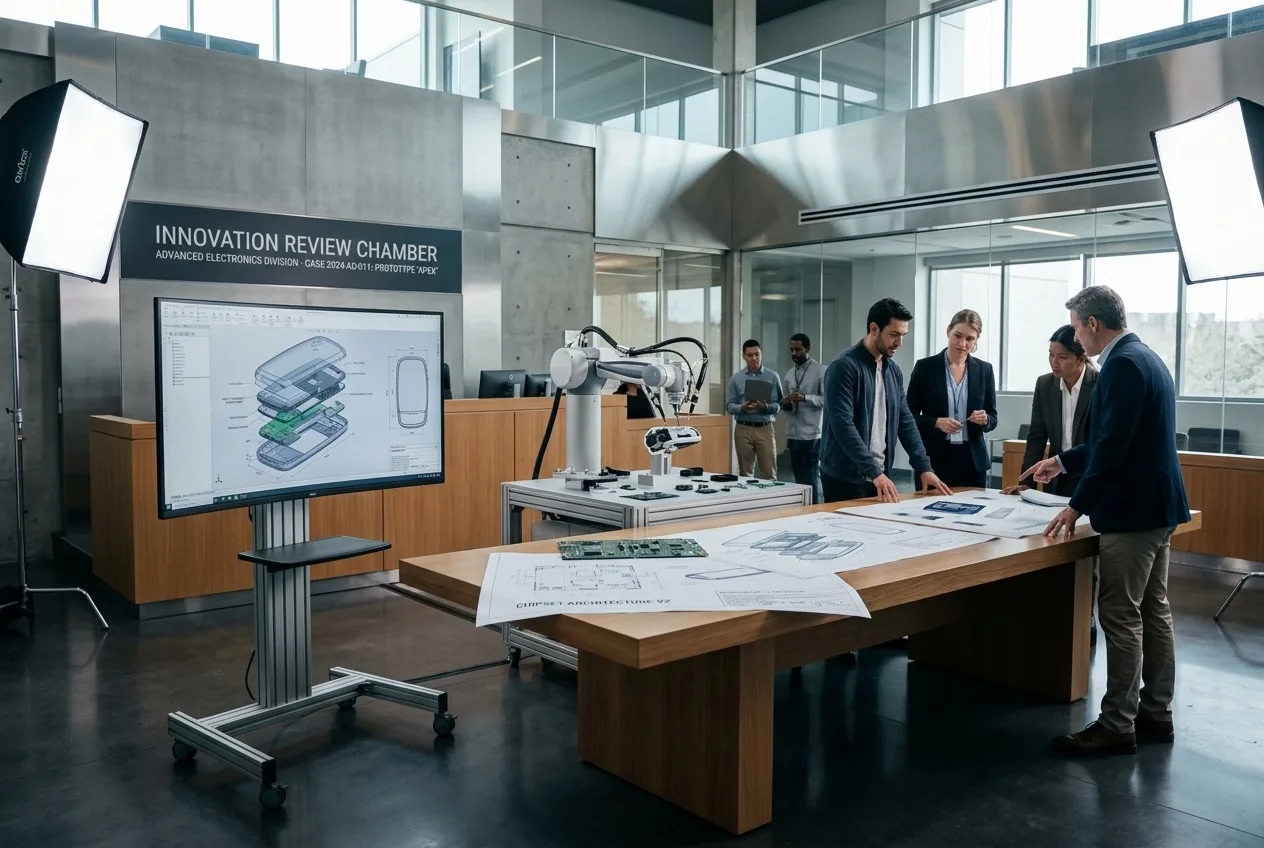
For years, the generative artificial intelligence boom has played out almost entirely in the ethereal realm of data centers, custom silicon compute clusters, and transformer model weights. But the ambition to liberate artificial intelligence from the rectangular glass prison of the smartphone has inevitably collided with physical reality. Building high-volume consumer electronics requires precision manufacturing pipelines, bespoke metallurgical tooling, and decades of hardened supply chain relationships. Now, that collision has landed inside a federal courtroom.
In a 41-page complaint filed in the U.S. District Court for the Northern District of California, Apple has launched a direct legal assault against OpenAI and io Products, the hardware design firm founded by former Apple design chief Sir Jony Ive and acquired by OpenAI for $6.4 billion in May 2025. The lawsuit alleges systematic trade secret misappropriation, claiming that OpenAI orchestrated an illicit operation to siphon proprietary engineering architectures, unreleased product blueprints, and sensitive vendor tooling agreements directly out of Cupertino.
The civil action represents a rupture between two tech giants that only recently maintained a headline software partnership. More fundamentally, it exposes the structural chokepoints of modern consumer hardware: as artificial intelligence companies attempt to build physical devices that can interact with the real world, they are discovering that mastering inference is radically different from mastering yield rates on an assembly line.
The Hardware Exfiltration Playbook
Apple’s filing does not deal in vague corporate generalities. Instead, the complaint details forensic records of data transfer, structured recruiting debriefs, and the alleged extraction of confidential production tolerances. At the center of the complaint sits Tang Tan, OpenAI’s Chief Hardware Officer. Tan spent roughly 24 years inside Apple’s product design hierarchy, ultimately rising to Vice President with oversight of mechanical engineering for the iPhone and Apple Watch product lines before departing in 2024 to join io Products.
According to Apple, Tan utilized his institutional knowledge not merely to recruit engineering talent, but to bypass the multi-year iteration cycles that define commercial hardware development. The complaint accuses Tan of systematically deploying internal Apple project codenames during recruitment screens, explicitly urging prospective hires to divulge engineering workbooks, and in multiple instances, instructing candidates to physically bring proprietary Apple internal components into technical interviews.
The forensic narrative extends down to OpenAI technical staff member Chang Liu. Apple alleges that Liu exfiltrated dozens of proprietary CAD models, component stress-testing presentations, and detailed technical specifications for hardware products that have not yet reached public disclosure. Furthermore, digital logs cited in the lawsuit demonstrate that Liu actively coached a sitting Apple hardware engineer on methods to evade enterprise data-loss prevention software while copying confidential engineering files to personal storage media.
While Jony Ive himself is not named personally as a defendant, io Products—the design house he established to explore novel post-smartphone form factors—is named directly alongside OpenAI. The legal theory hinges on the acquisition: Apple argues that OpenAI bought an operation whose early prototype hardware rested on intellectual property harvested illicitly from Apple’s mechanical and industrial design labs.
The Supply Chain as Proprietary Intellectual Property
In mechanical engineering, a blueprint is only as good as the factory floor capable of holding its tolerances. One of the most revealing dimensions of Apple’s lawsuit is the accusation that OpenAI systematically targeted the iPhone maker’s confidential vendor agreements and supply chain logistics. To casual observers, knowing which tier-one manufacturing partner molds a chassis or glues an optical array might seem mundane. To an industrial operation, it is often the most valuable trade secret in existence.
Consumer devices operating at sub-millimeter scales demand specialized materials science, custom Computer Numerical Control milling profiles, customized anodization baths, and proprietary automated optical inspection systems. Apple spends billions of dollars and years of joint process engineering with contract manufacturers across Asia to push yields on novel titanium alloys, miniature haptic motors, and ultra-dense flex-printed circuit assemblies.
Can AI Native Hardware Escape the Smartphone?
The lawsuit lands at a critical strategic inflection point for OpenAI. Chief Executive Officer Sam Altman has repeatedly articulated a post-smartphone computing paradigm, positioning ambient, conversational artificial intelligence as a modality that will supplant handheld screens. Yet initial market efforts in the dedicated AI hardware category—ranging from wearable lapel pins to pocket companion modules—suffered disastrous commercial launches due to thermal throttling, catastrophic battery drain, poor cellular modem performance, and clumsy industrial ergonomics.
Achieving ambient intelligence requires extreme hardware competence. A standalone audio, optical, or spatial computing device must balance passive thermal dissipation, battery chemistry, RF antenna efficiency, and mechanical durability against rigorous weight constraints. These are not software bugs that can be resolved via an over-the-air API push; they are thermal and mechanical design laws governed by physics.
Executive Transitions and Shifting Alliances
The timing of the complaint underscores shifting fault lines across Silicon Valley. In 2024, Apple showcased an integration of OpenAI’s ChatGPT into its operating systems as an interim solution for Siri. But that tentative detente has steadily unraveled. Earlier this year, Apple pivoted toward Google to support its core platform intelligence, signaling a cooling relationship with Altman’s organization.
Internally, Apple is preparing for its own generational leadership transition. With Chief Executive Tim Cook scheduled to step down in September, handing executive authority to longtime hardware engineering lead John Ternus, the company’s posture reflects its deep-seated identity. Ternus is an engineer whose career is rooted in Mac, iPad, and iPhone hardware delivery. Under his upcoming tenure, any attempt to expropriate proprietary hardware design patterns or encroach upon Apple’s supply chain is guaranteed to meet zero tolerance.
Simultaneously, OpenAI has been moving toward an initial public offering amid intense commercial competition from rival labs. An intellectual property lawsuit targeting the company’s core hardware aspirations introduces complex legal discovery risks and the prospect of injunctions that could bar its forthcoming physical consumer products from entering global distribution channels.
The High Cost of Industrial Shortcuts
In a terse official statement responding to the complaint, OpenAI asserted: “We have no interest in other companies’ trade secrets. We remain focused on building innovative technology that empowers people everywhere.” The company will likely lean on standard Silicon Valley defense doctrine, arguing that employee mobility is protected under California law and that the skills, general knowledge, and vendor familiarity accumulated by seasoned executives do not automatically equate to stolen intellectual property.
Yet the physical world offers a forensic clarity that pure code often obscures. If an unreleased OpenAI device reaches regulatory testing featuring identical structural ribbing, specialized potting compounds, or proprietary alloy treatments lifted from Cupertino’s confidential test files, the legal defenses will narrow quickly.
The dispute proves that the artificial intelligence revolution is no longer just a war of parameters and inference throughput. To build the future of computing, software conglomerates must master the brutal, unforgiving mechanics of mass manufacturing. And as OpenAI is discovering, in the physical universe, you cannot synthesize hardware experience without paying the engineering overhead.




Comments
No comments yet. Be the first!