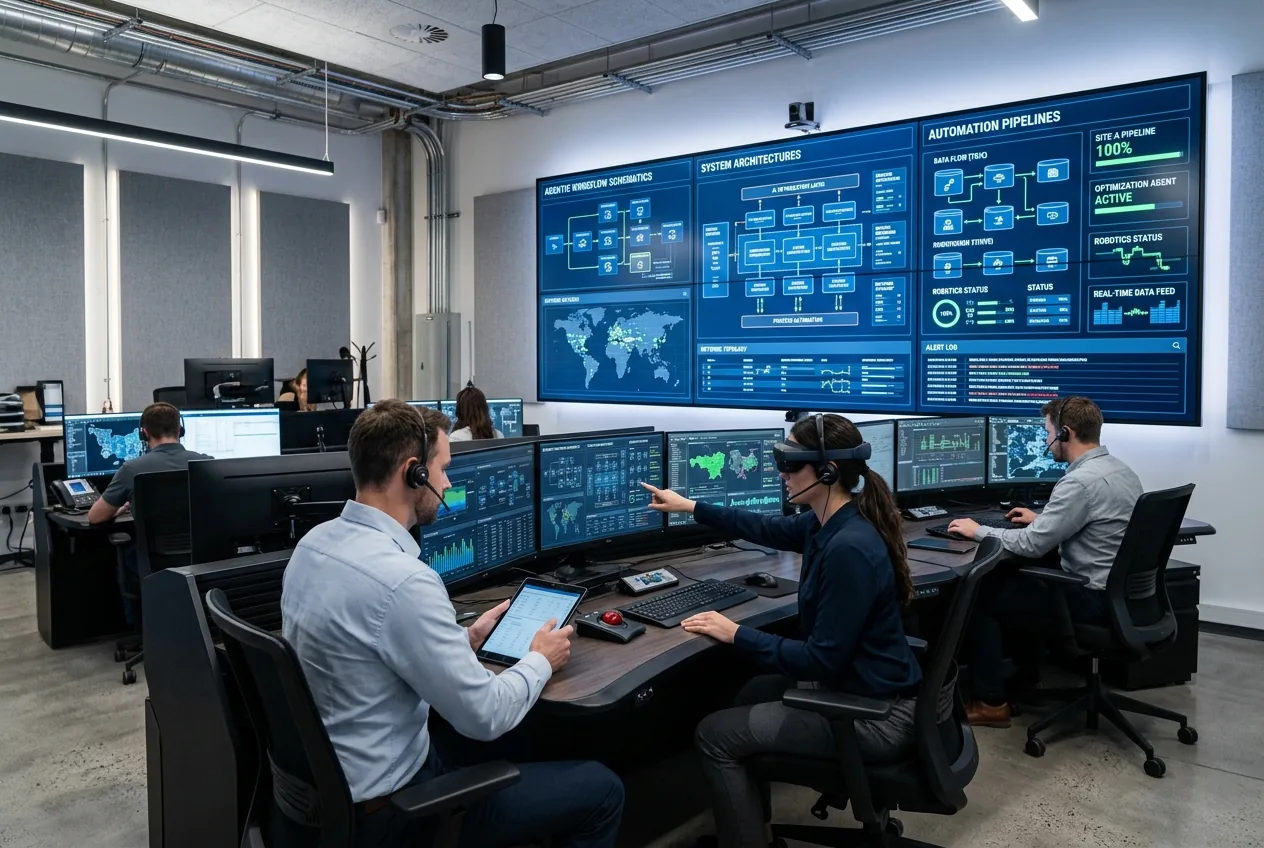
Enterprise automation has spent years navigating an awkward impasse. While frontier large language models demonstrate remarkable zero-shot reasoning, deploying them across high-volume, multi-turn corporate pipelines has routinely broken enterprise budgets. Token consumption across persistent autonomous loops scales aggressively, making brute-force inference economically unviable for mundane operational tasks. With the general release of the GPT-5.6 series—anchored by the specialized Sol, Terra, and Luna model architectures—OpenAI is attempting to bridge this gap between raw computational capability and practical workplace economics.
Integrated directly into the enterprise-focused ChatGPT Work environment, the 5.6 family abandons the monolithic model approach that characterized earlier generations of generative artificial intelligence. Instead, OpenAI has engineered a stratified topology. By bifurcating workloads across discrete weight classes tailored for distinct operational latencies and token price points, the system targets autonomous tool execution, complex application switching, and deterministic reasoning. For technical operators and automation architects, this release represents a transition from speculative chatbot interfaces to structured digital labor.
Stratified Compute Across Sol, Terra, and Luna
The foundation of the GPT-5.6 deployment lies in its architectural segmentation. Rather than routing every database query, workflow trigger, and syntactic check through an expensive frontier parameter set, OpenAI divides operational responsibilities among three distinct engines. Sol serves as the heavy-duty operational driver, engineered for complex reasoning and prolonged execution loops. Terra occupies the balanced middle tier, handling high-throughput conversational routing and standard data synthesis. Luna functions as a lean, low-latency execution node designed for high-frequency micro-tasks, parsing, and structured schema extraction.
This hardware-conscious stratification reflects a mature engineering reality: high-end reasoning is wasteful when applied to deterministic data extraction. In automated testing environments, running continuous validation checks through a top-tier cognitive model produces diminishing returns while inflating API overhead. By allowing enterprise platforms to seamlessly orchestrate tasks across Luna for mechanical parsing and Sol for ambiguous edge cases, OpenAI provides the granular resource allocation that industrial software pipelines have long demanded.
The engineering advances behind this rollout also clarify the structural pipeline leading into the next iteration of frontier intelligence. Lessons learned in model quantization, intermediate state caching, and context isolation during the 5.6 lifecycle directly inform the cost curves seen across subsequent frontier iterations, including the high-capacity Astra systems and the GPT-6 architecture. The ultimate objective is clear: driving inference costs downward while steadily advancing task completion reliability.
Benchmarking the Economics of Autonomous Workflows
In enterprise engineering, benchmarks only matter when tied to the balance sheet. Traditional evaluations like broad knowledge exams fail to capture whether an artificial agent can navigate enterprise software architectures, handle authentication states, or recover from transient API errors. The 5.6 deployment addresses this by calibrating performance against multi-step functional evaluations, including AutomationBench, Agents’ Last Exam, and operating system interaction environments such as OSWorld.
On multi-app business workflow assessments, which evaluate agentic routines across dozens of disparate enterprise tools spanning inventory management, logistics planning, support routing, and internal operations, the Sol tier exhibits significant structural improvements over competing market models. More importantly, it achieves competitive task completion at a fraction of the computational expense. Historical implementations of agentic loops routinely stalled out due to compound latency and exponential fallback costs, where failure in an intermediate node forced an expensive top-tier model to take over the context window.
Re-Engineering the Interface Through Direct Computer Use
Perhaps the most technically demanding facet of the new deployment is the expansion of native computer use. Traditional robotic process automation relied heavily on rigid, brittle API hooks or fragile visual coordinate mapping that fractured whenever an application updated its user interface. When an interface element moved ten pixels to the left, automated scripts inevitably broke down, demanding human intervention to recalibrate DOM selectors or mouse triggers.
GPT-5.6 approaches interface automation through multimodal spatial reasoning and dynamic OS-level interaction. Operating through the ChatGPT Work environment, the agent parses visual layouts, identifies active input windows, and constructs programmatic actions dynamically. If an enterprise dashboard alters its visual hierarchy, the model interprets the semantic layout rather than executing a hardcoded sequence of mouse coordinates. It can retrieve operational telemetry from legacy SCADA viewers, compile metrics across distributed spreadsheets, and populate supply chain databases without requiring bespoke middleware for every interaction.
This functional flexibility significantly reduces the implementation friction that has historically slowed industrial automation projects. Modernizing operational data flows across legacy industrial stacks typically requires months of systems integration, custom API wrappers, and endless edge-case debugging. An agent capable of operating general-purpose desktop environments with dependable spatial judgment lowers the capital expenditure required to link legacy databases with modern cloud infrastructure.
Token Economics and the Industrial Viability of Agentic Systems
From a mechanical and systems engineering standpoint, software components must satisfy rigorous cost-to-throughput thresholds before they can be embedded in critical operational paths. In high-frequency operational loops, where thousands of parallel agents query sensor arrays, update enterprise resource planning tables, and triage inventory alerts, token expenditure functions as an ongoing variable operating cost. If the marginal cost of agentic reasoning exceeds human labor or deterministic procedural code, adoption stalls immediately.
OpenAI’s pricing strategy for the 5.6 lineage acknowledges this economic constraint. Pricing models that charge prohibitive sums per million tokens naturally restrict autonomous agents to niche, high-margin advisory roles. By refining prompt caching techniques and optimizing server-side transformer execution, OpenAI has slashed input and output token overhead. The architectural efficiencies established here have lowered API rates to practical thresholds—scaling down to pennies per million tokens for intermediate execution layers like Luna and significantly reducing the cost burden on high-effort Sol inferences.
The Trajectory Toward Deterministic Automation
As the GPT-5.6 architecture establishes its footprint across enterprise infrastructure, the conversation surrounding artificial intelligence is undergoing a critical tonal shift. The initial novelty of open-ended conversational generation has largely run its course. Industrial leaders, software architects, and operations managers are no longer evaluating models based on how eloquently they draft an email; they are measuring them on determinism, operational uptime, context fidelity, and execution cost per completed task.
OpenAI’s decision to bifurcate its model strategy into task-optimized tiers reflects an engineering maturity that the sector desperately needed. The era of the all-purpose, compute-heavy monolith is giving way to balanced computing architectures that prioritize mechanical efficiency and workload-appropriate sizing. In bridging the divide between frontier cognitive reasoning and predictable operational expenses, the GPT-5.6 ecosystem signals that artificial intelligence is finally ready to operate not just as an interactive tool, but as durable, reliable infrastructure.




Comments
No comments yet. Be the first!