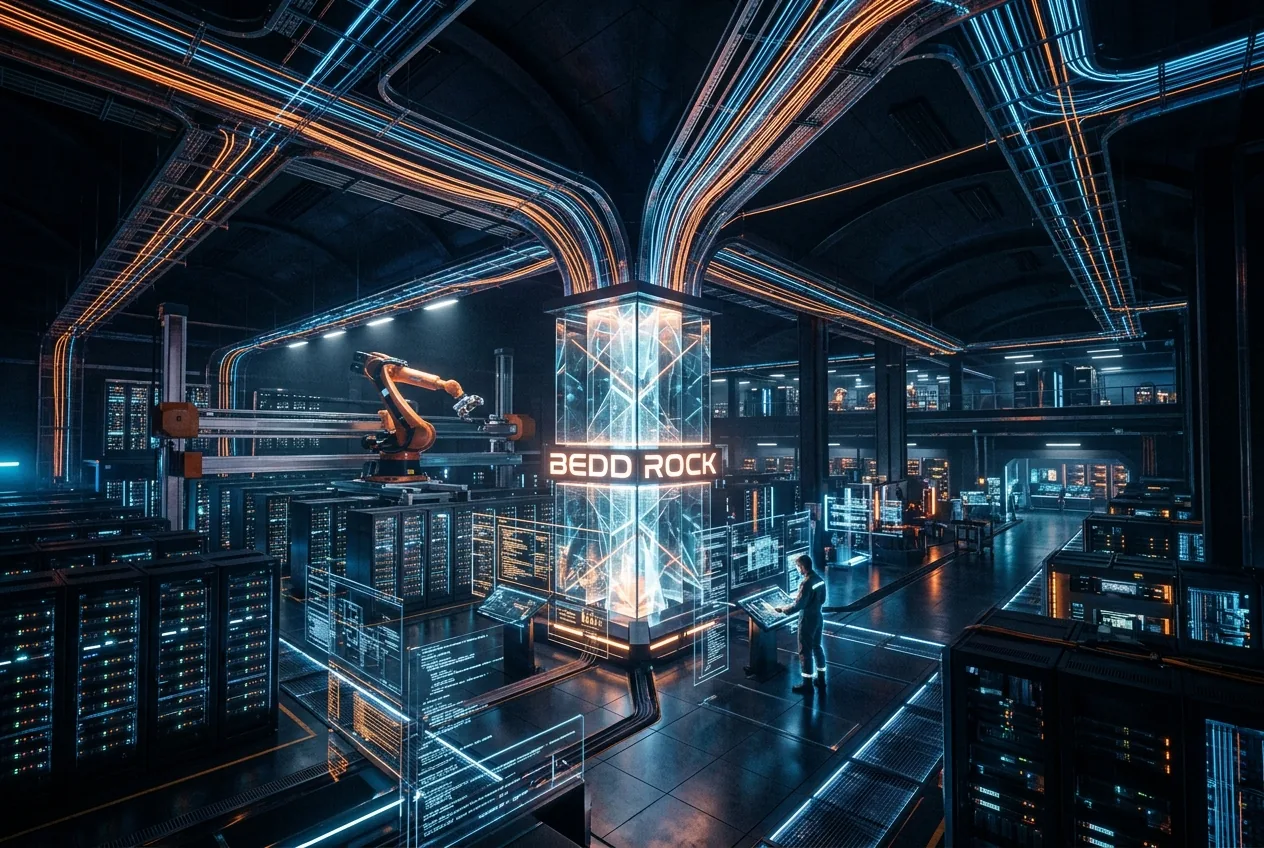
The landscape of industrial-scale artificial intelligence has undergone a fundamental shift. For years, the strategic partnership between OpenAI and Microsoft Azure was the primary axis upon which the generative AI industry rotated. However, that era of exclusivity has officially ended. OpenAI’s latest frontier models—GPT-5.5 and GPT-5.4—alongside the Codex coding agent, are now generally available on Amazon Bedrock. This move represents more than just a new distribution channel; it is a calculated expansion into the massive AWS ecosystem, where the world’s most critical industrial, logistics, and technical infrastructure resides.
For organizations that have built their data pipelines on Amazon Web Services, the arrival of GPT-5.5 marks a turning point. Until now, leveraging OpenAI’s top-tier reasoning required bridging disparate cloud environments or migrating heavy datasets to Azure—a process fraught with latency issues and security complexities. With this integration, AWS users can now invoke OpenAI’s most advanced reasoning engines directly within their existing virtual private clouds, utilizing the same security protocols and IAM (Identity and Access Management) roles they use for their databases and compute clusters.
The Technical Hierarchy of GPT-5.5 and GPT-5.4
In the hierarchy of the new release, GPT-5.5 sits at the apex. Engineered for what OpenAI describes as "hardest customer workloads," GPT-5.5 is optimized for complex reasoning, multi-step agentic workflows, and professional-grade technical tasks. From a mechanical and systems engineering perspective, the "agentic" nature of these models is the most significant development. Unlike previous iterations that primarily functioned as sophisticated text predictors, GPT-5.5 is designed to operate with a level of autonomy that allows it to manage long-horizon tasks—such as coordinating a supply chain response or debugging a distributed software architecture—with minimal human intervention.
Conversely, the GPT-5.4 model is positioned as the high-efficiency workhorse. While it retains much of the reasoning capability of its larger sibling, it is tuned for price-performance. In industrial applications where thousands of tokens are processed every second—such as monitoring telemetry from thousands of IoT sensors or managing real-time customer service agents—the economic viability of the model becomes as important as its raw intelligence. GPT-5.4 offers a lower-latency, lower-cost alternative for high-volume tasks that do not require the extreme cognitive depth of the 5.5 variant.
Both models are served through Amazon Bedrock’s next-generation inference engine. This engine is specifically built to handle the rigorous demands of production environments, focusing on deterministic performance and high availability. By using the new Responses API, developers can call these models through the bedrock-mantle endpoints, ensuring that the heavy lifting of model inference is handled by AWS’s custom-designed hardware accelerators while maintaining the familiar OpenAI SDK interface.
Codex and the Evolution of Autonomous Development
Perhaps even more impactful for the technical sector is the general availability of Codex on Bedrock. OpenAI’s specialized coding agent has already seen massive adoption, with over 4 million developers reportedly using it weekly. However, its integration into the AWS environment elevates its utility from a simple code-completion tool to a comprehensive software development agent. Powered by GPT-5.5 inference, the new Codex can navigate large, complex codebases to perform refactoring, debugging, and validation tasks that previously required senior-level human oversight.
The significance of Codex on Bedrock lies in its deep integration with the developer’s environment. It supports the Codex App, the Codex CLI, and major IDEs including Visual Studio Code, JetBrains, and Xcode. For teams managing large-scale industrial software—where a single bug in a control system can have physical-world consequences—the ability to have an AI agent validate code against AWS-specific best practices and security standards is invaluable. Because the inference is routed through Bedrock, the code never leaves the selected AWS region, addressing one of the primary concerns of enterprise legal and security departments: IP leakage.
Security, Data Residency, and Economic Realities
From an architectural standpoint, the most compelling reason for the shift to Bedrock is the handling of data residency and security. In the high-stakes world of aerospace, robotics, and defense, data cannot be allowed to transit across multiple cloud providers. Amazon Bedrock ensures that all data processing remains within the specific region the customer selects. This provides a level of sovereign data control that was previously difficult to achieve with third-party AI integrations.
The economic model of this launch also signals a shift toward utility-based consumption. Unlike traditional enterprise software that often relies on seat licenses or per-developer commitments, the OpenAI models on Bedrock operate on a pay-per-token basis. This allows organizations to scale their AI usage linearly with their needs. For a startup, this means access to world-class intelligence without a massive upfront capital expenditure; for a global conglomerate, it means the ability to accurately forecast operational costs based on transaction volume.
Furthermore, the elimination of seat licenses for tools like Codex represents a significant reduction in the "barrier to entry" for large engineering teams. When an organization can deploy an AI coding agent across 10,000 engineers without negotiating 10,000 individual licenses, the speed of adoption accelerates exponentially. This is the industrialization of AI: moving from a boutique tool to a ubiquitous utility.
Can AWS Bedrock Maintain its Lead?
The addition of OpenAI to a roster that already includes Anthropic’s Claude, Meta’s Llama, and Mistral creates a unique competitive environment within the Bedrock platform. For the first time, developers can perform head-to-head comparisons of the world’s leading models within the same infrastructure. This "model-agnostic" approach is a core part of Amazon’s strategy, betting that customers value choice and ease of integration over brand loyalty to a single AI provider.
However, this poses an interesting challenge for OpenAI. On Azure, they were the undisputed flagship. On Bedrock, they must compete for token share against Anthropic, which has traditionally enjoyed a very close relationship with AWS. The winner of this competition will likely be determined not just by benchmarks, but by the robustness of the supporting ecosystem—how well these models integrate with AWS Lambda, S3, and SageMaker. The technical specifications suggest that OpenAI has optimized the GPT-5.5 bedrock-mantle endpoints to minimize the overhead usually associated with cross-provider APIs, aiming for the sub-100ms latency figures required for real-time industrial control.
The Future of Agentic Industrial Systems
As we look toward the integration of these models into physical systems, the potential is staggering. GPT-5.5’s ability to handle "agentic workflows" suggests a future where AI does not just suggest code or write emails, but actively manages complex machinery. We are moving toward a world where a model on Bedrock can receive a maintenance alert from a robotic arm in a factory, diagnose the mechanical failure by analyzing telemetry data, generate a Python script to reroute the production line, and order the necessary replacement parts—all while staying within the secure perimeter of the company’s AWS environment.
The general availability of GPT-5.5, 5.4, and Codex on Amazon Bedrock is the final piece of the puzzle for enterprise AI. It combines the world’s most advanced cognitive engines with the world’s most robust industrial cloud infrastructure. For engineers and technology leaders, the message is clear: the period of experimentation is over. The tools required to build the next generation of autonomous, intelligent industrial systems are now live, scalable, and ready for production.




Comments
No comments yet. Be the first!