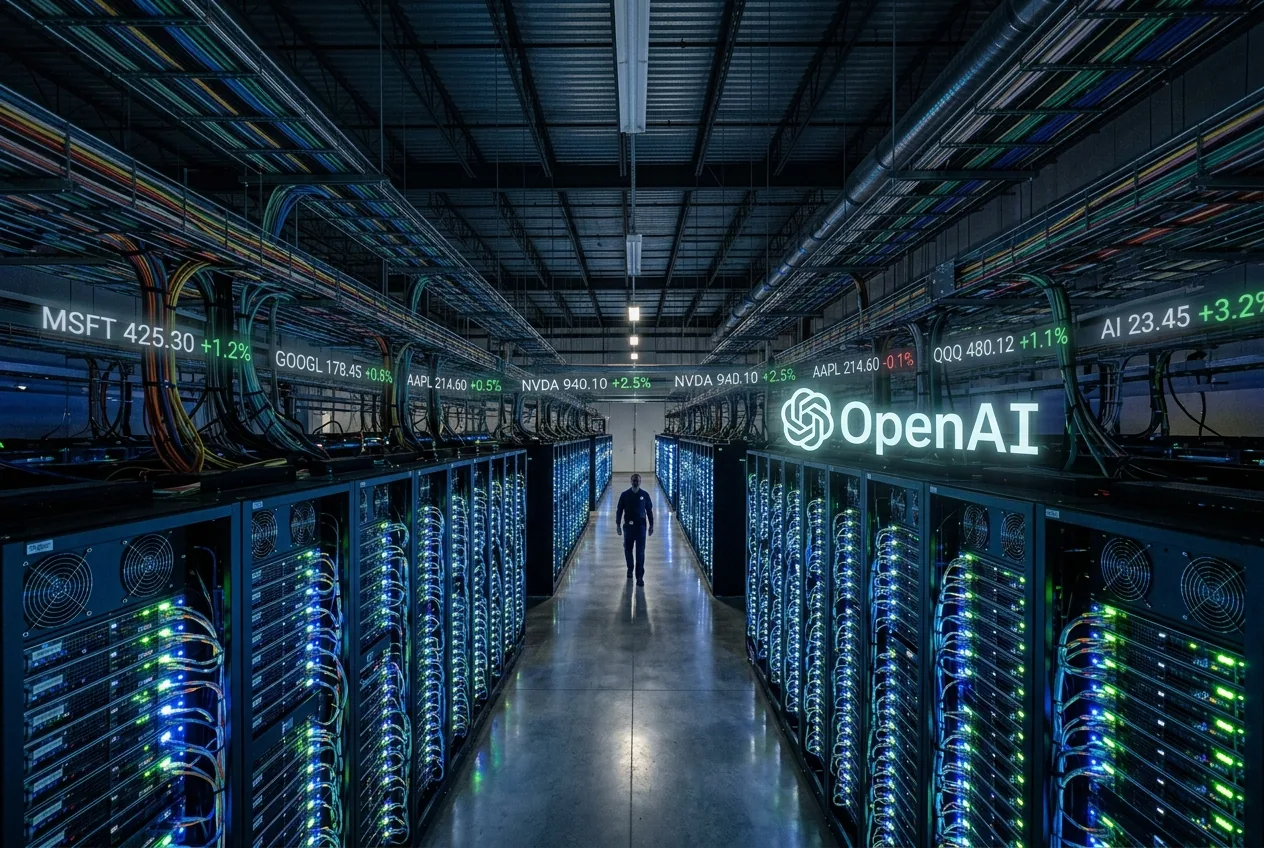
The trajectory of OpenAI, once a lean research laboratory dedicated to the theoretical safety of artificial intelligence, has shifted decisively toward the industrial scale. Reports emerging this week indicate that the company is preparing to file a confidential initial public offering (IPO) prospectus with federal regulators. According to sources familiar with the matter, including reports from the Wall Street Journal, the filing could arrive as early as this Friday, setting the stage for a potential public listing as soon as September.
Working in conjunction with financial heavyweights Goldman Sachs and Morgan Stanley, OpenAI is reportedly drafting the documentation necessary to transition from a venture-backed powerhouse to a public entity. This move follows a series of internal and external shifts that have cleared the path for what would likely be one of the most significant technology listings in history. With a private valuation recently pegged at approximately $852 billion, OpenAI is no longer just a software firm; it is becoming a primary driver of global computational infrastructure.
The legal catalyst and the removal of hurdles
From an industrial and mechanical perspective, the resolution of this case allows OpenAI to formalize its corporate structure without the immediate threat of a court-mandated restructuring. Analysts suggest that the dismissal provided CEO Sam Altman and the board the necessary confidence to move forward with the filing. For investors, the removal of this "legal overhang" makes the company’s governance more predictable—a prerequisite for the rigorous auditing process required by the Securities and Exchange Commission (SEC).
The high cost of artificial intelligence infrastructure
Why go public now? The answer lies in the sheer mechanical and electrical demands of the next generation of AI models. As an engineer might look at a power plant, OpenAI must look at the global supply of compute. Training models like GPT-5 and their successors requires an unprecedented concentration of hardware, specifically NVIDIA’s H100 and B200 Blackwell chips. These are not merely digital assets; they are physical components that require massive cooling systems, dedicated power substations, and complex logistics networks.
OpenAI’s capital requirements are staggering. Projections suggest the company may need to spend upwards of $1.4 trillion over the next decade on data centers. Project "Stargate," a joint venture with Microsoft, is rumored to be a $100 billion supercomputing complex designed to house millions of specialized AI chips. No amount of private venture capital can comfortably sustain that level of industrial expansion indefinitely. An IPO allows OpenAI to tap into the public markets, providing a deeper well of liquidity to fund the physical reality of artificial general intelligence (AGI).
Evaluating the monthly revenue vs. the burn rate
The economic viability of OpenAI is a study in contrasts. In late March, the company reported generating approximately $2 billion in monthly revenue, an incredible feat for a firm that was largely unknown to the public three years ago. This revenue is driven by a mix of consumer subscriptions to ChatGPT Plus and enterprise API integrations. However, the cost of goods sold (COGS) in the AI world is fundamentally different from traditional software-as-a-service (SaaS) models.
In traditional software, the marginal cost of serving an additional user is near zero. In AI, every query requires a dedicated slice of GPU time and a measurable amount of electricity. As OpenAI scales, its operational expenses scale in tandem with its hardware footprint. For the technical journalist, the question is not just about the user interface, but about the efficiency of the inference engines and the thermal management of the racks. The IPO will eventually force OpenAI to disclose these granular details, offering the first real look at the "compute-to-revenue" ratio that will define the industry’s future.
The confidential filing process and market timing
The September target is ambitious but strategic. The IPO market has been relatively quiet for tech giants over the last 24 months, and there is significant pent-up demand for high-growth assets. Furthermore, OpenAI is in an unofficial race with other "frontier" technology companies. SpaceX is reportedly eyeing its own public maneuvers, and OpenAI’s primary rival, Anthropic, is also rumored to be considering a listing. By moving now, OpenAI aims to capture the first-mover advantage in the public AI sector, potentially vacuuming up available capital before market fatigue sets in.
A shift in the workforce and mechanical expertise
As OpenAI transitions toward a public model, the composition of its workforce is also evolving. The company is increasingly hiring specialists in hardware integration, data center operations, and supply chain management. The transition from a software-first approach to a hardware-dependent one is a classic industrial pivot. To maintain its lead, OpenAI must secure not just the brightest researchers, but the most capable engineers who can manage the interface between silicon and the power grid.
The upcoming IPO represents a maturation of the AI industry. It signals that the "science fair" era of generative AI is over, and the era of industrial automation and massive-scale computation has begun. For the public, an OpenAI IPO offers a chance to own a piece of the engine driving the fourth industrial revolution. For the company, it is a necessary step to secure the trillions of dollars required to build the machines that they believe will change the world.
The role of Microsoft and the investor ecosystem
One cannot discuss OpenAI's financial future without mentioning Microsoft. As a primary investor and the exclusive cloud provider for OpenAI, Microsoft’s relationship with the company is both a blessing and a complexity. The IPO will likely clarify how the revenue-sharing agreements and intellectual property licenses function in a public context. For industrial observers, the Microsoft-OpenAI partnership is essentially a supply chain agreement: Microsoft provides the "factory" (Azure), and OpenAI provides the "logic" (the models).
Other investors, including NVIDIA, Amazon, and SoftBank, are watching the filing closely. A successful OpenAI IPO would likely trigger a revaluation of the entire AI stack, from chip manufacturers to energy providers. If the public markets accept OpenAI’s $850 billion+ valuation, it will validate the thesis that AI is the most significant technological shift since the internal combustion engine. However, if the market remains skeptical of the high burn rates and infrastructure costs, it may force a period of consolidation across the entire robotics and automation sector.
As the potential Friday filing deadline approaches, the tech world is braced for a shift in gravity. OpenAI is moving from the protected cocoon of private equity into the cold, analytical light of the public markets. For those of us focused on the mechanics of industry and the hard realities of hardware, this is the moment where the hype must finally be backed by sustainable, scalable engineering.




Comments
No comments yet. Be the first!