In a move that signals a pivot from general-purpose generative AI toward specialized industrial application, OpenAI has confirmed the public launch of its GPT-5.6 model family this Thursday. The release, which includes the flagship Sol model alongside its siblings Terra and Luna, comes after a month of internal delays and a period of expanded preview access. While the tech industry often focuses on the conversational prowess of these systems, the engineering and economic implications of the GPT-5.6 architecture suggest a far more significant shift. This is not just a software update; it is an infrastructure play aimed at the heart of robotics, supply chain logistics, and high-precision automation.
Defining the GPT-5.6 Architecture: Sol, Terra, and Luna
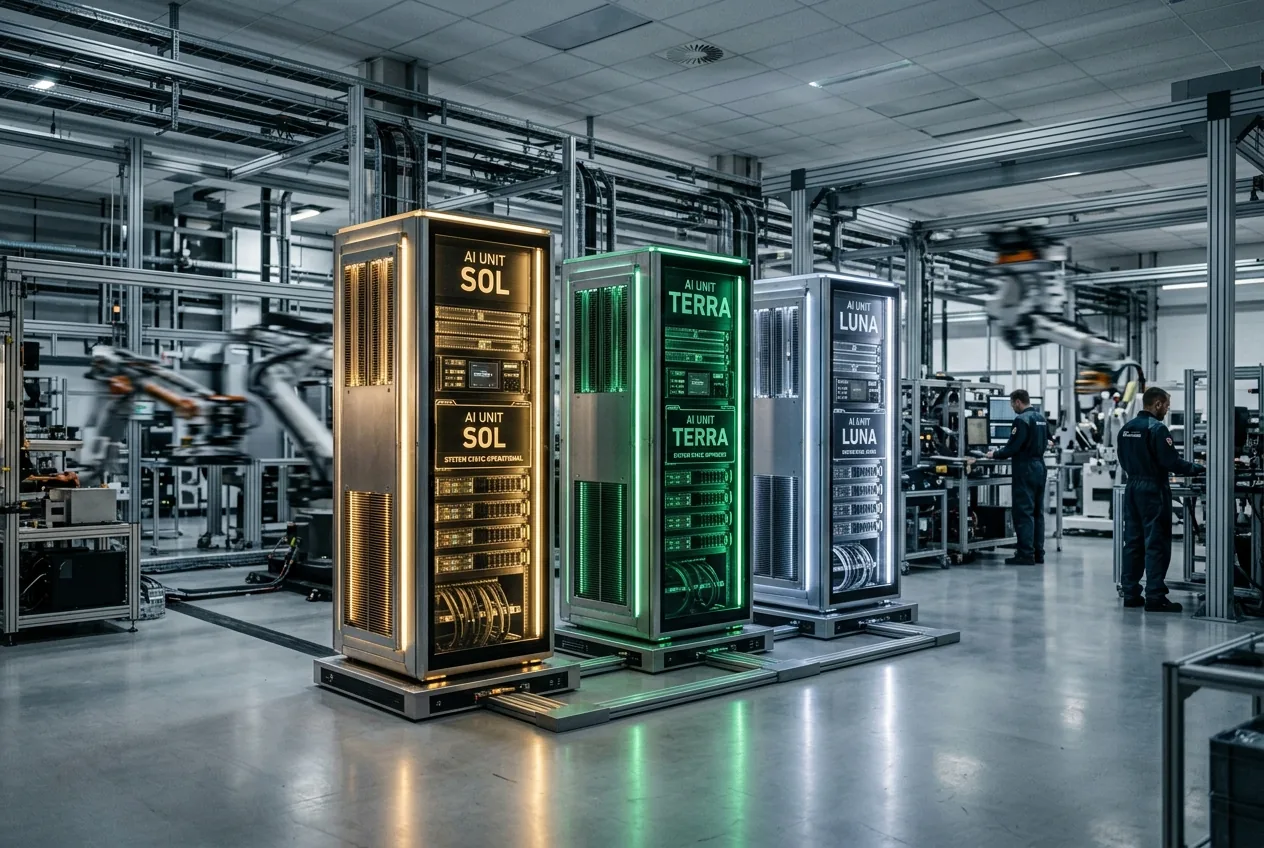
The naming convention for this release—Sol, Terra, and Luna—indicates a tiered approach to compute and application that OpenAI has been refining since the initial GPT-5 rollout. GPT-5.6 Sol is the flagship, representing the maximum ceiling of the company’s current reasoning capabilities. Sol is expected to handle massive context windows and high-complexity multi-modal inputs, making it the primary choice for scientific research and deep-tier engineering simulations. From a mechanical engineering perspective, Sol’s value lies in its ability to process complex CAD data and structural analysis at speeds that previous iterations simply could not reach. It is the high-parameter heavy-lifter designed for centralized, high-compute environments where precision outweighs the need for low-latency response.
Luna completes the trio as the lightweight, edge-optimized entry. In the robotics sector, the bottleneck has often been the latency involved in sending data to a cloud-based model and waiting for a response. Luna is designed to be deployed on-device or on local edge servers, providing the near-instantaneous control loops required for tactile sensing and rapid mechanical adjustments. While it lacks the raw intelligence of Sol or the spatial breadth of Terra, its utility in the supply chain cannot be overstated. Luna provides the "reflexes" for autonomous systems, allowing for a decentralized intelligence architecture where heavy reasoning happens in the cloud while immediate physical tasks are managed locally.
Strategic Competition and the Race for the Industrial Edge
The timing of this launch is no accident. The AI sector has seen a surge in competitive pressure, most notably from Anthropic, which recently restored its Mythos model and introduced the low-cost Sonnet 5. Anthropic has successfully carved out a niche by offering high performance at a lower price point per million tokens, forcing OpenAI to defend its market share. This Thursday’s launch is OpenAI’s attempt to reclaim the high ground by offering a broader spectrum of utility. By diversifying the GPT-5.6 line, OpenAI is moving away from the "one size fits all" model and instead providing a modular toolkit for developers and industrial giants who need specialized performance rather than a generic chatbot.
Elon Musk’s xAI has also added to the pressure, with recent teases of Grok 4.5. However, while Grok focuses on high-speed information retrieval and a less restrictive conversational style, OpenAI is doubling down on the "enterprise-grade" reliability that industrial sectors demand. The GPT-5.6 family is built for a world where AI is integrated into the mechanical assembly line, not just the marketing department. The competition is no longer about who can write the best poetry; it is about who can provide the most reliable logic for an autonomous crane or a multi-agent logistics network. This shift toward industrial utility is the primary driver behind the significant R&D investments we are seeing across the board.
Regulatory Approval and the Path to Deployment
One of the most notable aspects of the GPT-5.6 rollout is the recent approval from the Trump administration for wide public release. This regulatory green light reflects a broader shift in policy toward accelerated AI deployment as a matter of national industrial competitiveness. In the context of 2026, the administration’s focus has been on ensuring that the United States maintains a lead in "physical AI"—the intersection of software intelligence and mechanical hardware. The approval of GPT-5.6 suggests that the models have met rigorous safety standards regarding their potential use in critical infrastructure and manufacturing sectors.
This regulatory clarity is essential for large-scale industrial adoption. Companies involved in mechanical engineering and heavy industry are historically risk-averse; they cannot afford to integrate a technology that might be pulled from the market or heavily restricted due to sudden policy shifts. With the government’s approval, the path is cleared for Tier 1 automotive suppliers and logistics firms to begin the deep integration of GPT-5.6 into their proprietary systems. This creates a feedback loop where the models get better at physical tasks as they are fed more real-world operational data, further solidifying OpenAI's position in the industrial stack.
However, this approval does not mean the debate over AI safety is over. Instead, the focus has shifted from existential risks to operational ones. The engineering community is now asking: How do we verify the safety of a model like Terra when it is controlling a multi-ton robotic arm in a shared workspace with humans? The launch of GPT-5.6 will serve as the first large-scale test case for these new safety protocols. OpenAI has integrated what they call "hard-coded logic gates" within the models to prevent commands that violate basic physical safety parameters, a feature that will be closely scrutinized by mechanical and safety engineers over the coming months.
The Practical Reality: Integration and the Supply Chain
For the supply chain manager or the mechanical engineer, the launch of GPT-5.6 is less about the "magic" of AI and more about the precision of its application. The introduction of Luna, for example, allows for a more robust decentralized network. In a modern automated warehouse, thousands of individual units need to communicate and make split-second decisions to avoid bottlenecks. Running these operations through a central model would be inefficient and prone to network-related failures. By utilizing the Luna model at the edge, each unit gains a degree of autonomous intelligence, reducing the reliance on a single point of failure and increasing the overall resilience of the system.
Sol’s role in this ecosystem is the "brain" of the operation, analyzing historical data to predict long-term trends and optimize the entire network. For instance, Sol can simulate thousands of different warehouse layouts and operational flows, using its high-parameter reasoning to identify efficiencies that would be invisible to human planners or lower-tier AI. The synergy between these models—Sol planning, Terra interpreting the environment, and Luna executing the movement—represents the blueprint for the next generation of industrial automation. This is where the real-world utility of the GPT-5.6 family will be proven.
Future Outlook: Toward GPT-6 and Beyond
As the tech world prepares for the immediate impact of Sol, Terra, and Luna, the long-term roadmap remains focused on the eventual leap to GPT-6. However, the GPT-5.6 release suggests that the path to Artificial General Intelligence (AGI) may be paved with highly specialized, tiered systems rather than a single monolithic entity. By perfecting the specialized roles of Sol, Terra, and Luna, OpenAI is gathering the specific data needed to train a more unified successor that truly understands the nuances of the physical and digital worlds. For now, the focus remains on successful deployment and the rigorous testing of these models in high-stakes industrial environments.




Comments
No comments yet. Be the first!