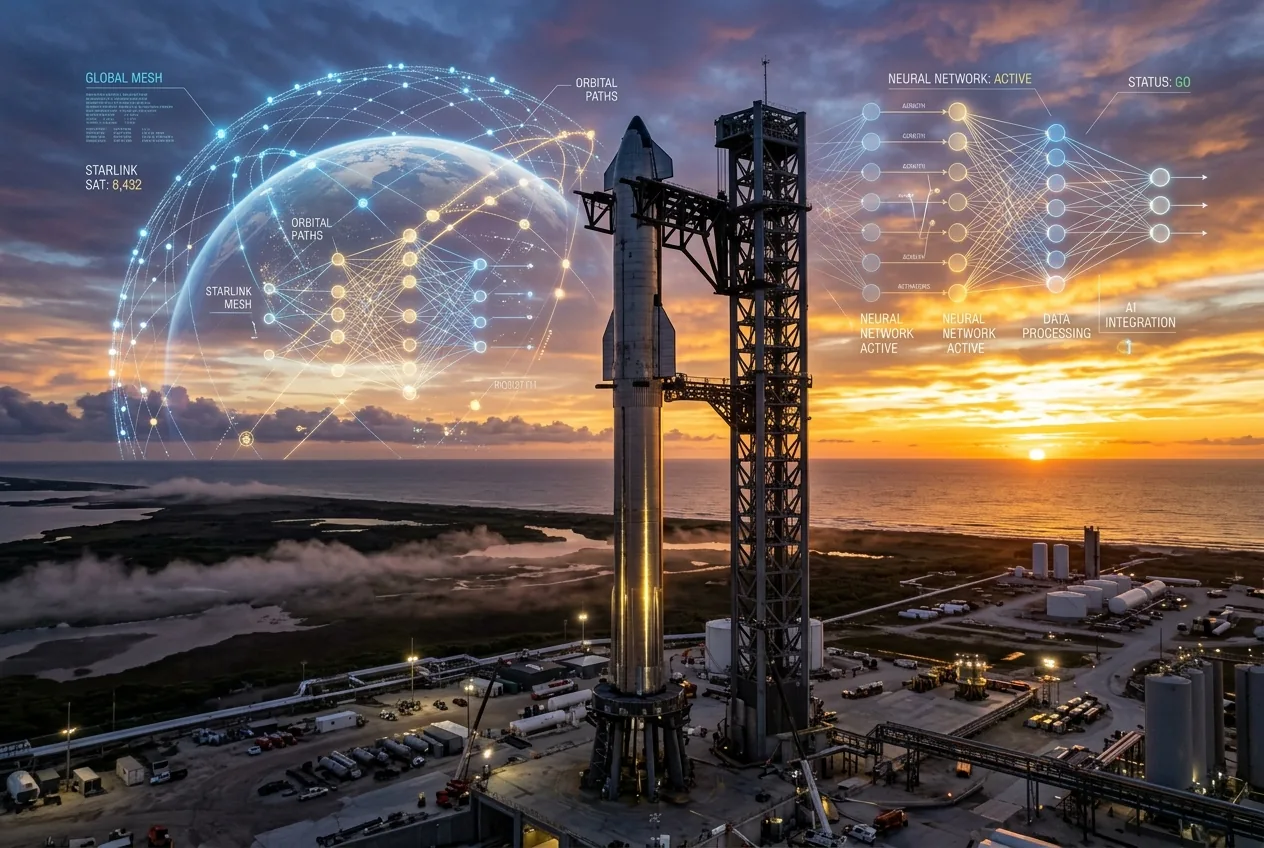
The boundary between heavy industry and digital infrastructure is dissolving as SpaceX, the titan of private aerospace, moves toward a public listing that promises to be the most significant financial event of the decade. Following the reported finalization of its S-1 prospectus, the company is preparing for a June 2026 Initial Public Offering (IPO) that aims to raise upwards of $75 billion. This move would not only shatter the record held by Saudi Aramco but would also cement a post-merger valuation of $1.75 trillion, driven by a strategic absorption of Elon Musk’s artificial intelligence venture, xAI.
The Architecture of a $1.75 Trillion Conglomerate
The core of the SpaceX valuation lies in its transition from a high-cost R&D firm into a high-margin utility provider. In the 2025 fiscal year, the company reported record revenues of $16 billion. While launch services remain the visible face of the company, the primary driver of this growth is Starlink. The satellite constellation has reached a level of scale where the marginal cost of adding a new subscriber is negligible compared to the infrastructure investment already in place. This is a classic industrial scale-up, where the capital expenditure (CapEx) of the Falcon 9 and Starship programs is now yielding operational cash flow that can sustain the company’s more ambitious goals.
Why Orbital AI Data Centers Are the Next Frontier
Furthermore, the Starlink network’s mesh architecture, which uses laser inter-satellite links, creates a global backbone that is essentially immune to regional geopolitical disruptions. For institutional clients and governments, the value proposition of an AI that resides in a high-redundancy, space-based environment is immense. It provides a level of data sovereignty that terrestrial networks cannot match. The $1.75 trillion valuation reflects the market’s realization that SpaceX is no longer just competing with Boeing or Lockheed Martin; it is competing with Amazon Web Services and Google Cloud, but with the added advantage of owning the rockets that deploy the servers.
Analyzing the Bitcoin Treasury and Strategic Reserves
While the aerospace technology captures the imagination of the public, the financial structure of SpaceX reveals a sophisticated approach to treasury management. As of March 2026, the company holds approximately 8,285 Bitcoin, valued at roughly $580 million. This position has been meticulously managed through various market cycles, including a strategic write-down in 2022 and a consolidation of legacy addresses into a single, audit-compliant custody solution in preparation for the IPO.
From a pragmatic standpoint, Bitcoin serves as a hedge against currency debasement for a company whose projects—like the colonization of Mars—span decades. More importantly, for a public entity, this treasury creates what analysts call a 'Trojan Horse' effect for institutional investors. Once SpaceX is listed on major indices like the Nasdaq 100, passive funds and pension plans will be forced to purchase the stock to track the index. By doing so, they will gain indirect exposure to Bitcoin. This effectively integrates the digital asset into the bedrock of global capital markets, providing a permanent price floor supported by institutional 'forced buying.'
The Starship Economic Multiplier
High-throughput launch capability enables the construction of 'Moonbase Alpha' and the deployment of the next generation of Starlink satellites, which are too large for the Falcon 9 fairing. These V3 satellites are expected to carry the bulk of the xAI processing units. The IPO capital is earmarked specifically for this acceleration. By securing $75 billion in liquidity, SpaceX can insulate its R&D pipeline from the quarterly earnings pressure that often stifles innovation in public companies. It allows the firm to treat the Starship program as a capital-intensive utility build-out rather than a speculative venture.
How Will the Market Handle the Risks?
Despite the overwhelming optimism surrounding the IPO, the S-1 filing must address several critical risks that could derail the $1.75 trillion thesis. The first is the physical environment of Low Earth Orbit (LEO). As the population of satellites grows, the risk of the Kessler Syndrome—a cascade of orbital debris—becomes a tangible threat to the company’s primary revenue stream. SpaceX’s technical lead in autonomous collision avoidance will be under constant scrutiny as the constellation expands.
The second risk is regulatory. The merger with xAI brings SpaceX into the crosshairs of evolving AI governance. As governments around the world grapple with the implications of LLMs and autonomous agents, SpaceX’s orbital AI could face unique jurisdictional challenges. Does a data center in orbit follow the laws of the country where it was launched, or the country where the data is downlinked? These are unanswered legal questions that could impact the company’s ability to operate its space-based compute network globally.
Finally, there is the 'key man' risk. The valuation of SpaceX is inextricably linked to the vision and execution of Elon Musk. While the company has built a deep bench of engineering talent and a robust middle-management layer, the market’s confidence is heavily weighted on Musk’s ability to navigate the complex interface of aerospace, AI, and finance. The IPO will test whether the company can maintain its rapid pace of iteration while satisfying the transparency and reporting requirements of a public entity.
The Dawn of the Space-Based Economy
For the broader technology sector, the success of this IPO will serve as a bellwether. It will determine whether the market has the appetite for massive, multi-decade capital projects that prioritize long-term infrastructure over short-term software gains. If the raise is successful, it will likely trigger a wave of similar listings in the robotics, energy, and aerospace sectors, as other firms seek to replicate the 'Musk Effect' of vertical integration and technical audacity. As June 2026 approaches, the financial world is not just watching a stock listing; it is watching the birth of a new industrial paradigm.




Comments
No comments yet. Be the first!