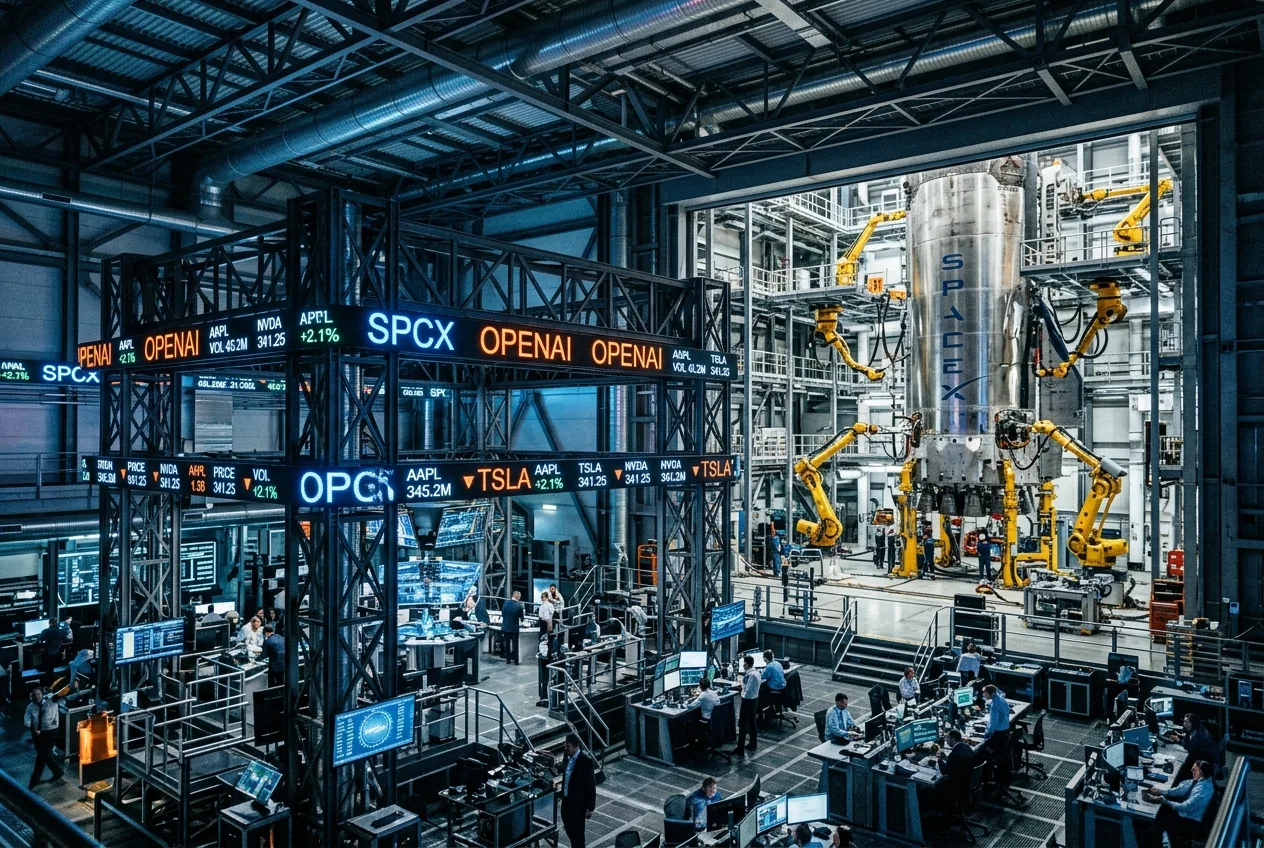
In the high-altitude world of aerospace and artificial intelligence, the transition from visionary private enterprise to public market titan is often more turbulent than the technology itself. This week, that transition reached a fever pitch. In a move that has been whispered about in the corridors of Silicon Valley for years, Elon Musk’s SpaceX has finally filed its IPO prospectus. Almost simultaneously, reports have surfaced that Sam Altman’s OpenAI is preparing its own confidential filing, setting the stage for a dual-track public debut that could redefine the global financial hierarchy.
For those of us tracking the intersection of heavy machinery and deep learning, these filings represent more than just a liquidity event for early investors. They are the first official blueprints of how the world’s most ambitious engineering firms plan to survive the transition from experimental R&D to sustainable industrial scale. As SpaceX prepares to list under the ticker “SPCX,” the transparency of the S-1 filing offers a sobering, technical look at the mechanics of a company that has, until now, operated largely behind a veil of private funding rounds and government contracts.
The Financial Engine of Starlink and the SPCX Prospectus
The SpaceX S-1 filing is a massive document, filled with the gloss of Falcon Heavy launches and Starlink constellations, but the raw numbers tell a more complex story of industrial scaling. SpaceX is seeking to raise an unprecedented $80 billion, a move that would value the company at roughly $1.7 trillion. To put that in perspective, this would eclipse the 2019 Saudi Aramco IPO, previously the largest in history. For a mechanical engineer, the most telling aspect of the filing isn't the valuation, but the internal allocation of revenue and the massive capital expenditures required to maintain orbit.
The prospectus reveals that Starlink, the company’s satellite communications arm, has become the primary financial engine of the SpaceX empire. Accounting for more than two-thirds of the total revenue, Starlink generated $1.2 billion in profit in the most recent quarter. However, the broader SpaceX entity—which now officially includes interests in xAI and the social media platform X—is still burning through cash at a rate that would make most CFOs wince. Despite an annual revenue of $18.7 billion in 2025, SpaceX reported an accumulated deficit of $41.3 billion. The net loss for Q1 2026 alone stood at $4.27 billion, a significant jump from the $528 million loss reported just one year prior.
This acceleration of losses highlights the sheer cost of building the physical infrastructure of the future. The development of Starship, the heavy-lift vehicle intended for Mars, requires a level of capital investment that private markets can no longer sustain alone. By moving to the Nasdaq, Musk is betting that public investors will prioritize long-term dominance in the space and AI sectors over short-term profitability. Furthermore, the filing solidifies Musk’s absolute control; thanks to special Class B shares, he retains 85% of the voting power, ensuring that even as a public entity, SpaceX remains a reflection of its founder’s singular, often erratic, vision.
OpenAI Prepares for a Friday Filing
While SpaceX’s filing was a public rollout, OpenAI is reportedly taking a more discreet path, at least initially. Sources indicate that Sam Altman and the OpenAI board are preparing to file a confidential IPO prospectus with regulators as early as this Friday. The goal is a public debut in September 2026. This move marks a pivot for a company that was once a non-profit research lab and is now the tip of the spear in the generative AI revolution.
The timing of the OpenAI filing is no coincidence. As Musk integrates xAI into the SpaceX IPO, Altman is feeling the pressure to secure a massive capital infusion to fund the next generation of large language models and the compute infrastructure they require. The relationship between OpenAI and Microsoft, while fruitful, has always been a point of strategic tension. A public offering would give OpenAI the independent war chest it needs to compete in the burgeoning “physical AI” market—a space where software meets hardware, and where the costs of entry are measured in the tens of billions.
The “treacherous road” for OpenAI involve navigating the intense regulatory scrutiny surrounding AI safety and data privacy. Unlike SpaceX, which has a tangible product in rockets and satellites, OpenAI’s value is tied to its intellectual property and the scaling laws of neural networks. Investors will be looking closely at how OpenAI plans to monetize its enterprise services and whether it can maintain its lead against increasingly capable open-source competitors and established incumbents like Google and Meta.
Nvidia and the Shift Toward Physical AI
In the background of these IPO maneuvers, Nvidia remains the silent kingmaker of the industry. Their latest Q1 results, which showed revenues of $81.6 billion—up 85% year-over-year—continue to defy the gravity of the tech market. However, the most interesting detail from Nvidia’s earnings call wasn't the revenue beat, but the emphasis on “physical AI.”
As the market for pure data center chips begins to mature and competition intensifies, Nvidia is pivoting toward the industrial sector. This includes government-level sovereign AI initiatives and private enterprise applications for robotics and automated supply chains. This shift is critical for the long-term viability of companies like SpaceX and OpenAI. If the “intelligence” created by OpenAI and the “logistics” mastered by SpaceX are to merge, it will happen through the medium of physical AI—autonomous factories, robotic laborers, and self-navigating spacecraft.
Nvidia’s work in diversifying its sales away from hyperscalers toward these physical applications is a signal that the AI boom is entering its second phase. The first phase was about training models on text and images; the second phase is about training models to interact with the laws of physics. For the industrial world, this is the most consequential development of the decade. It moves AI out of the browser and onto the factory floor, requiring a new level of mechanical precision and edge-computing reliability.
Can Anthropic Automate the Engineering Workforce?
While the giants prepare for the public markets, Anthropic is making aggressive moves in the specialized world of software engineering. The launch of “Claude Code” in London this week highlights a growing trend: the automation of the very people who built the AI revolution. Claude Code is pitched as a safer, more integrated way to automate coding, allowing AI to handle the rote tasks of debugging and refactoring while human engineers focus on high-level architecture.
Is the Market Ready for Frontier Tech Volatility?
The fundamental question looming over the SpaceX and OpenAI IPOs is whether public investors are truly prepared for the volatility inherent in frontier technology. Traditional public companies are valued on earnings, cash flow, and steady growth. SpaceX and OpenAI, however, are “moonshot” companies in the most literal sense. Their balance sheets are characterized by massive losses, astronomical debt, and long lead times for ROI.
The SpaceX S-1 shows a company that is essentially a high-stakes gamble on the colonization of the solar system and the dominance of satellite-based internet. OpenAI is a gamble on the premise that intelligence itself can be commodified. When these companies hit the public markets, they will be subject to quarterly earnings calls, short-seller reports, and the whims of institutional investors who may not have the stomach for a $4 billion quarterly loss.
The pivot from private to public is a coming-of-age moment for the 21st-century tech industry. It represents the end of the “move fast and break things” era of venture capital and the beginning of a more disciplined—but arguably more dangerous—era of public accountability. For the observers at Apollo Thirteen, the technical specs remain the most reliable guide. Whether it is the thrust-to-weight ratio of a Raptor engine or the parameter count of a new transformer model, the hardware must ultimately work, and the economics must eventually close. The filings this week are just the beginning of that final test.




Comments
No comments yet. Be the first!