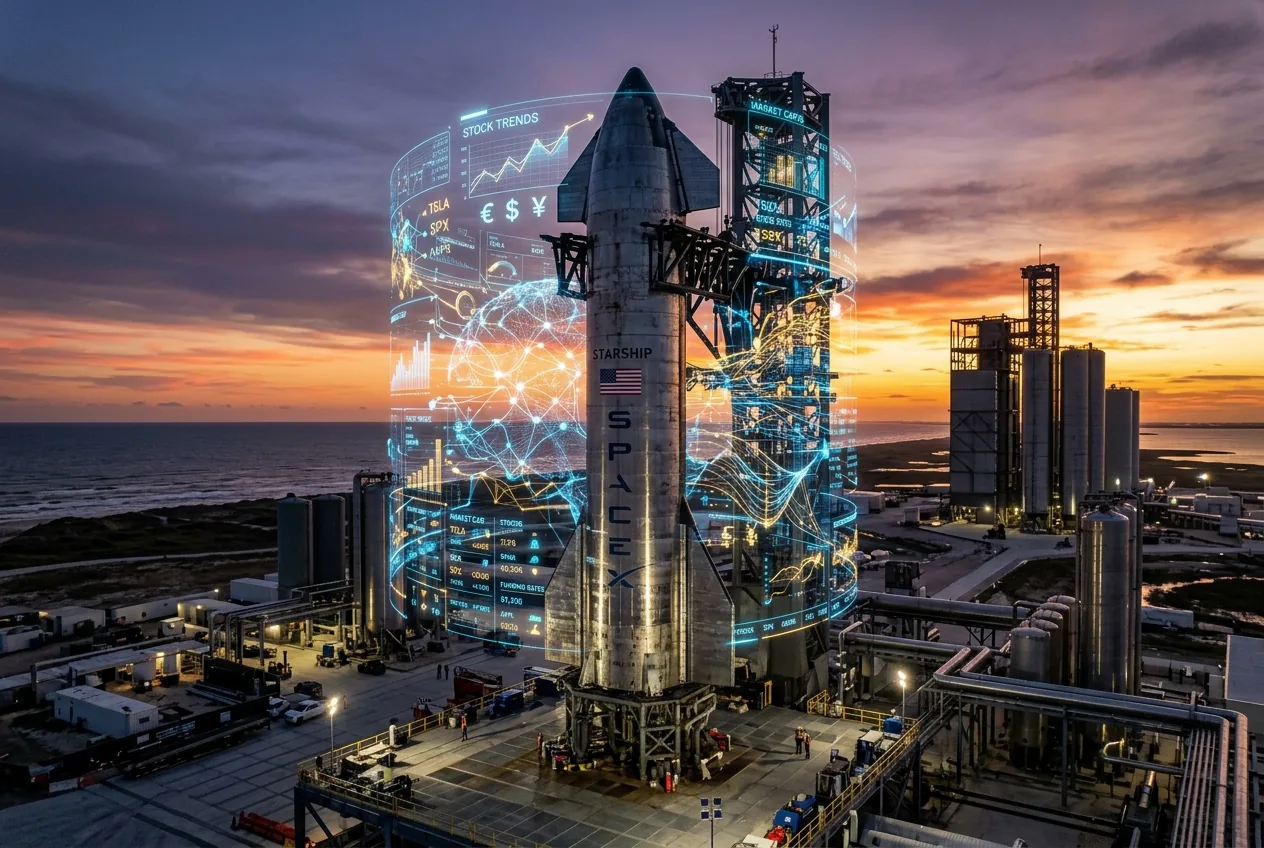
In a move that resets the ceiling for the private aerospace and technology sectors, SpaceX has publicly filed for an initial public offering (IPO) seeking a valuation of $1.75 trillion. This filing represents more than just a transition from private to public markets; it is a calculated gamble on a vertically integrated future where orbital infrastructure and artificial intelligence are inextricably linked. For a company that reported $18 billion in revenue against a $4.9 billion loss in 2025, the trillion-dollar-plus valuation suggests that investors are being asked to price in not just current launch dominance, but the total colonization of the Earth-Moon-Mars economic sphere.
From a mechanical engineering and industrial standpoint, the filing clarifies the strategic necessity of SpaceX’s recent pivot. While Starlink remains the primary revenue driver, the valuation is heavily underpinned by the nascent xAI division and the technical promise of the Starship launch system. To justify a $1.75 trillion market cap—a figure that rivals the world’s largest tech titans—SpaceX must prove it can transition from a transportation provider to a comprehensive platform for orbital computing and deep-space logistics. However, the financial data reveals a company still burning significant capital, with over $37 billion in total losses since its inception, highlighting the immense cost of developing the world’s first fully reusable heavy-lift rocket.
The Technical Architecture of a Trillion-Dollar Valuation
The core of the SpaceX valuation does not lie in its existing Falcon 9 fleet, which has become the industry workhorse, but in the successful deployment of Starship. As a mechanical system, Starship is designed to reduce the cost per kilogram to Low Earth Orbit (LEO) by orders of magnitude through total reusability. For the $1.75 trillion figure to hold weight, SpaceX must achieve a flight cadence that allows for the rapid deployment of Starlink V3 satellites and, more importantly, the infrastructure for orbital AI data centers. These data centers represent a new frontier for xAI, Elon Musk’s artificial intelligence venture, which is increasingly being integrated into the SpaceX ecosystem.
Financial Realities and the xAI Adoption Gap
Despite the high-altitude valuation, the IPO filing brings the company’s financial health into sharp focus. Reporting $18 billion in revenue is an impressive feat for an aerospace firm, yet the $4.9 billion annual loss underscores the high CapEx requirements of Musk’s ambitions. To put this in perspective, AI rivals like Anthropic are reportedly nearing their first profitable quarters with lower revenue bases, primarily because their overhead is focused on compute and talent rather than the physical fabrication of 120-meter-tall stainless steel rockets. SpaceX is effectively trying to maintain the growth multiples of a software company while burdened by the capital intensity of a heavy industrial manufacturer.
There is also the matter of Grok, the flagship model of the xAI division. Recent federal AI inventory records and corporate adoption metrics present a sobering picture. While OpenAI and Anthropic have secured hundreds of instances within federal agencies and thousands in the enterprise sector, Grok’s presence is negligible. Critics and Pentagon sources have pointed to a lack of specialized performance in Grok compared to Gemini or Claude, particularly in fields like data analysis and coding. For SpaceX to justify its AI-inflated valuation, it must prove that Grok is not just a secondary feature for social media, but a robust enterprise tool capable of justifying the immense cost of orbital deployment.
The Governance of a Conglomerate
Investors entering the SpaceX IPO will be doing so under a governance structure that grants Elon Musk absolute control. Holding over 85% of the voting power while serving as CEO, CTO, and Chairman, Musk ensures that the company’s trajectory remains aligned with his multi-planetary vision, regardless of short-term market pressures. This level of concentrated power is rare in companies of this scale and presents a unique risk-reward profile for public shareholders. It allows for the kind of long-term, high-risk engineering projects that traditional public companies often avoid, but it also leaves little room for institutional oversight or pivots if the Starship-to-Mars roadmap encounters further delays.
This governance model is particularly relevant as the company navigates the complex intersection of defense contracting and commercial AI. SpaceX has become an essential partner for the U.S. Department of Defense, yet the integration of xAI and the push for a $1.75 trillion valuation may invite stricter regulatory scrutiny. As Nvidia concedes certain international markets due to export restrictions, SpaceX’s attempt to globalize AI via satellite networks could face similar geopolitical hurdles. The IPO filing indicates that the company believes its vertical integration—controlling the rocket, the satellite, and the AI model—is the only way to bypass the bottlenecks currently slowing down the rest of the tech industry.
Can Starship Deliver the Promised Returns?
The ultimate viability of the $1.75 trillion IPO rests on a single variable: the operational success of Starship. If Starship becomes as reliable as the Falcon 9, SpaceX will effectively monopolize the launch market, enabling the massive constellation density required for Starlink to achieve high-margin profitability. This cash flow would then theoretically subsidize the massive R&D costs of xAI and the eventual Mars transit infrastructure. However, the engineering tolerances required for a vehicle of Starship’s size to survive atmospheric reentry and land with precision remain the most difficult technical hurdle in the company's history.
We are looking at a company that is attempting to bridge the gap between heavy mechanical engineering and the ethereal world of generative AI. If they succeed, they will have built the first truly modern industrial conglomerate, one that treats space not as a destination, but as a platform for the next generation of compute. If the adoption of Grok fails to pick up or if Starship development stalls, the $1.75 trillion valuation will be remembered as one of the most ambitious overreaches in the history of capital markets. For now, the filing stands as a testament to the belief that the future of technology is not just on our screens, but in the stars, powered by the largest engines ever built by human hands.
Market Context and the AI Infrastructure Race
The timing of the SpaceX filing is no coincidence. It occurs during a period of massive upheaval in the AI hardware market. With Nvidia facing restrictions in China and startups like Anthropic seeking nearly $1 trillion valuations of their own, the race for infrastructure is at a fever pitch. SpaceX is positioning itself as a unique player in this race. While others are building data centers in the desert, SpaceX is building them in the vacuum of space, potentially avoiding the "heat hazard" that is beginning to plague terrestrial urban planning.




Comments
No comments yet. Be the first!