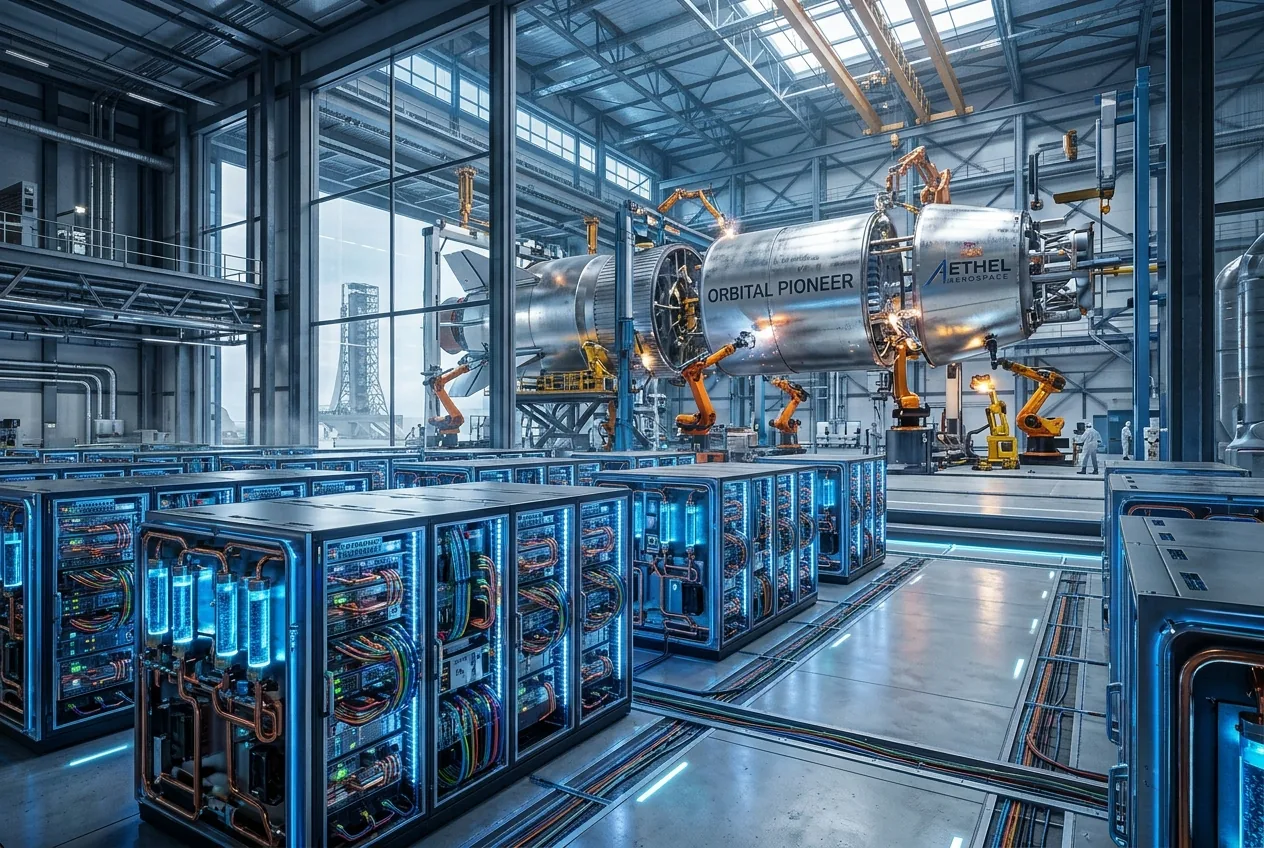
When international financial reports began circulating claims that Nvidia had quietly disclosed monumental equity stakes—amounting to $21 billion in SpaceX and $30 billion in Intel—the global technology and financial sectors responded with a mix of shock and acute skepticism. If taken at face value, investments of this magnitude would represent one of the most radical capital realignments in industrial history. A $30 billion position in Intel would constitute roughly a third of the legacy chipmaker's total market capitalization, while a $21 billion stake in SpaceX would represent more than ten percent of the world’s preeminent private aerospace manufacturer.
Yet, in modern industrial technology, raw numbers rarely tell a simple story. While regulatory bodies like the United States Securities and Exchange Commission have recorded no Schedule 13D or formal filings documenting outright equity acquisitions of this size, the sudden prominence of these figures exposes a deeper, operational truth. The borders between semiconductor design, advanced foundry packaging, and deep-tech hardware platforms like Elon Musk’s xAI and SpaceX are dissolving. Whether these figures reflect misunderstood advanced hardware procurement obligations, debt-adjacent infrastructure guarantees, or distorted balance-sheet commitments, they highlight an undeniable reality: Nvidia's balance sheet is now vast enough to shape the physical trajectories of aerospace, robotics, and rival silicon giants alike.
The Balance Sheet Realities of Megacap Tech
To evaluate whether a company can deploy $51 billion across two industrial powerhouses, one must look directly at mechanical and financial liquidity. Nvidia’s ascent during the artificial intelligence boom has yielded historic cash generation, with quarterly operating cash flows regularly crossing the $15 billion mark. However, allocating tens of billions into equity stakes requires crossing profound legal, structural, and regulatory thresholds. An acquisition of a major voting or non-voting block in Intel would instantly trigger intense antitrust scrutiny from the Federal Trade Commission, the Department of Justice, and the European Commission, particularly given ongoing investigations into compute monopolies.
In the case of SpaceX, the aerospace firm remains tightly held, conducting structured secondary sales and tender offers that strictly regulate outside ownership. A unilateral $21 billion equity purchase would require a restructuring of SpaceX's private capitalization tables, an event that would reverberate through the defense sector, the Department of Defense, and NASA. Instead, capital allocations of this magnitude in modern high-tech enterprise often disguise themselves under different accounting definitions: multi-year component prepayments, shared risk wafer agreements, joint venture infrastructure tranches, and synthetic off-balance-sheet compute partnerships.
When market observers see numbers such as $21 billion or $30 billion attached to names like SpaceX and Intel, they are frequently viewing the aggregated, multi-year economic value of silicon access, wafer supply contracts, and industrial joint ventures. When hardware demand outstrips the physical capacity of global manufacturing, guaranteed access to silicon becomes functionally equivalent to equity. Understanding why Nvidia would be linked to these two distinct titans requires breaking down the physical engineering challenges of both advanced computing and orbital space systems.
The xAI and SpaceX Hardware Nexus
SpaceX’s operational footprint is no longer merely about rocket propulsion and carbon-composite airframes; it has evolved into one of the world's most compute-intensive infrastructure operations. Through its relationship with Elon Musk’s artificial intelligence venture, xAI, the boundaries between SpaceX's spaceborne telemetry, the Starlink megaconstellation, and ground-based supercomputing have largely merged. The construction of the 'Colossus' supercomputing cluster in Memphis, Tennessee—comprising 100,000 liquid-cooled Nvidia Hopper H100 GPUs, with plans to double that capacity using Blackwell architectures—demonstrates the massive financial and hardware throughput linking Nvidia directly to Musk’s industrial complex.
Deploying 100,000 high-performance accelerators is an extreme mechanical engineering challenge. Each high-density server rack pulls dozens of kilowatts, necessitating advanced liquid-to-liquid cooling distribution units, complex facility-level chillers, and dedicated megawatt-scale utility substations. The interconnect fabric alone, driven by Nvidia’s Spectrum-X Ethernet switches, requires millions of feet of precision fiber-optic cabling capable of running non-blocking, low-latency collective operations across tens of thousands of compute nodes. This infrastructure is not just training generative language models; it is being leveraged to solve complex mechanical simulations, autonomous rendezvous calculations for Starship, and massive real-time routing optimization for the thousands of active satellites in the Starlink constellation.
SpaceX's orbital hardware requirements are beginning to intersect with edge AI architectures. Starlink satellites operate as an interconnected mesh network in low Earth orbit, relying on optical inter-satellite links to route terabits of data through space without touching ground stations. As next-generation payloads demand onboard autonomous data triage, radiation-hardened edge computing, and localized deep learning inference, the pipeline of specialized silicon flowing from Nvidia's design floors into SpaceX’s aerospace integration facilities represents an enterprise value measured in the tens of billions over a multi-year horizon.
Why the Intel Foundry Dilemma Involves Everyone
Nvidia’s flagship AI platforms rely heavily on Chip-on-Wafer-on-Substrate (CoWoS) packaging, an advanced microelectronics assembly technique that integrates the main compute dies with stacks of High Bandwidth Memory (HBM3e) on a silicon interposer. TSMC’s CoWoS capacity has been consistently oversubscribed, creating global lead times that bottleneck the entire AI sector. This brings Intel into sharp relief. Despite Intel’s internal struggles with product execution and foundry profitability, the company possesses some of the most advanced packaging facilities in the world, including its proprietary EMIB (Embedded Multi-die Interconnect Bridge) and Foveros 3D stacking technologies.
For Nvidia, Intel is both a rival in the data center and an indispensable geographic hedge. While a direct $30 billion stock purchase would invite crushing regulatory hostility, an investment framework of comparable magnitude—structured as multi-year foundry reservations, advance purchase commitments for Intel Foundry Services (IFS), and joint engineering for domestic packaging—is an operational necessity. To insulate American advanced compute supply chains from geopolitical vulnerabilities in the Taiwan Strait, the U.S. government and commercial chip designers are strongly incentivized to keep Intel’s domestic manufacturing roadmap solvent and functional.
Physical Automation and the Shift to Embodied Systems
The convergence of these massive capital and hardware streams points toward the next major phase of industrial development: physical, embodied AI. High-performance computing is no longer confined to processing textual queries or running consumer software applications. The real economic frontier lies in the automation of heavy industry, aerospace assembly, and autonomous kinetic systems.
Within modern manufacturing lines, the integration of advanced robotics requires an end-to-end compute continuum. At the high end, massive supercomputers like Colossus ingest petabytes of sensor data, computer vision streams, and spatial telemetry to train foundational models for physical movement. These models are then distilled and deployed onto localized edge hardware—such as Nvidia’s Jetson and Drive Thor platforms—which must run inference onboard industrial humanoids, automated guided vehicles (AGVs), and aerospace manufacturing rigs with deterministic, sub-millisecond latencies.
SpaceX’s Starbase facility in Boca Chica, Texas, serves as a prime example of this industrial paradigm. The rapid fabrication of the Starship launch system relies on advanced automated orbital welding, structural laser metrology, and high-precision robotic placement of heat-shield tiles. When an enterprise combines state-of-the-art physical automation with continuous compute feedback loops, the hardware provider supplying the underlying silicon becomes the most strategic asset in the entire operational pipeline. Whether through formal balance-sheet equity or massive hardware allocation pacts, Nvidia's technological footprint within these facilities is foundational to their operational throughput.
The Mechanics of Modern Market Misconceptions
For instance, when an enterprise enters into an agreement guaranteeing tens of billions of dollars in component procurement over a five-to-ten-year lifecycle, that commitment is a binding balance-sheet liability. To a casual market observer or an automated news translation service, an advanced component allocation or shared infrastructure spend of $30 billion can easily be misread as taking a direct equity stake in the manufacturing partner. Similarly, off-balance-sheet special purpose vehicles (SPVs) frequently used by tech conglomerates to fund dedicated data center real estate, nuclear power procurement, and specialized cooling infrastructure involve astronomical sums that tie these corporations together without traditional stock transfers.
The Real Measure of Semiconductor Influence
Regardless of the accounting classification or reporting inaccuracies surrounding these specific $21 billion and $30 billion figures, the broader dynamic they reflect is entirely real. Compute has replaced raw financial capital as the ultimate constraining resource of the modern industrial economy. A company that possesses the dominant design architecture, the interconnect networking standard, and the software ecosystem for high-performance computing does not need to formally purchase a rival or an aerospace contractor to exercise immense strategic control over its operations.
Nvidia’s leverage over both the aerospace and foundry sectors is an engineering reality. If SpaceX requires guaranteed compute allocations to maintain Starlink’s expansion and autonomous rocket development, it must align its engineering pipelines with Nvidia's silicon release cadence. If Intel hopes to scale its commercial foundry business to rival TSMC, it must secure massive packaging and manufacturing orders from high-volume accelerator designers, chief among them Nvidia. In this environment, the deployment of capital is merely the secondary mechanism; the true source of power is the capacity to process physical information at scale.
As the industrial world races to build out domestic semiconductor supply chains, deploy orbital satellite constellations, and commercialize physical robotics, the capital flowing between these sectors will only continue to balloon. The sensational headlines linking Nvidia directly to ownership of SpaceX and Intel may mistake the structural mechanism of modern tech partnerships for traditional equity buyouts, but they correctly identify the pressure points of the global economy: silicon, packaging, and the unprecedented compute required to build the future.



Comments
No comments yet. Be the first!