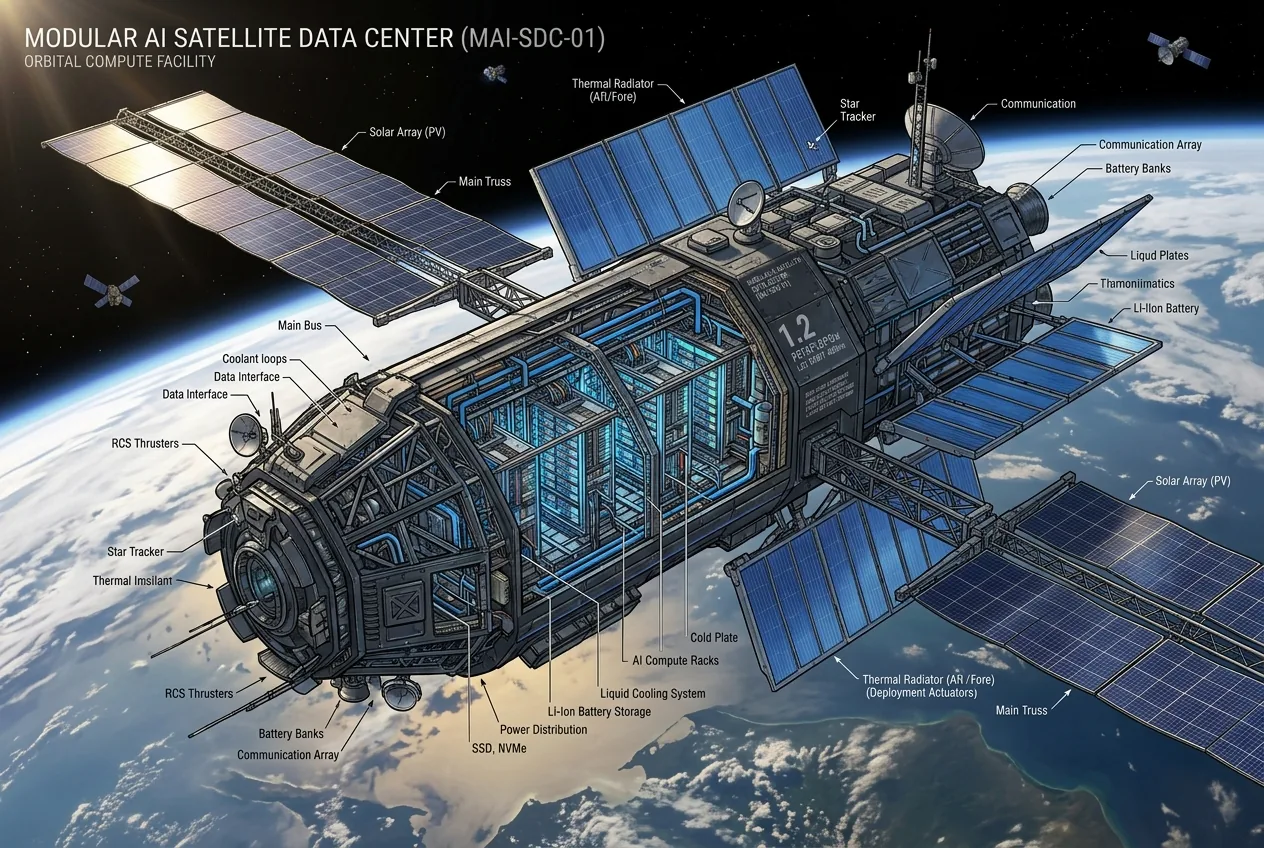
Terrestrial artificial intelligence clusters are rapidly colliding with the physical limits of planetary infrastructure. Between substation transformer backlogs stretching beyond four years, regional water tables depleted by evaporative cooling towers, and strained electrical grids struggling to allocate gigawatts of continuous power, land-based hyperscalers are running out of headroom. SpaceX is proposing an aggressive, orbit-based departure from conventional ground computing: a mega-constellation of specialized data-center satellites designed to process high-intensity model workloads in space.
Known internally as Project Starmind, the initiative envisions launching specialized computing spacecraft into low Earth orbit as early as 2027. Following the operational integration of xAI, regulatory paperwork filed with the Federal Communications Commission outlines an orbital deployment envelope that could ultimately scale up to one million operational nodes. Rather than treating spacecraft simply as communication repeaters, as with the Starlink broadband network, the architecture repositioned by SpaceX treats orbital hardware as distributed, co-located computing clusters running uninterrupted off direct solar flux.
The AI1 Platform and the Bastrop Manufacturing Hub
The core computational building block of the constellation is a dedicated satellite platform designated AI1. Unlike traditional communication satellites, which prioritize high-frequency radio transmitters and flat-panel phased array antennas, the AI1 is designed from the chassis up around accelerator boards and power distribution units. Preliminary technical documentation reveals that each baseline node is designed to draw approximately 120 kilowatts of continuous electrical power, sustained by an expansive dual-wing photovoltaic array.
Fabrication of these specialized nodes will be centered at a newly established Gigasat facility in Bastrop, Texas. Rather than utilizing bespoke cleanroom assembly lines typical of aerospace manufacturing, SpaceX intends to port over the high-volume, automated production methodologies refined on its Starlink bus assembly lines. Achieving even a fraction of the filing’s headline figure requires an unprecedented rate of industrial output, transforming satellite assembly from an aerospace discipline into a continuous, heavy-industrial manufacturing pipeline.
The Radiative Challenge of Orbital Thermodynamics
On Earth, shedding thermal energy from dense clusters of processing silicon is primarily an exercise in convection and phase change. Liquid coolants circulate through cold plates mounted directly over processor dies, transferring thermal energy to massive chillers, cooling towers, or external air heat exchangers. In the vacuum of low Earth orbit, conduction and convection do not exist outside the hermetic enclosures of the spacecraft itself. Every watt of heat generated by onboard artificial intelligence processors must be shed exclusively via thermal radiation.
Grid Interconnection Backlogs versus Launch Mass Economics
The conceptual appeal of orbital data centers is directly proportional to the logistical paralysis currently afflicting terrestrial power infrastructure. In major hyperscale corridors such as Northern Virginia, Silicon Valley, and Western Europe, securing a 500-megawatt grid interconnection agreement frequently requires years of administrative review, environmental impact assessments, and utility transmission upgrades. In orbit, solar irradiance is approximately 30 percent higher than at sea level, completely free of atmospheric attenuation, cloud cover, or diurnal downtime in sun-synchronous orbits.
Critics, including OpenAI chief executive Sam Altman, have historically questioned the economic rationale of orbital computation, citing the exorbitant launch costs per kilogram, the inability to service failed hardware, and the harsh radiation environment that degrades semiconductor silicon. Terrestrial clusters benefit from immediate physical access for maintenance, low-latency fiber backbones, and standard commodity hardware. In contrast, every component launched into orbit must withstand severe mechanical shock, vibrational acoustic loading during ascent, and continuous cosmic ray bombardment.
SpaceX’s counter-thesis rests on the flight economics of its fully reusable Starship heavy-lift launch system. If Starship achieves its target flight cadences and marginal launch costs, the payload penalty to low Earth orbit drops low enough to fundamentally reconfigure datacenter unit economics. Rather than paying escalating ground-based power purchase agreements, industrial water fees, and real estate taxes, computing platforms can amortize their operational costs strictly against the initial capital cost of hardware and launch services. The reported interest from tech companies such as Google and Anthropic underscores an industry-wide appetite for unconstrained power, wherever it can be found.
Networking Fabrics in a Vacuum
Parallel processing across modern AI workloads relies heavily on low-latency, extremely high-bandwidth networking fabrics like NVLink or InfiniBand to synchronize millions of parameters across separate processor nodes. Transferring these workloads from a single raised-floor data hall to a distributed constellation flying through orbital planes introduces an intricate networking challenge. While Earth-based nodes communicate over passive optical fiber runs measured in meters, orbital nodes must communicate across kilometers of empty space.
SpaceX intends to bridge this gap using next-generation optical inter-satellite links. Modern space-borne laser communications systems are capable of terabit-scale throughput, operating in the vacuum of space where light travels roughly 40 percent faster than it does through terrestrial silica glass fibers. By weaving the AI1 constellation into a dynamically routed, mesh-networked optical fabric, adjacent satellites within the same orbital shell can function as a coherent, distributed compute supercluster.
For large-scale model inference, where discrete tasks can be distributed asynchronously without continuous parameter synchronization, the orbital fabric is exceptionally well-suited. Training foundational frontier models, which requires microsecond-level synchronization across vast pools of shared memory, remains an open engineering problem in orbit. Addressing this requires novel algorithmic partitioning, distributing model layers across orbital shells while mitigating the latency penalties of dynamic orbital geometry.
Orbital Debris Dynamics and Industrial Precedent
Operating a constellation on the order of hundreds of thousands—or ultimately one million—individual spacecraft presents monumental orbital safety and sustainability challenges. Low Earth orbit is already heavily populated, and adding unprecedented volumes of high-mass computing satellites dramatically compounds the risk profile for orbital collisions. A dense megaconstellation operating at scale must maintain an immaculate safety margin to prevent cascading debris events from compromising entire orbital bands.
The engineering validation of Starmind will hinge entirely on the initial demonstration launches slated for 2027. If the AI1 bus can effectively demonstrate steady-state heat rejection, withstand persistent total ionizing radiation doses, and deliver cost-competitive floating-point operations back to ground stations via laser downlinks, it will mark a structural turning point for global computing architecture. The transition from terrestrial servers to orbital constellations signals that the future of artificial intelligence may no longer be bound by the geographic or electrical limitations of the surface of the Earth.




Comments
No comments yet. Be the first!