When Alphabet and Fidelity jointly injected $1 billion into Space Exploration Technologies Corp. in January 2015, the transaction was framed primarily as an infrastructure gambit to expand global internet access. At the time, SpaceX commanded a private valuation hovering near $10 billion, Falcon 9 booster landings were still experimental attempts over Atlantic waters, and Starlink existed only as a speculative blueprint inside Hawthorne headquarters. Nearly a decade later, the compounding capital value of that minority position represents one of the most remarkable equity windfalls in modern industrial history, fundamentally altering the calculus of corporate venture capital in heavy aerospace.
As secondary market share purchases and structured liquidity tenders have driven SpaceX's internal valuation toward and beyond the $200 billion to $350 billion corridor, financial observers and tech analysts have scrutinized corporate filings to gauge the exact magnitude of Alphabet’s equity stake. While recurring internet speculation and premature headlines frequently anticipate an outright initial public offering, the reality on the ground—and in the cap table—reveals a much more nuanced economic partnership. SpaceX remains resolutely private, yet Alphabet’s balance sheet reflects the surging valuation of an orbital logistics monopoly that continues to defy conventional market dynamics.
The Mechanics of a Decade-Old Mega-Round
To understand the current scale of Alphabet’s equity value, one must unpack the structural mechanics of the 2015 Series G round. Alphabet, then operating under Google Inc. before its corporate restructuring, provided the vast majority of that $1 billion tranche, securing an estimated 7.5 to 8.5 percent equity stake in the launch provider. The strategic premise was explicitly tethered to telecommunications: Google had previously experimented with atmospheric connectivity through Project Loon’s high-altitude balloons, but recognized that low-Earth-orbit satellite mega-constellations represented the definitive solution for low-latency planetary broadband.
Over subsequent funding rounds, dilution inevitably occurred as SpaceX issued additional capital to finance the capital-intensive development of the Starship architecture and the manufacturing line for Starlink satellites in Redmond, Washington. Even after accounting for customary pro-rata adjustments and employee equity expansions, market estimates place Alphabet’s residual stake at roughly five to seven percent. In secondary tender offers that price SpaceX among the world's most valuable private entities, that single early-stage industrial bet has quietly swelled into a position worth tens of billions of dollars, rivaling the market capitalization of legacy aerospace giants like Northrop Grumman and Lockheed Martin.
Crucially, Alphabet’s balance sheet registers these gains under non-marketable equity securities, measured periodically at fair value under standard accounting guidelines or marked when observable transactions take place. Unlike public market investments that swing wildly on daily ticker volumes, SpaceX shares have operated under a controlled liquidity framework. This structure has shielded Alphabet’s underlying book value from standard market volatility while granting the search giant an unprecedented financial cushion built on aerospace hardware.
Why Public Markets Have Waited
The persistent cycle of rumors alleging imminent public listings overlooks the deliberate economic architecture Elon Musk has erected around SpaceX. Traditional initial public offerings are designed to solve two specific corporate problems: raising massive tranches of operational capital and providing an exit path for early investors and employees. SpaceX has systematically bypassed both imperatives without ceding sovereignty to public market quarterly earnings expectations.
Instead of enduring the regulatory scrutiny, mandated transparency, and short-term earnings pressure of a public debut on the New York Stock Exchange or Nasdaq, SpaceX has relied on semi-annual tender offers. These orchestrated liquidity windows allow long-term employees and early angel investors to sell tranches of vested equity directly to pre-vetted institutional capital, sovereign wealth pools, and established family offices. By setting internal valuations that ratchet upward with every successful milestone—from Falcon 9 reuse cadences to commercial Starlink cash-flow neutrality—SpaceX effectively captures the benefits of liquidity while preserving total operational autonomy.
Musk has reiterated for years that an IPO for SpaceX as a consolidated entity is fundamentally misaligned with its core mission. Developing Starship into a fully reusable, heavy-lift transportation system capable of reaching Mars demands an tolerance for high capital expenditure and catastrophic test flight anomalies that risk-averse public markets rarely stomach. If a Falcon 9 booster failure or a Super Heavy flight-termination event triggers a twenty-percent intraday stock plummet, corporate focus splinters. Private ownership ensures that engineering iterations, even explosive ones, proceed at hardware-development speed rather than investor-relations pace.
The Starlink Spinoff Calculus
Where the public market equation genuinely shifts is Starlink. Unlike the core launch business, which operates as a hybrid of government defense contractor and orbital freight hauler, Starlink is a consumer and enterprise telecommunications utility. Its financial performance is measured in average revenue per user, ground terminal unit economics, inter-satellite laser link uptime, and orbital spectrum licensing. It is a recurring-revenue engine with high gross margins once constellation replenishment reaches a steady state.
Musk has consistently maintained that if any vehicle goes public, it would be Starlink once its cash flows achieved predictable and stable trajectories. With over four million active customers, profitable operational metrics, and maritime and aviation sectors signing multi-year deployment deals, Starlink has theoretically crossed that viability threshold. Yet even here, management has chosen restraint. The sheer cash generation from Starlink subscriptions is currently being channeled directly into funding the Starship orbital launch complex at Starbase, Boca Chica, creating a closed-loop internal financial engine that eliminates the immediate need for outside public equity.
For Alphabet, the delay of a Starlink spinoff is practically irrelevant. Holding private equity in the parent company grants Alphabet indirect exposure to both the orbital broadband monopoly and the heavy-lift launch monopoly. Moreover, the strategic alliance extends beyond mere equity appreciation into ground-level compute infrastructure.
Compute, Cloud, and Ground-Station Synergies
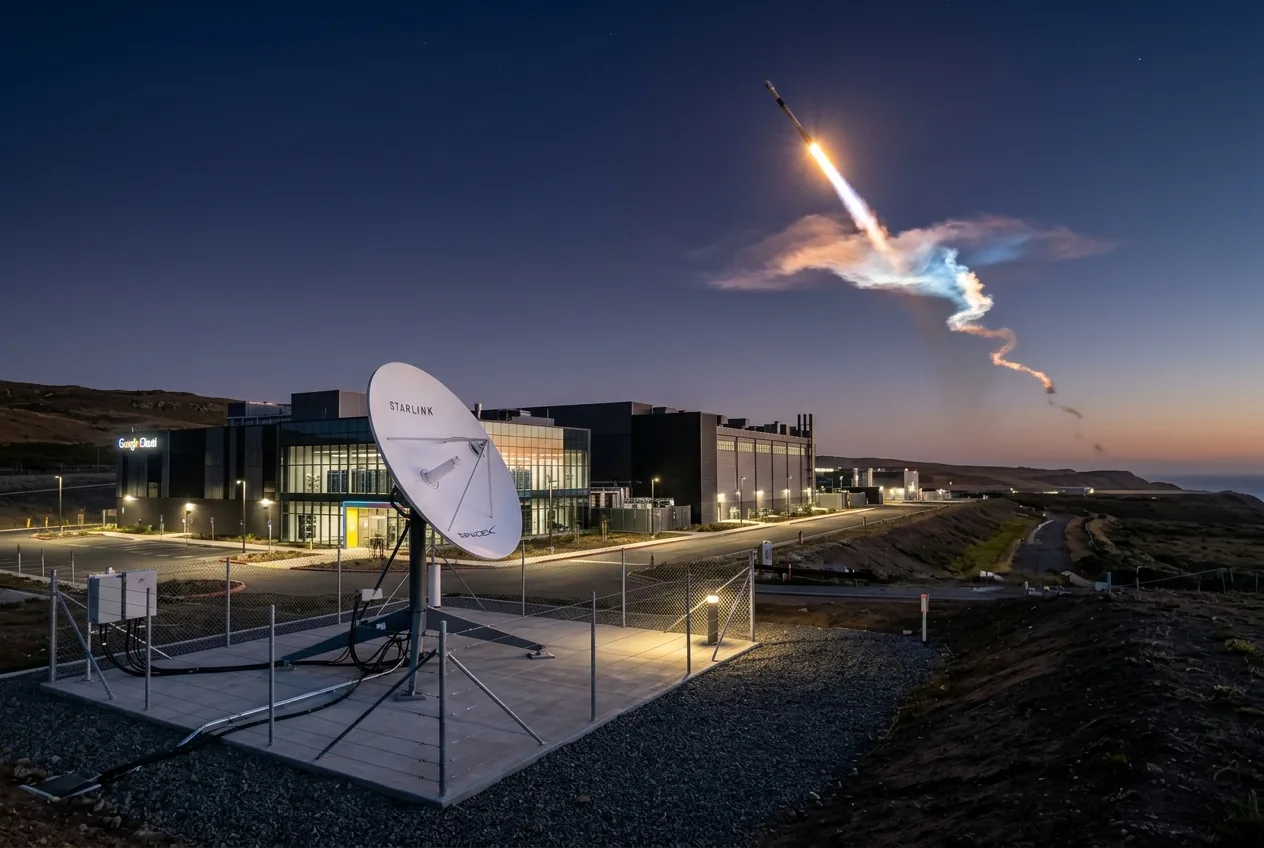
The corporate intersection between Mountain View and Hawthorne is not merely financial; it is physical. In 2021, Google Cloud entered into a consequential infrastructure agreement with SpaceX. Under the partnership, Starlink ground stations and network termination points were colocated directly within Google’s high-capacity data centers. This hybrid network topology allows enterprise clients to route data from remote industrial sites, mining operations, and military installations through Starlink satellites directly into Google Cloud without transiting the public internet.
This hardware alignment provides Google Cloud with a distinct low-latency edge against competitors like Amazon Web Services and Microsoft Azure. While Amazon is funding its own rival constellation, Project Kuiper, SpaceX has already deployed thousands of operational spacecraft. Google effectively secured high-bandwidth orbital transport connectivity without needing to manufacture a single solar panel, design a phased-array antenna, or absorb the immense risk of rocket propulsion development.
From an automation and industrial workflow perspective, this terrestrial-orbital integration is foundational. Autonomous agricultural fleets, offshore robotic drilling rigs, and remote supply-chain hubs require real-time telemetry processing. By combining Google’s edge-compute algorithms with SpaceX’s satellite transport layer, the partnership delivers the operational throughput required for distributed industrial automation across continents where fiber-optic cables do not reach.
Friction in the Broader AI Landscape
While the business synergies between Alphabet and SpaceX remain mutually beneficial, the broader technological ecosystem has grown considerably more complex. Elon Musk’s aggressive expansion into artificial intelligence via xAI has placed his external software ambitions in direct competition with Google DeepMind and Alphabet’s Gemini ecosystem. The race to construct planetary-scale compute clusters, optimize transformer models, and deploy autonomous agents is creating strategic crosswinds across all of Musk’s enterprises.
xAI’s rapid deployment of the Colossus supercomputer in Memphis—relying on tens of thousands of liquid-cooled enterprise GPUs—demonstrates an intent to rival Google’s proprietary Tensor Processing Unit infrastructure. The tension lies in the corporate boundary lines: SpaceX employs advanced machine learning for autonomous orbital collision avoidance, booster precision landing, and satellite phased-array beamforming, yet Musk’s primary generative AI assets reside inside xAI, which shares telemetry and operational insights with Tesla and X rather than external corporate partners.
Despite this competitive divergence in artificial intelligence, Alphabet’s balance-sheet position in SpaceX remains insulated. Equity ownership in the world’s preeminent launch provider is not a tech partnership that can be easily severed by rivalries in algorithmic research. SpaceX’s structural moat in space logistics is simply too wide. With Falcon 9 executing over a hundred orbital launches annually and Starship scaling its mass-to-orbit capabilities, no software conglomerate, including Alphabet, can afford to walk away from the industrial infrastructure that dictates the economics of the lower orbital envelope.
The True Value of Orbital Dominance
Ultimately, Alphabet’s SpaceX valuation mark represents an extraordinary validation of patient, high-conviction capital. At a time when traditional venture capital prioritized asset-light software applications and short-cycle consumer platforms, Google committed hundreds of millions of dollars into liquid-fueled rocket engines, advanced metallurgical tooling, and mass-manufactured satellite arrays. The resulting industrial asset is now virtually impossible to replicate through private investment alone.
Whether SpaceX eventually pursues an unprecedented multi-hundred-billion-dollar direct listing, spins off Starlink into a public utility, or continues to finance its Mars architecture exclusively through private secondary markets and commercial cash flow, Alphabet sits in an enviable position. It holds an immovable equity cornerstone in the single company that controls the transit gateway to Earth's orbit. For an enterprise that built its fortune organizing information across terrestrial networks, owning a massive slice of the hardware that connects the planet from above remains one of the smartest industrial decisions Alphabet has ever made.



Comments
No comments yet. Be the first!