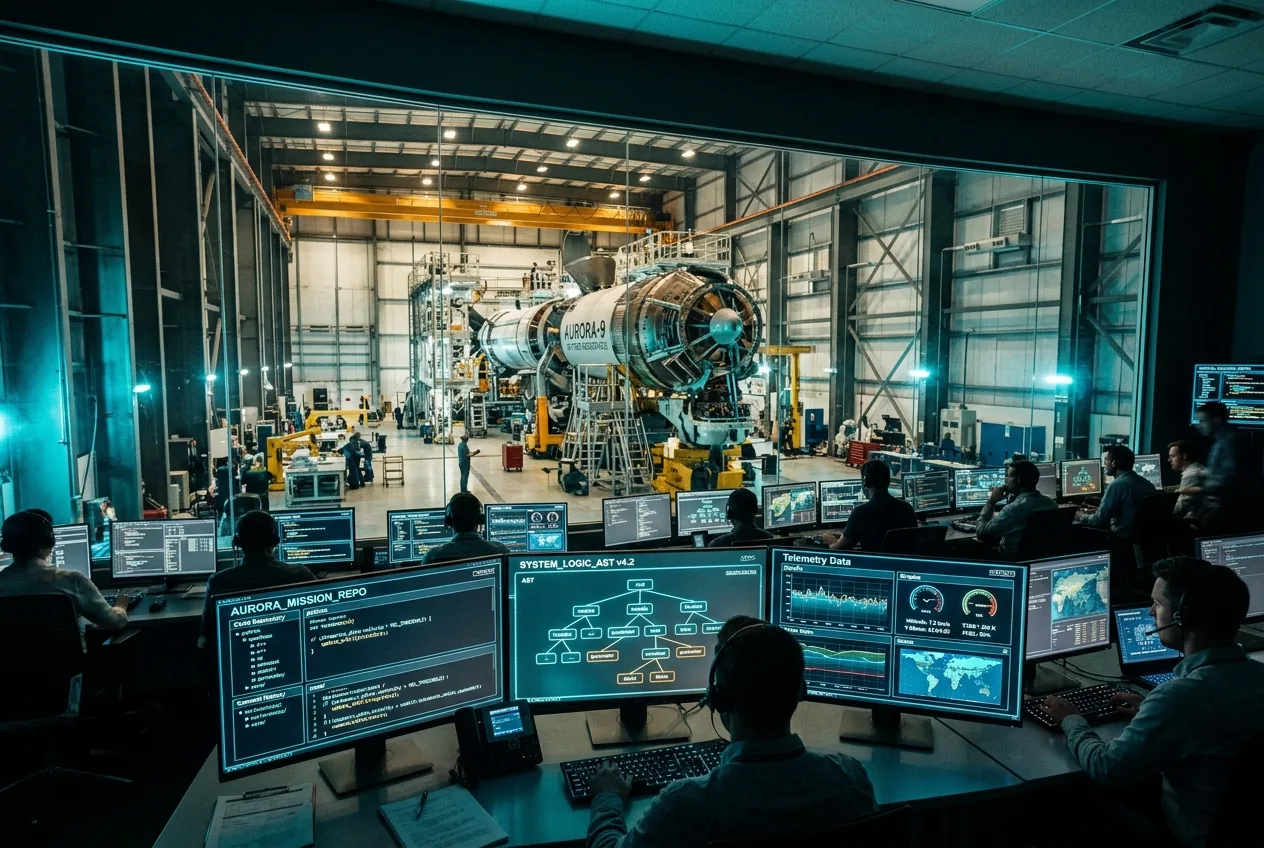
When algorithmic news feeds and syndication aggregators recently spun up breathless headlines claiming SpaceX had executed an astronomical sixty-billion-dollar acquisition of AI coding darling Cursor right after an imaginary public offering, veteran tech watchers laughed off the syndication glitch. SpaceX remains one of the world's most valuable private industrial powerhouses, and Cursor—developed by the stealthy San Francisco startup Anysphere—is a lean developer-tools company valued in the low billions, not a mega-cap conglomerate. Yet the viral curiosity surrounding the report struck an exposed nerve across the engineering world. The idea that Elon Musk’s sprawling industrial empire would pour immense capital into automated code generation is not far-fetched in principle; it is merely misunderstood in its execution.
Behind the absurd headlines lies a very real, high-stakes operational bottleneck. As hardware iteration speeds up across aerospace manufacturing, autonomous driving, and humanoid robotics, the limiting factor is no longer how fast factories can stamp sheet metal or mill rocket thrust chambers. The primary constraint has migrated to software verification, firmware deployment, and telemetry analytics. Understanding why cutting-edge coding assistants like Cursor matter to heavy industry requires peeling back the marketing veneer and looking directly at the machine instructions governing physical machines.
The Mechanical Architecture of Cursor
To grasp why developers in hardware-heavy companies are drawn to Cursor, one must dissect how it differs from conventional code-completion tools. Built as a focused fork of Microsoft’s Visual Studio Code, Cursor does not treat artificial intelligence as a simple auto-complete widget hovering in an adjacent sidebar. Instead, it rearchitects the development environment around direct codebase comprehension using fine-tuned retrieval-augmented generation and abstract syntax tree indexing.
In standard software workflows, a large language model struggles because code is rarely self-contained. A change to an avionics communication protocol requires awareness of hardware pinouts, bus timing definitions, sensor calibration structures, and legacy error-handling routines scattered across tens of thousands of files. Cursor addresses this by generating comprehensive semantic embeddings of entire local repositories, indexing symbols, dependencies, and project structures. When an engineer queries the model or requests a multi-file refactoring, the environment feeds relevant architectural context directly into the context window of underlying frontier models.
For complex engineering teams, the primary utility is not generating boilerplate web interfaces, but navigating monumental codebases. In an enterprise hardware environment, tracing how an actuator control command propagates from a supervisory planner down to a microcontroller register can consume days of human engineering time. By allowing developers to execute semantic searches and implement automated codebase-wide refactors in an isolated workspace, tools in Cursor’s class compress the feedback loop between human intent and compiled code.
The Aerospace Wall and the Determinism Problem
SpaceX’s flight computers on Starship and Falcon 9 rely on triple-redundant architectures executing deterministic real-time operating systems. Control loops executing at hundreds of Hertz must read inertial measurement units, compute vehicle dynamics, and gimbal rocket engines within strict microsecond deadlines. In this environment, dynamic memory allocation is strictly forbidden, runtime garbage collection is non-existent, and code must adhere to rigorous static-analysis rules that prevent race conditions, memory leaks, and undefined behavior. Every line of C and C++ deployed to flight hardware must be mathematically verifiable.
Where Generative Code Actually Delivers Industrial Returns
If automated software generation cannot be trusted with flight-critical actuation loops, why are deep-tech leaders so deeply invested in the technology? The answer lies in the massive, invisible iceberg of secondary and tertiary engineering systems that support the physical hardware. While flight software may consist of tens of thousands of lines of rigorously audited code, the supporting infrastructure requires millions.
- Automated Test-Harness Generation: Validating a single rocket engine valve or battery management circuit requires writing thousands of permutations of unit tests, fault-injection scripts, and corner-case simulations. Generative coding assistants excel at reading interface definitions and generating exhaustive, tedious test harnesses in Python or Rust, shaving months off pre-flight qualification timelines.
- Telemetry Ingestion and Anomaly Hunting: Modern launch vehicles and satellite constellations generate gigabytes of operational telemetry per second. Writing custom parsing pipelines, sensor correlation scripts, and ground-station analysis tools is an ideal task for codebase-aware AI tools, which can instantly draft analytical tools tailored to changing data schemas.
The xAI Compute Nexus and Vertical Integration
Musk’s operational playbook has always prioritized vertical integration to eliminate supplier margins and streamline engineering cycles. At SpaceX and Tesla, proprietary internal software has systematically replaced off-the-shelf enterprise software across CAD, finite element analysis, and manufacturing execution. The logical next phase of this strategy is internalizing the AI development pipeline itself. A software-agent infrastructure trained natively on proprietary telemetry, mechanical assembly files, and custom hardware registers would be far more valuable to a robotics or aerospace operation than any generic consumer coding assistant.
While third-party platforms like Cursor, GitHub Copilot, and Cognition's Devin battle for developer adoption in commercial tech firms, the frontier for industrial technology lies in domain-specific reasoning models. When an artificial intelligence agent can ingest a mechanical stress report, understand the thermal limits of an Inconel alloy, and autonomously draft the corresponding firmware limiters for a high-pressure pump, the boundary between hardware and software engineering will permanently blur.
The Economic Reality of Software Automation
The financial hallucination of an instant sixty-billion-dollar acquisition obscures the genuine capital dynamics of the AI developer space. Elite developer tools are capturing venture capital and enterprise contracts at an unprecedented rate because elite software talent represents one of the single highest operating expenditures for deep-tech conglomerates. An experienced embedded systems engineer commands significant compensation and requires years of domain-specific training.
The sensationalized headlines of overnight mergers may make for compelling clickbait, but the reality of industrial automation is a story of grinding precision. As SpaceX pushes toward orbital refueling and rapid Starship reusability, and as Tesla races to scale autonomous robotics, the software underpinning these physical machines must become faster to deploy, easier to verify, and more deeply integrated with compute infrastructure. The developer environments being forged today are the scaffolding upon which the next era of heavy industrial machinery will be built.




Comments
No comments yet. Be the first!