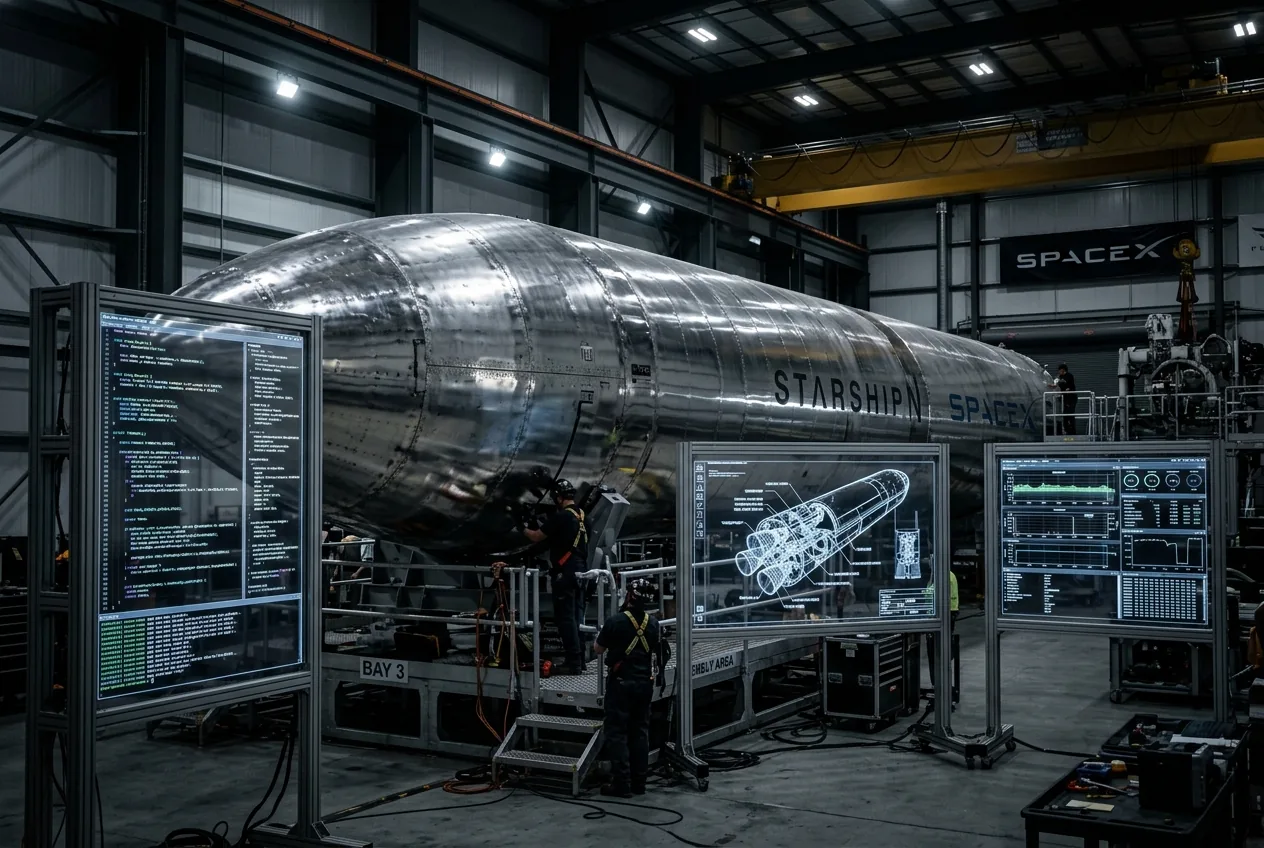
In what marks one of the most audacious consolidations in modern industrial computing, SpaceX has moved to finalize a reported $60 billion transaction to acquire Cursor, the AI-driven development environment built by Anysphere. While the scale of the capital deployment immediately sends shockwaves through Silicon Valley and the aerospace sector alike, the strategic calculus behind the maneuver reflects a deeper, far more pragmatic imperative. SpaceX is not merely purchasing an automated code editor; it is attempting to rewire the underlying software velocity of its orbital logistics, automated manufacturing pipelines, and real-time flight telemetry.
For an enterprise operating at the intersection of heavy mechanical engineering and planetary-scale distributed computing, software iteration is increasingly the governing constraint on hardware throughput. From the automated orbital collision avoidance matrices required by tens of thousands of Starlink satellites to the deterministic control loops governing Starship's Raptor engines during descent, lines of code must be drafted, tested, and validated faster than legacy human engineering workflows can accommodate. By folding Cursor's context-aware language model pipelines directly into its internal software factory, SpaceX is betting that generative code synthesis can make the transition from consumer software utilities to deterministic, mission-critical systems.
The Engineering Anatomy Behind Cursor’s Code Intelligence
To understand why an aerospace manufacturer would commit capital of this magnitude to an IDE, one must look past the interface layer down to Cursor’s systems architecture. Built as a specialized fork of Microsoft’s Visual Studio Code, Cursor differentiated itself from competing AI coding assistants by abandoning simple single-file code completion in favor of full-repository indexing. The platform employs high-performance embedding models paired with custom retrieval-augmented generation (RAG) pipelines that build a structural shadow map of a codebase, tracking symbol graphs, dependency trees, and historical commit deltas in real time.
This structural mapping enables speculative multi-file edits, predicting changes across interconnected modules before a developer manually invokes a patch. When a developer alters an interface contract or modifies a data structure, the platform infers the cascading downstream consequences across thousands of lines of dependent files. In standard web development, this translates to faster feature rollout. In a rocket production environment, where a single change to a propellant valve pressure threshold must cascade across telemetry parsers, launch sequencer state machines, and ground support logging systems, that level of multi-file semantic awareness reduces human verification latency from days to seconds.
Furthermore, Cursor’s integration of local model caching and low-latency inference fits the rigorous data segregation requirements of aerospace defense contractors. Operating under the constraints of International Traffic in Arms Regulations (ITAR) and strict proprietary controls, SpaceX cannot route source code for proprietary guidance navigation and control (GNC) systems through third-party commercial API endpoints. Bringing Cursor’s intellectual property, custom context architectures, and underlying developer ecosystem under internal control gives SpaceX full sovereignty over its automated developer toolchain, permitting air-gapped deployments inside high-security engineering centers from Hawthorne to Starbase.
The High-Risk Leap to Deterministic Aerospace Code
Despite the platform’s technical elegance, the operational application of generative language models within aerospace software introduces severe mechanical and algorithmic contradictions. Standard commercial software tolerates runtime exceptions, intermittent edge-case crashes, and non-deterministic behavior; safety-critical avionics do not. Flight software governing a Falcon 9 or Starship vehicle operates under hard real-time constraints, executing deterministic C and C++ control loops that must complete within fixed clock cycles on radiation-hardened hardware.
In this arena, hallucinations are catastrophic. A generative code model that introduces an undetected race condition, memory leak, or unhandled pointer exception into a guidance loop could yield catastrophic loss of mission. Aerospace software has historically adhered to stringent engineering paradigms like DO-178C, where every line of code requires exhaustive bidirectional traceability back to formal system requirements, structural coverage analysis, and physical hardware-in-the-loop (HIL) validation. Standard large language models, trained fundamentally on statistical token probability rather than formal mathematical logic, cannot inherently guarantee deterministic correctness.
Symbiosis with xAI and the Memphis Compute Cluster
The industrial logic of this transaction cannot be isolated from the broader convergence between SpaceX and xAI. The development of next-generation foundational models requires two complementary assets: immense compute infrastructure and rich, real-world data telemetry. With xAI operating its massive "Colossus" GPU cluster in Memphis, Tennessee, the acquisition provides an immediate, high-leverage application layer for domain-specific models tailored precisely to hardware engineering, physics simulations, and embedded robotics.
Existing general-purpose commercial coding models are predominantly optimized for common languages like Python, JavaScript, and Rust within enterprise IT contexts. They exhibit comparatively weak performance when dealing with esoteric embedded hardware description languages, low-level real-time operating system (RTOS) primitives, or mathematical finite element analysis routines. By routing real-world flight data, telemetry streams, and CAD-to-code pipelines from SpaceX directly into xAI's model training loops, the combined entities can build custom code-synthesis architectures tuned to physical mechanics and fluid dynamics.
This closed loop transforms Cursor from a general-purpose programming tool into a specialized industrial synthesizer. An engineer configuring an automated weld schedule on the Starship assembly line or adjusting the dynamic thrust vectoring commands on a Super Heavy booster could theoretically articulate mechanical parameters in high-level domain language, allowing the underlying model to generate compliant, verified microcode directly linked to the physical hardware sensors. The compute cluster in Memphis ceases to be merely a consumer AI farm and becomes the centralized intelligence engine governing physical manufacturing and flight operations.
Re-Architecting the Starlink Orbital Mesh
Beyond vehicle propulsion and trajectory calculations, the most immediate industrial beneficiary of automated code synthesis is the Starlink constellation. Managing an active mesh network consisting of thousands of satellites travelling at 27,000 kilometers per hour requires an unprecedented volume of continuous software deployment. Each satellite acts as an autonomous router, constantly evaluating laser inter-satellite links, ground station handoffs, spectrum licensing constraints, and orbital debris avoidance vectors.
The networking software running on Starlink is essentially a globally distributed edge computing platform operating in a high-radiation, bandwidth-constrained environment. Software engineers are perpetually deploying firmware patches, optimizing beam-forming algorithms, and rebalancing traffic loads across shifting continental demand patterns. Human software teams simply cannot write and audit manual micro-updates at the speed necessary to optimize a dynamic network of this density.
With an integrated Cursor-derived codebase platform, SpaceX can automate the generation of decentralized routing configurations and satellite firmware patches. Code intelligence platforms can parse telemetry logs across the entire constellation, diagnose systemic communication bottlenecks, draft corrective network routines, and present verified patches to human ground controllers. The goal is to compress the cycle time between observing an atmospheric propagation anomaly and deploying an orbital routing fix from several days to under an hour, maintaining network uptime through algorithmic self-correction.
The Long-Term Economics of Algorithmic Tooling
A $60 billion valuation is an extraordinary sum for a developer tools start-up, representing a price tag that outstrips the market capitalization of numerous long-standing defense primes and industrial conglomerates. Such an astronomical figure reflects how vital software automation has become to modern industrial scale. In legacy aerospace, software development cycles run in parallel to long hardware procurement lead times, with progress measured in fiscal quarters and cost-plus contracting milestones. SpaceX has achieved its dominance by treating rockets as software-defined machines wrapped in stainless steel.
When software velocity dictates hardware iteration, the efficiency of an engineering workforce becomes the primary variable determining unit economics. If a proprietary, deeply integrated code intelligence engine allows an engineering corps of a few thousand to match the functional output of a traditional aerospace workforce ten times its size, the long-term capital efficiency shifts dramatically. It lowers the per-launch integration overhead, speeds up Starship's cadence toward full orbital reusability, and accelerates the automated production of lunar and Martian infrastructure.
The risks, however, remain substantial. Integrating high-entropy machine learning architectures into low-tolerance mechanical hardware requires cultural and technical bridges that few software companies have ever successfully crossed. If SpaceX succeeds in harnessing Cursor to automate deterministic, safety-critical aerospace systems, it will redefine not just the methodology of spaceflight avionics, but the role of human software engineers across all industrial manufacturing. The code that propels humanity toward the stars will no longer be typed character by character; it will be orchestrated, verified, and deployed through the automated synthesis of machines.




Comments
No comments yet. Be the first!