Viral headlines across financial blogs and speculative market newsletters have recently declared that Elon Musk has officially crossed the threshold to become the world’s first trillionaire. The claim, driven by aggressive mathematical models from market research firms like Informa Connect Academy and inflated valuations following private equity rounds, runs ahead of verified financial accounting. Musk has not liquidated or marked to market a trillion dollars in personal assets. However, the arithmetic propelling these projections reveals a structural transformation in how industrial wealth is generated, shifting away from consumer software platforms and toward the physical convergence of synthetic intelligence, heavy aerospace logistics, and high-volume automation.
The Memphis Colossus and the Physical Footprint of xAI
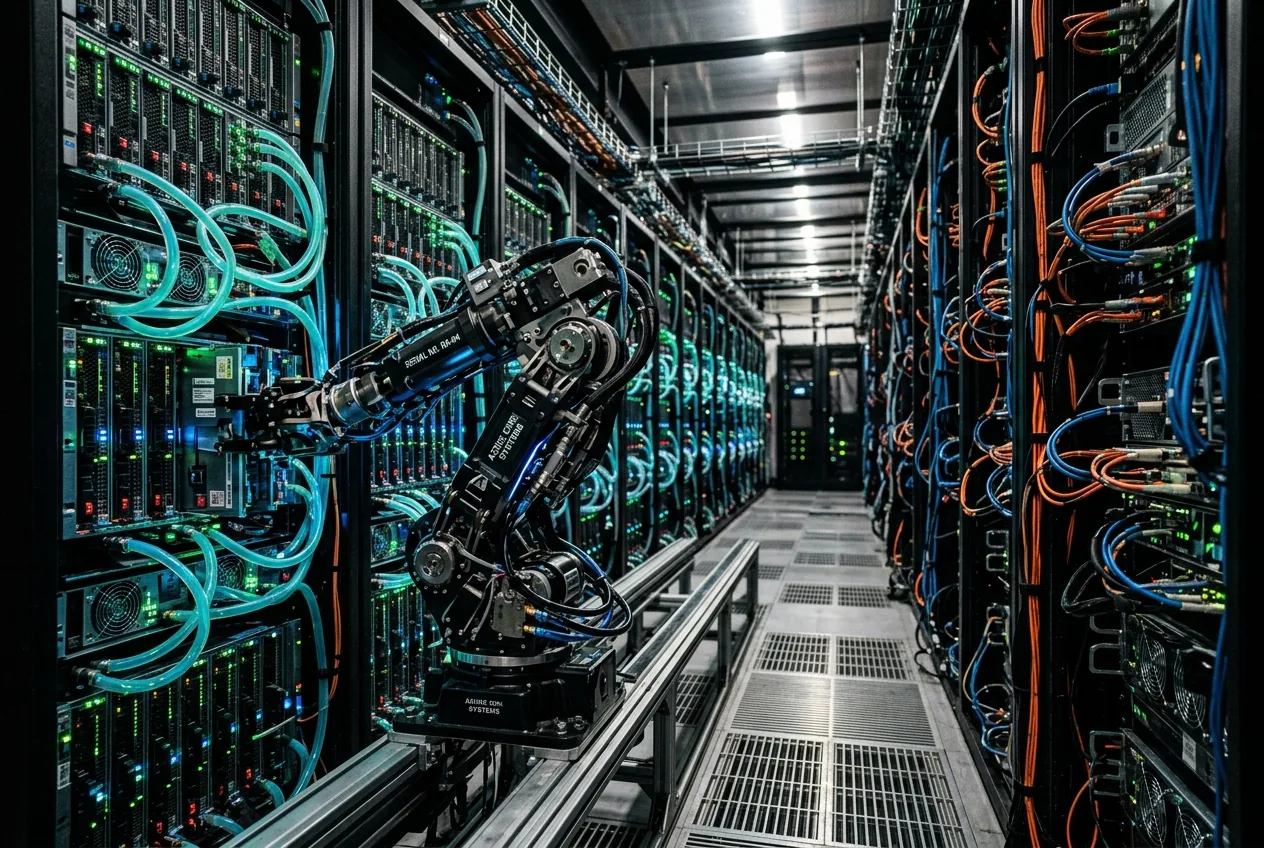
Much of the recent valuation momentum originates not from Tesla’s automotive balance sheet, but from xAI, the artificial intelligence venture Musk founded in early 2023. Unlike software startups that operate purely as tenants within third-party hyper-scaler clouds, xAI pursued a capital-intensive hardware deployment model. In Memphis, Tennessee, xAI erected 'Colossus,' a supercomputing cluster consisting of 100,000 liquid-cooled Nvidia H100 GPUs, brought from bare concrete to full network operation in roughly 122 days. The engineering effort required to procure, rack, interconnect, and power a facility of this scale is a heavy industrial achievement that blindsided traditional technology incumbents.
Running 100,000 enterprise-grade accelerators demands immense mechanical and electrical infrastructure. At full operational load, the Memphis cluster draws tens of megawatts of continuous electrical power, requiring dedicated utility substations, specialized liquid-to-liquid cooling manifolds, and custom RDMA network topologies over Ethernet. By owning and operating this physical tier of compute, xAI minimized the markup paid to public cloud operators. In turn, venture syndicates valued the company north of $40 billion in rapid funding rounds, pricing xAI not as a modest research lab, but as a sovereign infrastructure provider capable of training frontier models like Grok.
This physical compute base forms the foundation for Musk’s personal equity surge. Every institutional funding round that revalues xAI injects billions in theoretical net worth onto Musk’s balance sheet. When combined with the enterprise's access to real-time data streams from social platform X, xAI functions as a vertically integrated pipeline for training multimodal networks. Yet, the financial translation of this compute into durable industrial cash flow remains the true operational test.
Cross-Pollination Across the Industrial Hardware Stack
In classical corporate governance, disparate technology enterprises maintain distinct engineering pipelines and operational silos. In Musk’s orbit, corporate boundaries blur into an interdependent manufacturing and compute matrix. xAI does not exist in isolation from Tesla’s autonomous driving programs or SpaceX’s satellite communications grid; rather, the hardware and software layers feed directly into one another.
This tight coupling produces a multiplier effect on valuation. Investors participating in xAI funding rounds are not merely betting on a conversational chatbot; they are funding the centralized intelligence engine intended to pilot physical machinery across multiple industrial sectors. When private markets evaluate xAI or SpaceX, they assign premiums based on structural defensibility. Traditional automotive companies cannot replicate xAI’s compute scale without massive capital restructuring, and software-only AI labs lack the robotic platforms required to execute physical tasks in the material world.
The Humanoid Multiplier and the Economics of Physical Labor
If financial models project Musk’s personal balance sheet crossing the twelve-figure mark before 2030, the single largest variable in those models is Tesla’s humanoid robotics initiative, Optimus. The mechanical design of Optimus represents a direct attempt to commoditize physical labor. From an engineering standpoint, the transition from wheeled electric vehicles to bipedal electromechanical systems requires radical optimization across energy density, actuator design, and structural mass.
Modern industrial automation relies on fixed robotic arms operating within structured, highly predictable work cells. These machines excel at high-speed repeatability but fail completely when confronted with environmental variance. Optimus approaches the problem from the opposite direction: utilizing integrated planetary gearsets, custom permanent-magnet electric actuators, and localized vision-based neural networks to navigate human-engineered environments. By designing actuators specifically matched to the torque and velocity curves of human biomechanics, Tesla aims to drive the unit manufacturing cost of a humanoid robot down to approximately $20,000 at volume.
The speculative financial implications of this machine are astronomical. Standard macroeconomic theory treats labor as a finite, biologically constrained factor of production. If an industrial conglomerate can mass-produce autonomous electromechanical units capable of eight-hour continuous shifts on an automotive assembly line, the economic definition of production capacity collapses and rebuilds itself. A factory floor populated by general-purpose humanoid systems removes the throughput ceiling imposed by human physiological limits. Analysts projecting Musk as the first trillionaire routinely assign multi-trillion-dollar enterprise valuations to Tesla precisely because they price Optimus as an infinite labor supply, despite the platform remaining in early industrial trial phases.
Paper Multiples Versus Structural Capital Realities
While the mathematical trajectory on paper suggests exponential wealth accumulation, serious engineers and financial analysts must distinguish between mark-to-market valuations and structural capital realities. The assertion that an individual has reached trillionaire status assumes uninterrupted liquidity at prevailing equity marks—an economic impossibility.
Musk’s assets remain predominantly illiquid, bound up in massive blocks of equity across public and private corporate charters. Liquidating even a fraction of these holdings to realize cash introduces immediate downward price pressure, regulatory scrutiny, and severe tax friction. Furthermore, valuation multiples applied to high-growth industrial AI companies are notoriously sensitive to macroeconomic conditions, including interest rates, enterprise capital expenditure cycles, and the physical availability of grid power.
In the physical realm, computational growth is running headfirst into hard limits. Scaling xAI’s infrastructure from 100,000 accelerators to a million-accelerator system is not simply a matter of capital deployment; it is constrained by the manufacturing output of advanced semiconductor lithography and the multi-year lead times required to build high-voltage power generation and water cooling systems. If the infrastructure buildout stalls due to electrical grid constraints or silicon shortages, the aggressive revenue growth rates embedded in trillion-dollar wealth projections will necessarily decelerate.
The narrative of the first trillionaire is fundamentally an accounting projection based on the assumption that software margins can be mapped directly onto physical manufacturing and energy infrastructure. Elon Musk has not crossed the trillion-dollar mark today. Whether he does so in the years ahead will not be determined by stock market sentiment alone, but by the measurable, mechanical success of running distributed compute clusters, building operational humanoid hardware, and successfully industrializing artificial intelligence at planetary scale.




Comments
No comments yet. Be the first!