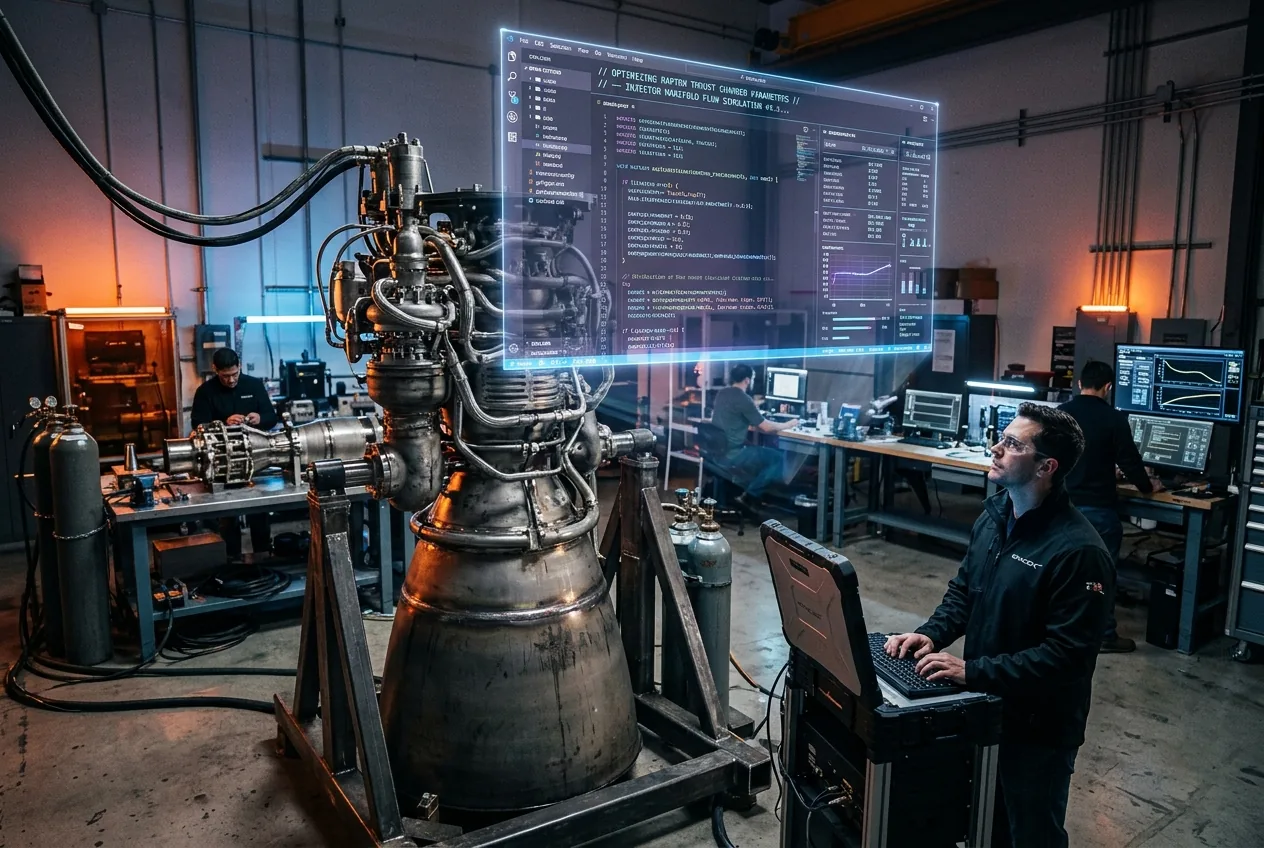
In a move that fundamentally redefines the boundaries between aerospace engineering and software development, SpaceX has finalized its acquisition of Anysphere, the startup behind the AI-native code editor Cursor. The deal, valued at approximately $60 billion in an all-stock transaction, represents the largest acquisition of a venture-backed startup in history. While the figure initially sent shockwaves through the financial sector, the strategic logic reveals a company intent on leveraging high-frequency AI iteration to accelerate the development of Starship and the Starlink constellation. For SpaceX, this is not merely a diversification of its portfolio; it is the acquisition of the nervous system for its future industrial operations.
The Mechanics of a Record-Breaking Stock Swap
The transaction was formalized through an SEC 8-K filing, signaling that SpaceX is now operating under the scrutiny and transparency of a public entity. Financial analysts point out that the valuation, while steep, accounts for the proprietary data and the high-density talent pool within Anysphere. Unlike traditional software acquisitions where a parent company might stifle the innovation of the subsidiary, SpaceX intends to keep Cursor as a functional tool for the broader developer community while simultaneously using it as a specialized engine for its own internal engineering challenges. This dual-use strategy mirrors the way Starlink serves both commercial consumers and the internal logistical needs of SpaceX’s launch services.
Why Cursor is the Engine of Engineering Velocity
In the context of mechanical engineering and aerospace, the bottleneck is often not the physical fabrication of parts, but the software and simulation environments that govern them. SpaceX engineers rely on millions of lines of code to manage everything from liquid oxygen flow rates to autonomous drone ship landings. By integrating Cursor’s agentic capabilities—specifically its ability to not just suggest code, but to autonomously refactor and debug complex systems—SpaceX is betting that it can reduce the software development lifecycle by an order of magnitude. This is particularly relevant as the company moves toward the Grok 4.6 and 4.7 models, which are being tuned specifically for physics-based reasoning and systems engineering.
Furthermore, Cursor’s ability to operate locally while leveraging cloud-based compute power provides the security necessary for aerospace defense contracts. Anysphere’s focus on privacy and enterprise-grade security was a key selling point for SpaceX, which must adhere to strict ITAR (International Traffic in Arms Regulations) compliance. The acquisition ensures that the proprietary algorithms governing SpaceX’s proprietary rocket engines stay within a closed loop, even as they are augmented by the most advanced AI models available on the market.
The Role of the Colossus Supercomputer
A critical component of this acquisition is the infrastructure that will now power Cursor’s evolution. SpaceX’s sister entity, xAI, recently brought the 'Colossus' supercomputer online in Memphis, Tennessee. This massive cluster, featuring over 100,000 NVIDIA GPUs, represents the largest AI training facility in the world. With the acquisition of Cursor, SpaceX can now dedicate a significant portion of this compute power to training specialized 'coding-physicist' models. These models will be trained on vast datasets of telemetry, CAD designs, and aerospace software, creating a version of Cursor that understands the laws of thermodynamics as well as it understands Python or C++.
The integration of Cursor with the Grok-series models allows for a feedback loop that few other companies can replicate. As SpaceX engineers use Cursor to write software, the data generated from those sessions—anonymized and secured—can be used to fine-tune the Grok models in real-time. This creates a recursive improvement cycle: the AI helps the engineer write better code, and the engineer’s code helps the AI understand the engineering domain more deeply. This synergy is intended to culminate in the 'Grok Bot' and other autonomous agents capable of performing complex software maintenance with minimal human oversight.
The economic viability of this infrastructure is predicated on the idea of vertical integration. In the same way that SpaceX builds its own engines, its own rocket bodies, and its own satellites, it is now building its own intelligence. By owning the hardware (Colossus), the model (Grok), and the interface (Cursor), SpaceX has eliminated the middleman in the AI stack. This reduces the per-token cost of AI development to the cost of electricity and hardware depreciation, allowing for a level of experimentation and iteration that would be cost-prohibitive for any firm paying for API access to GPT-4 or Claude.
Impact on the Global AI and Aerospace Landscape
The ripples of this deal extend far beyond the SpaceX campus in Hawthorne. For the startup ecosystem, the $60 billion exit for Anysphere sets a new benchmark for what is possible in the AI sector. It signals that 'agentic' tools—those that can act on behalf of a user rather than just answering prompts—are the highest-value assets in the current economy. The acquisition also puts pressure on traditional software giants like Microsoft and Google, who now find themselves competing against a vertically integrated titan that possesses both the compute power and the real-world application for AI-driven software.
In the aerospace industry, the move is likely to spark a new arms race. Competitors like Blue Origin and Boeing must now reckon with the fact that SpaceX is no longer just a hardware company, but a premier AI laboratory. The speed at which SpaceX can iterate on Starship—already famously fast—could potentially double if the software hurdles that typically plague aerospace projects are smoothed over by an AI that 'knows' the entire codebase of the vehicle. This may lead to a broader trend of industrial companies acquiring AI startups to build bespoke, internal development environments tailored to their specific engineering constraints.
However, the deal is not without its critics. Concerns regarding the consolidation of power within the Musk-controlled entities are mounting. With SpaceX, xAI, and now Cursor operating under a single umbrella, the data moat being built is unprecedented. Regulators are already looking closely at the 'SpaceXAI' structure to ensure that the cross-pollination of data between a public aerospace company and a private AI lab remains within legal bounds. Nevertheless, from a purely technical and industrial perspective, the acquisition of Cursor is a masterstroke in engineering efficiency, positioning SpaceX as the dominant force in the coming age of autonomous industrial intelligence.
The Shift Toward Agentic Industry
Ultimately, the acquisition of Cursor for $60 billion marks the end of the first chapter of the AI revolution and the beginning of the second. The first chapter was about chatbots and image generation; the second is about the application of that intelligence to physical reality and complex infrastructure. By embedding an AI-native editor into its core operations, SpaceX is moving toward a future where the line between the digital twin and the physical rocket becomes increasingly blurred. The goal is an autonomous loop where AI designs the software, simulates the physics, and monitors the manufacturing process, with humans acting as high-level architects rather than manual coders.
This transition is essential for the long-term goals of the company. Establishing a permanent human presence on Mars requires systems that can repair themselves, update their own software, and adapt to unforeseen environmental challenges without waiting for a 20-minute signal delay from Earth. The agentic capabilities of Cursor, backed by the raw power of the Grok models and the Colossus cluster, are the foundational technologies required for such a feat. SpaceX has not just bought a code editor; it has secured the tools to build the future of humanity's expansion into the solar system.




Comments
No comments yet. Be the first!