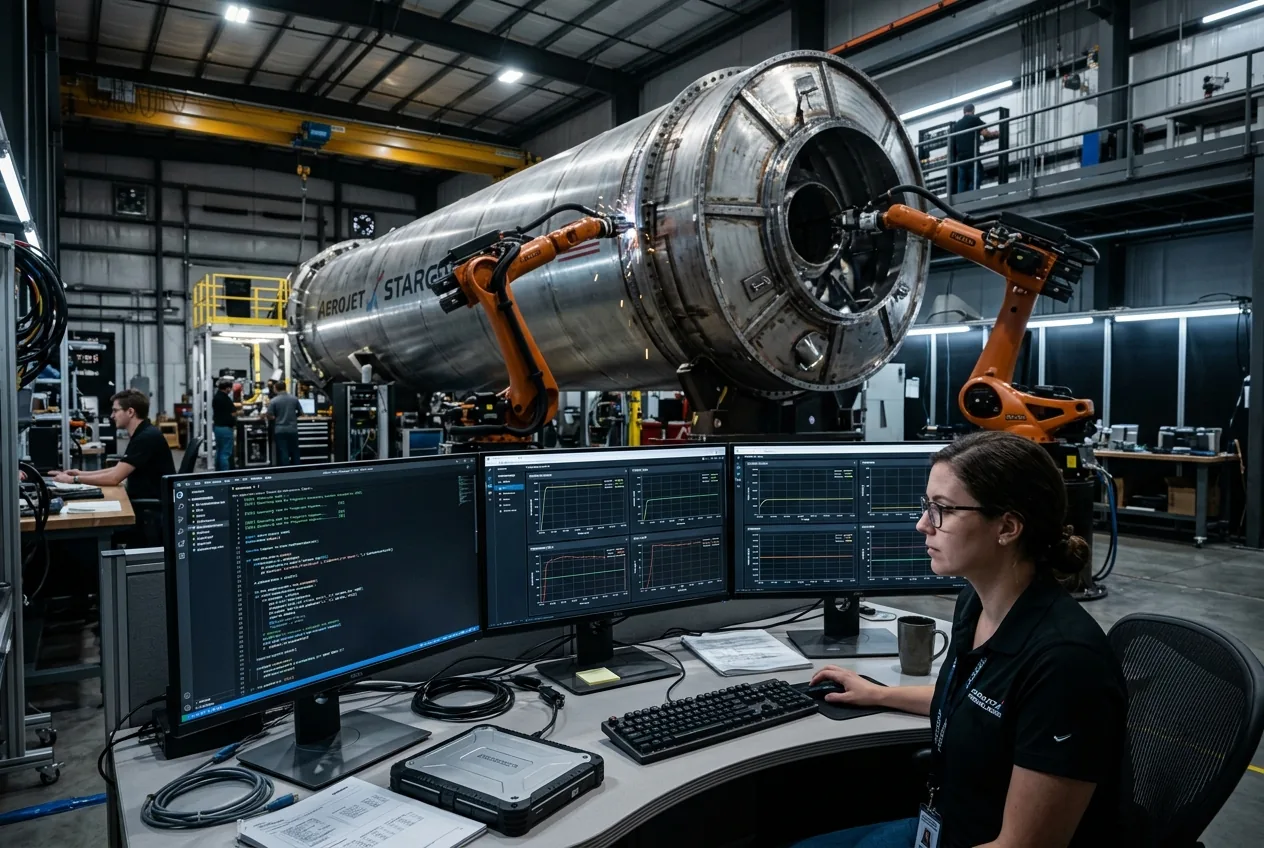
Viral rumors asserting that SpaceX has agreed to acquire Anysphere, the software laboratory behind the popular AI code editor Cursor, for a staggering sixty billion dollars have raced across industrial blogs and tech aggregators. On its face, the valuation figure is mathematically absurd. SpaceX, recently valued in secondary private tender offers in the ballpark of three hundred and fifty billion dollars, would not logically liquidate or dilute nearly a fifth of its capitalization to buy an application-layer developer tool that was valued closer to two and a half billion dollars in its recent private venture rounds. Yet, the viral persistence of the report points to a fascinating industrial crossroads: the collision of aerospace hardware production, real-time deterministic software, and the frantic effort across Elon Musk’s corporate federation to automate the digital scaffolding of spaceflight.
Understanding why such a rumor caught fire requires separating the financial fantasy from the authentic technical bottlenecks throttling modern aerospace manufacturing. At Starbase in Boca Chica, Texas, and across the manufacturing floor in Hawthorne, California, SpaceX is fundamentally a high-cadence manufacturing and robotics enterprise disguised as a launch provider. Building hundreds of Starlink satellites each month, milling complex regeneratively cooled Raptor rocket engine jackets, and managing thousands of concurrent orbital assets demands an unprecedented volume of mission-critical code. While an outright sixty-billion-dollar buyout of Anysphere belongs purely to the realm of speculative fiction, the underlying mechanical and software imperatives driving aerospace toward autonomous programming are concrete, immediate, and intensely competitive.
The Mathematical and Operational Disconnect
To evaluate the claim from an engineering and capital-allocation standpoint, one must weigh what Anysphere actually builds against what SpaceX operates. Anysphere’s primary product, Cursor, is an intelligent fork of Microsoft’s open-source Visual Studio Code. It weaves proprietary retrieval-augmented generation architectures, bespoke semantic indexing algorithms, and foundation language models from providers like Anthropic and OpenAI directly into the developer workflow. It is widely praised by embedded systems programmers and web developers alike for its uncanny ability to parse deeply nested codebases, understand inter-file dependencies, and generate syntactically clean scaffolding with minimal latency.
However, paying sixty billion dollars for an IDE layer—a sum rivaling major defense conglomerate market capitalizations like General Dynamics or Northrop Grumman—would represent an unprecedented capital misallocation. Aerospace manufacturing relies on thin, capital-intensive margins. SpaceX’s liquid reserves and internal cash generation are earmarked for capital expenditure: the buildout of Starship production infrastructure, continuous propellant plant expansion, deep-sea launch platform prototyping, and massive satellite constellation deployments. To expend tens of billions in equity or cash on a venture-backed startup whose core IP sits atop foundation models it does not exclusively own would run counter to every first-principles manufacturing doctrine SpaceX has practiced over the last two decades.
Furthermore, Anysphere’s economic profile, while growing exponentially among individual engineers and enterprise engineering teams, is fundamentally divorced from such astronomical numbers. Early-stage venture rounds in late 2024 pinned the company’s enterprise value in the low single-digit billions, backed by elite software investors who recognized its high retention rates. The leap to sixty billion dollars suggests either an erroneous transcription of internal speculative memos, a translation error across syndication channels, or an intentional market-distorting rumor designed to test the appetite for artificial intelligence infrastructure integration within defense-adjacent aerospace.
The Aerospace Flight-Software Verification Paradox
Cross-Pollination Between Memphis and Starbase
While SpaceX itself has little immediate strategic reason to absorb Anysphere, the broader web of Elon Musk’s technology firms provides the context in which these rumors thrive. Musk’s artificial intelligence venture, xAI, has engaged in rapid, resource-heavy consolidation of engineering talent and compute power. The deployment of the Colossus supercomputing cluster in Memphis, Tennessee—packing more than one hundred thousand Nvidia Hopper-class GPUs into a liquid-cooled data-center footprint—demonstrates an appetite for massive infrastructure buildouts designed to train the next generation of multimodal models.
There is documented, structural cross-pollination occurring between xAI, Tesla, and SpaceX. Tesla’s Full Self-Driving neural networks share optimization methodologies with xAI’s foundation research, while SpaceX’s high-throughput telemetry streams from the Starlink network feed complex distributed routing challenges that machine learning architectures are uniquely qualified to optimize. Within this nexus, a world-class code-synthesis platform is undeniably valuable. If a model can be trained on proprietary telemetry, raw telemetry logs, and mechanical failure databases, it could theoretically transform how industrial engineers write firmware for automated robotic weld cells, gantry cranes, and cryogenic propellant transfer stations.
In this operational reality, xAI or SpaceX building deep enterprise partnerships with developer tooling firms like Anysphere makes practical sense. Modern engineering organizations are locked in an intense war for developer velocity. If an aerospace engineer writing telemetry parsers for the Super Heavy hot-staging ring can leverage a localized, air-gapped instance of an advanced coding assistant to draft automated unit tests against synthetic vehicle flight data, deployment cycles shrink from weeks to hours. But licensing an enterprise software stack or providing custom compute environments is fundamentally distinct from a multi-billion-dollar corporate acquisition.
Where Generative Code Actually Fits Modern Industry
The true utility of AI code generation in heavy industry does not lie in letting a neural network fly a rocket; it lies in the unglamorous, high-volume plumbing that surrounds modern manufacturing. Aerospace plants generate terabytes of time-series sensor data from temperature probes, acoustic sensors, accelerometer arrays, and strain gauges during every static fire test. Writing the bespoke extract-transform-load scripts, visualization dashboards, and hardware-in-the-loop test harnesses required to make that data actionable represents an immense human sinkhole.
As industrial automation scales up, the division between software development and mechanical maintenance is dissolving. CNC mills, automated fiber-placement robots, and laser powder-bed fusion printers are controlled by complex software stacks that require continuous tuning. Equipping manufacturing technicians with sophisticated, natural-language-driven coding interfaces drastically accelerates the iteration loop on the factory floor. However, capturing this industrial efficiency requires steady, modular tool adoption, not the irrational financial engineering represented by the sixty-billion-dollar acquisition headlines.
The Trajectory of Autonomous Aerospace Tooling
The persistent buzz surrounding high-profile industrial acquisitions highlights how deeply market observers misunderstand the cost structures of the aerospace revolution. SpaceX has disrupted spaceflight not by out-spending national governments, but by ruthlessly driving down the unit cost of structural mass and hardware assembly. Every dollar expended must translate directly into payload capacity delivered to low Earth orbit or towards the long-term logistical viability of a Martian transport architecture.
Pouring gargantuan sums into consumer-facing or general-purpose software firms would violate this foundational ethos. Instead, the aerospace industry will continue to do what it has always done: ruthlessly extract utility from commercial off-the-shelf software, augment it with specialized internal toolchains, and enforce rigorous automated testing regimes before a single byte of compiled instructions touches a vehicle’s flash memory. Generative programming assistance has already altered the baseline productivity of modern engineers, but it will do so as an operational utility—not as a speculative sixty-billion-dollar takeover.




Comments
No comments yet. Be the first!