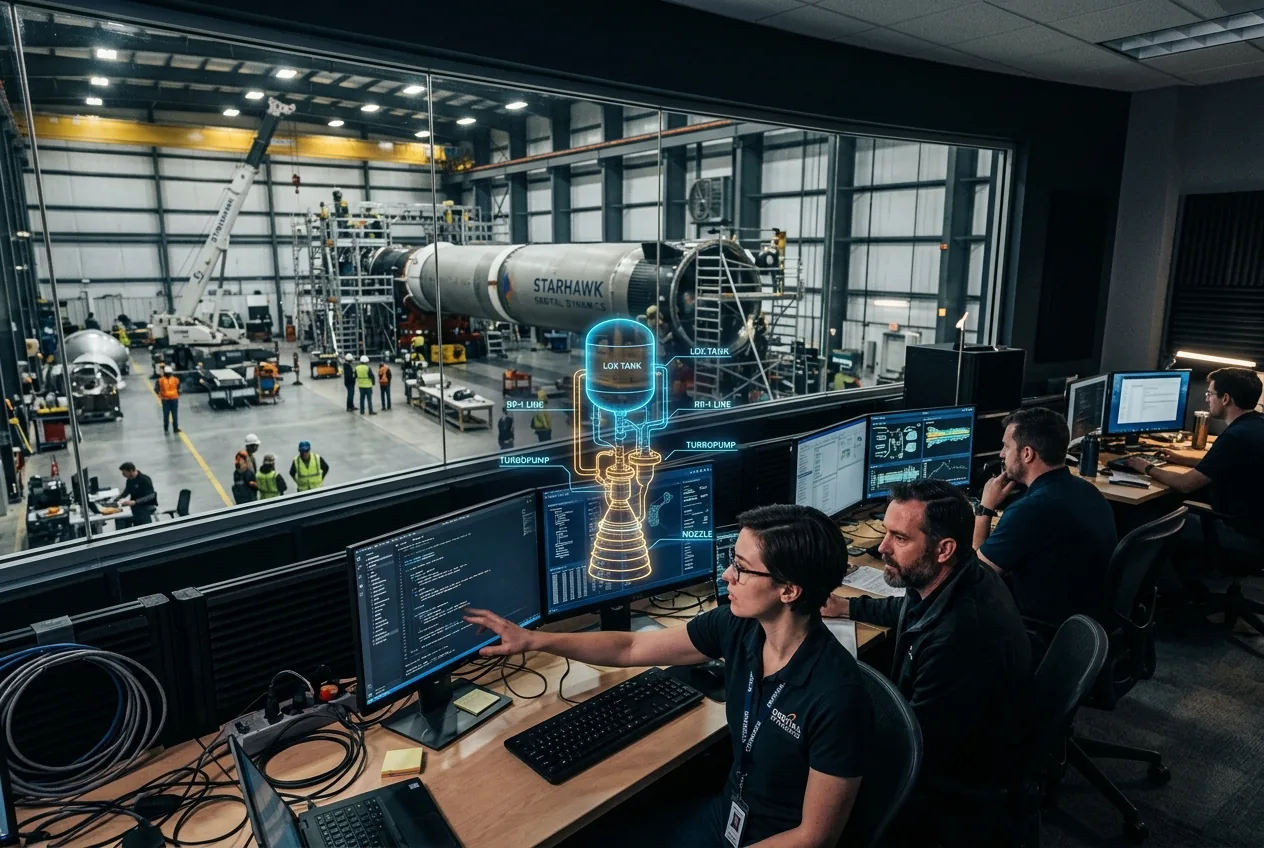
Reports detailing SpaceX’s prospective acquisition of Anysphere, the software laboratory behind the AI-assisted code editor Cursor, represent a fundamental shift in how advanced manufacturing conglomerates view digital infrastructure. While market analysts fixate on the sheer financial scale of the maneuver and its reverberations across private equity valuations, the deeper implications lie in the physical reality of aerospace production. Space exploration has long ceased to be purely a problem of rocketry and propellant chemistry; it is an enterprise dictated by the cadence of software deployment, telemetry verification, and real-time control algorithms.
Anysphere’s primary product, Cursor, has quietly become the software development environment of choice for high-velocity engineering teams throughout Silicon Valley and traditional industrial labs alike. By building an interface that natively integrates large language models directly into the file trees, debuggers, and terminal environments of working engineers, the startup demonstrated that code synthesis is far more than automated text completion. In an industrial context, where millions of lines of mission-critical C++, Rust, and Python govern everything from cold-gas thruster actuation to satellite constellation interlinks, reducing the iteration cycle between an engineer’s intent and verified machine instructions is the ultimate operational leverage.
The Aerospace Bottleneck Moves to the Compiler
Modern aerospace hardware development operates under an unforgiving cadence. At SpaceX’s facilities in Starbase, Texas, and Hawthorne, California, the mechanical structures of the Starship launch system and Falcon 9 boosters are fabricated, iterated, and scrapped at a pace that mirrors digital software development. Yet, the physical assembly of a Raptor engine is frequently gated not by the speed of metal printing or friction-stir welding, but by the readiness of the avionics software that controls its turbopumps, manifold pressures, and gimbal actuators.
Every physical test stand requires complex data acquisition harnesses running deterministic, hard real-time operating systems. The software governing these test fires must be written, vetted against static analysis tools, tested in software-in-the-loop simulators, and deployed to hardware controllers under strict deadlines. When an anomaly occurs during a static fire, the delay in resolving the issue often comes down to the hours required for flight software engineers to parse thousands of telemetry channels, isolate the logical defect in the control law, and commit a patch. Integrating an intelligent synthesis engine directly into this loop targets the single most stubborn bottleneck in the aerospace development cycle.
Hardware-in-the-Loop Testing and Contextual Synthesis
The primary technical hurdle in applying standard commercial AI coding assistants to aerospace is the lack of domain-specific context. An off-the-shelf language model trained on public code repositories understands common web frameworks and standard algorithms, but it fails when confronted with proprietary bus architectures, custom FPGA drivers, or specialized telemetry protocols like MIL-STD-1553 or customized SpaceWire derivatives. Anysphere gained its market dominance by solving the context problem: dynamically indexing large codebases, mapping dependencies across disparate modules, and feeding relevant semantic chunks to the model during active editing.
Within an aerospace engineering environment, that indexing capability must extend beyond code to encompass the physical system. A truly effective code generation engine for rockets must ingest physical schematics, sensor pinouts, and test stand hardware limitations. When an avionics engineer writes a driver for a pressure transducer, the development environment should automatically cross-reference the sensor’s response curve, voltage limits, and thermal drift coefficients from hardware specification sheets, generating verification assertions alongside the driver logic.
This tight coupling between physical specs and executable code directly benefits hardware-in-the-loop (HIL) testing rigs. HIL testing requires engineers to write massive arrays of simulated environments that mimic sensor inputs to the rocket’s actual onboard computers. Writing these simulation harnesses is historically slow and repetitive, requiring engineers to mock the physics of fluids, combustion, and orbital mechanics. Context-aware synthesis tools can turn mechanical design changes directly into simulated test vectors, closing the gap between structural revisions and software verification.
The Financial Logic of Vertical Industrial Integration
From an economic standpoint, the figures circulating around the transaction highlight a structural reconfiguration of value creation in the tech sector. SpaceX’s relentless private market appreciation, which has pushed its trajectory into direct comparison with the capitalization of traditional technology titans like Amazon, provides the company with unprecedented purchasing power. Using that leverage to absorb foundational developer tooling reflects the playbook of extreme vertical integration that defines the broader Musk industrial network.
Historically, aerospace primes subcontracted software development to external defense contractors, commercial software vendors, and third-party IT integrators. This model introduced administrative friction, sluggish update cycles, and intellectual property gridlock. In contrast, SpaceX builds its own avionics boards, writes its own operating systems, winds its own carbon fiber, and operates its own satellite constellation. Controlling the core environment where all of that software is authored, debugged, and maintained is the natural culmination of this operational philosophy.
Furthermore, the operational requirements of Starlink amplify the economic value of automated software engineering. Operating a constellation of thousands of low-Earth-orbit satellites involves continuous, autonomous orbital routing, phase-array beam forming, and dynamic collision avoidance against space debris. The codebase required to run a global telecommunications network in space cannot remain static. It requires perpetual optimization, continuous security hardening, and dynamic adaptation to localized orbital density, tasks that demand an exponential scaling of developer productivity.
The Reality of Safety-Critical Certification
Instead, the true engineering breakthrough will lie in combining generative models with formal verification methods. If an AI editor can be trained to generate not just code, but the formal mathematical proofs of correctness that accompany it, the speed of aerospace certification could accelerate by orders of magnitude. The software pipeline of the future will likely pit generative models against automated verification checkers in a continuous adversarial loop: one model generates the control algorithms, while automated theorem provers and static analyzers rigorously test the output against physical constraints before a single byte reaches a test stand.
A Redefined Industrial Landscape
The convergence of advanced aerospace manufacturing and cutting-edge artificial intelligence software signifies the closing of a multi-decade loop in industrial automation. For decades, software existed to model, analyze, and monitor physical production. Now, the systems that build software are being brought under the same roof as the foundries, rocket bays, and cleanrooms that forge physical hardware.




Comments
No comments yet. Be the first!