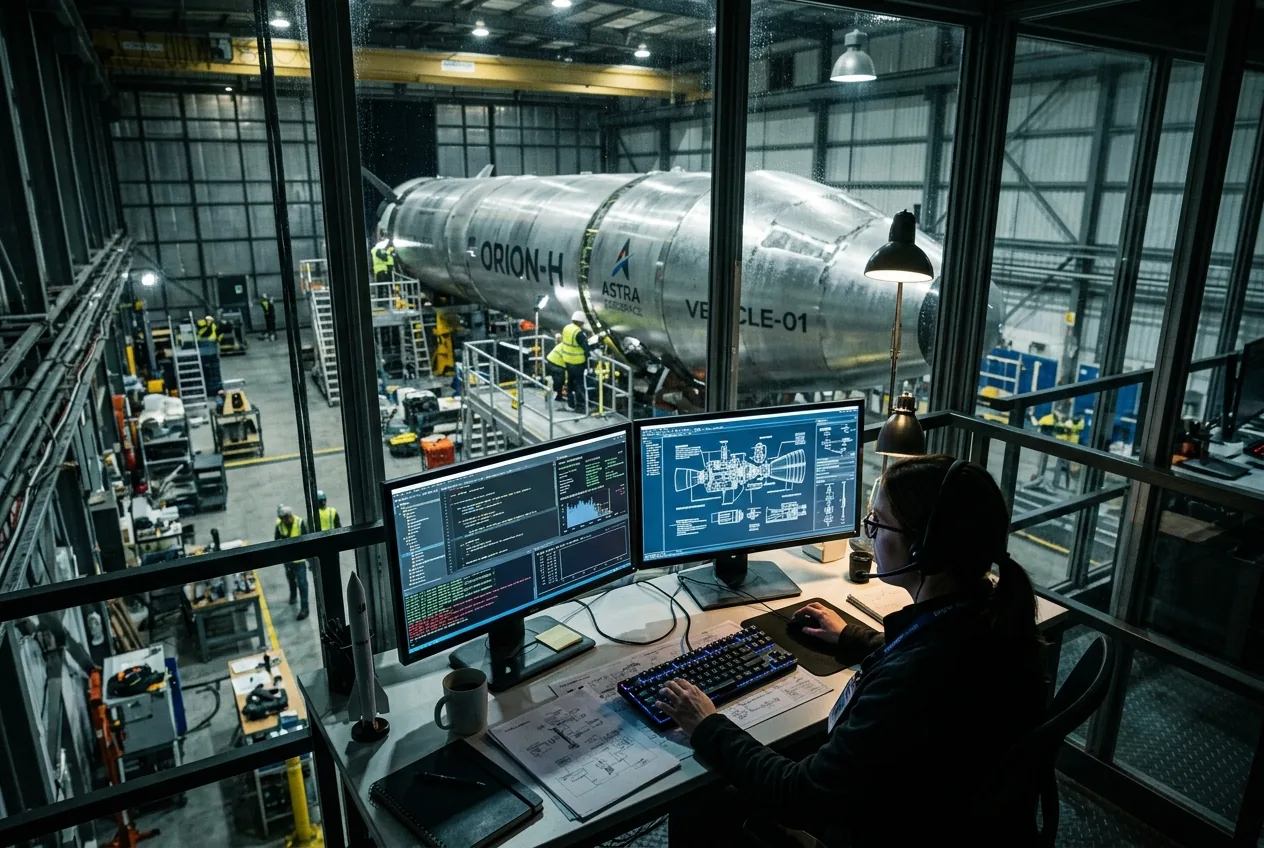
A sudden wave of speculation swept through the technology sector following reports suggesting that SpaceX had brokered an eye-watering $60 billion acquisition of Cursor, the breakout artificial intelligence code editor developed by San Francisco-based startup Anysphere. To anyone operating at the intersection of heavy industry, software development, and aerospace engineering, the headline figure does not simply raise eyebrows; it shatters every grounded framework of corporate valuation, capital allocation, and embedded systems architecture. While generative software tools are undeniably transforming developer productivity across Silicon Valley, attributing a megadeal valuation on par with the largest corporate acquisitions in tech history to an AI-assisted code editor reveals a deep misunderstanding of how spaceflight hardware and software are actually built.
The Staggering Arithmetic of a Market Anomaly
A $60 billion transaction would put the acquisition in the rarified territory of Microsoft’s $68.7 billion purchase of Activision Blizzard or Broadcom’s $61 billion absorption of VMware. SpaceX, whose own valuation hovers between $200 billion and $250 billion in secondary market tender offers, would essentially be staking nearly a quarter to a third of its entire enterprise value on an external developer tool. For an aerospace manufacturer that notoriously guards its cash to fund orbital infrastructure, capital-intensive Starship test campaigns, and global Starlink deployment, spending tens of billions on a desktop developer application defies every tenet of Elon Musk’s established capital playbook.
The genesis of this viral figure points toward an acute conflation of distinct entities within Musk’s broader industrial ecosystem. Between xAI raising capital at valuations exceeding $45 billion, SpaceX issuing internal tender offers to facilitate employee liquidity, and speculative commentary from aggregate tech platforms like Dataconomy, market chatter frequently blends these figures into sensationalized narratives. When private company funding milestones and speculative corporate partnerships are filtered through online echo chambers, the distinction between industrial strategic intent and financial fiction rapidly dissolves.
The Reality of Aerospace Flight Software
Beyond the balance sheet, the operational premise of a rocket company purchasing a developer-facing text editor collapses when examined under the strict engineering constraints of spaceflight. SpaceX does not build consumer web applications; it engineers mission-critical, hard real-time autonomous systems. The flight computers running aboard Falcon 9, Dragon, and Starship operate on stripped-down, highly customized operating systems driving C and C++ binaries, designed with triple-redundant voting architectures that prioritize deterministic execution over probabilistic inference.
In high-rel aerospace environments, code must be formally verified, mathematically deterministic, and tested relentlessly across hardware-in-the-loop test benches. Generative language models—the foundational technology powering Cursor’s predictive completions—are inherently non-deterministic. An LLM excels at pattern matching across syntax, boilerplate generation, and scaffolding cloud microservices, but it cannot guarantee the absence of memory race conditions or subtle arithmetic overflows in an active orbital thruster control loop.
SpaceX software engineers already leverage best-of-breed development tools, internal automation suites, and custom compilers tailored directly to their proprietary hardware interfaces. Integrating an AI coding tool into an engineering pipeline requires nothing more than an enterprise software license or an internally hosted API gateway to ensure proprietary intellectual property never leaks outside the corporate perimeter. Acquiring the software’s parent company for the GDP of a mid-sized nation would yield negligible engineering advantages over simply deploying local LLM instances inside SpaceX’s secure Hawthorne network.
The Synergies and Limits of the xAI Ecosystem
However, when xAI requires deeper coding capabilities, its operational trajectory points toward training in-house frontier reasoning models, not purchasing an application-layer interface company. Cursor relies heavily on underlying model APIs from external providers, particularly Anthropic’s Claude and OpenAI’s GPT architectures, wrapped in proprietary context-retrieval and indexing engines. For a compute-first entity like xAI, owning the user interface of an editor is secondary to mastering the core weights, synthetic data generation pipelines, and post-training alignment that allow a neural network to reason through complex mathematical and software problems.
If Musk’s ecosystem intended to allocate $60 billion toward software infrastructure, that capital would inevitably flow into physical silicon, high-bandwidth electrical substations, advanced thermal cooling loops, and the relentless acquisition of talent to scale raw training compute. An enterprise software tool that functions as an abstraction layer over someone else’s model endpoints represents the antithesis of the vertical integration strategy that made SpaceX and Tesla industrial leaders.
Capital Allocation in the Starship Era
To understand why industrial leaders view this acquisition rumor with extreme skepticism, one must look at the physical realities playing out on the launch pads of Starbase, Texas, and Cape Canaveral, Florida. SpaceX is currently engaged in the most capital-intensive phase of its corporate existence. Developing Starship into a fully reusable, rapid-cadence orbital transportation system demands massive ongoing investments in factory automation, automated cryogenic steel fabrication, and the serial production of Raptor 3 engines.
Simultaneously, the deployment of Starlink Direct-to-Cell capabilities requires manufacturing thousands of increasingly sophisticated satellites, each carrying specialized phased-array antennas and high-power radio frequency payloads. Every dollar of capital deployed by SpaceX is rigorously measured against its contribution to payload mass-to-orbit, launch cadence, and cash-flow generation. Committing financial resources anywhere near the reported $60 billion threshold to an asset disconnected from launch infrastructure or orbital mechanics would directly undermine the company’s primary industrial mandates.
Furthermore, defense contracts and NASA missions impose strict regulatory oversight on SpaceX’s corporate structure and cybersecurity frameworks. Programs under the National Security Space Launch umbrella require rigorous supply chain provenance and strict controls against unauthorized foreign or external dependencies. Diluting management attention and corporate balance sheets with unrelated consumer-grade software tools would trigger unnecessary regulatory scrutiny without offering any operational edge to the Artemis lunar program or Department of Defense orbital transfers.
Separating Industrial Substance from Market Euphoria
The rumor that SpaceX is striking a $60 billion transaction to consume Cursor serves as a prime case study in the speculative frenzy defining the current AI investment cycle. In an environment where enterprise software metrics are frequently divorced from unit economics, sensational claims can rapidly achieve unearned legitimacy simply by invoking high-profile industrial figures and popular developer utilities.
Industrial manufacturing, advanced robotics, and space exploration will continue to absorb automated code generation at an accelerating rate. Software engineers building telemetry decoders and robotic assembly controllers will use AI-assisted tools to eliminate drudgery and write unit tests faster than ever before. But they will do so using enterprise SaaS tiers, private container deployments, and internally hosted models that respect intellectual property safeguards.
SpaceX remains, at its core, a hardware-driven transportation and aerospace manufacturing powerhouse that treats code as a vehicle to command physical machinery in the vacuum of space. While Cursor will undoubtedly continue its rapid evolution as one of the most capable programming interfaces on the market, the notion of it becoming a $60 billion cornerstone of humanity’s multiplanetary roadmap belongs squarely in the realm of financial fantasy.




Comments
No comments yet. Be the first!