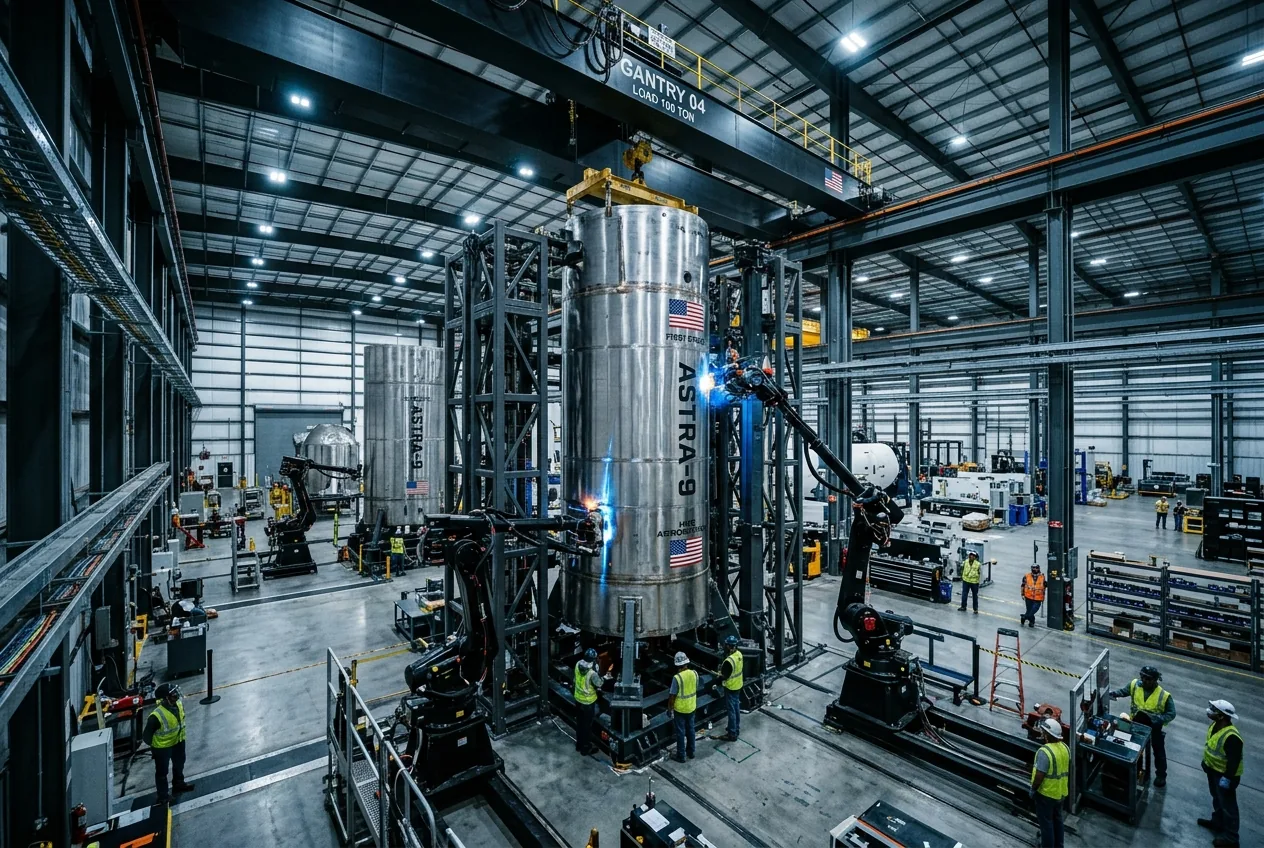
Every few quarters, financial desk chatter erupts with rumors that SpaceX is finally preparing a record-breaking initial public offering on the New York Stock Exchange. The speculation is understandable from the perspective of institutional fund managers eager to tap into commercial aerospace. SpaceX has captured a near-monopoly on Western orbital lift capability, deployed the world’s largest operational satellite constellation, and crossed private market valuations of $180 billion to over $210 billion through tender offers. Yet the reality inside the factory floor and the executive suite reveals an industrial architecture designed specifically to avoid the quarterly scrutiny of public equity markets.
The persistent buzz surrounding a potential public float—whether encompassing the entire launch provider or an anticipated spin-off of the Starlink satellite communications arm—collides directly with the mechanical and financial realities of high-cadence rocket engineering. Developing revolutionary aerospace infrastructure requires immense capital expenditure with long payback horizons, a tolerance for spectacular prototype failures, and an operational cadence that traditional public shareholders historically punish. Understanding why SpaceX continues to bypass the public markets requires examining the physics of its production lines, its balance sheet mechanics, and its symbiotic relationship with artificial intelligence infrastructure.
The Mechanics of Private Capital vs. Public Listings
Public equity markets exist primarily to provide liquidity, lower the cost of capital, and allow initial backers an orderly exit. SpaceX has systematically solved each of these challenges without filing an S-1 registration statement with the Securities and Exchange Commission. Rather than subjecting its proprietary manufacturing methods and launch economics to public disclosures, the company conducts bi-annual liquidity events via controlled secondary tender offers. These internal share buybacks and employee sales allow early investors and staff to liquidate equity at steadily climbing valuations, entirely driven by private institutional demand.
This closed-loop financial apparatus provides SpaceX with the best features of market capitalization without its typical operational handicaps. Institutional sovereign wealth funds, growth equity vehicles, and aerospace-focused family offices have demonstrated an almost limitless willingness to purchase secondary shares. Consequently, the company has no immediate functional need for a primary capital injection through a New York debut. The cost of complying with Sarbanes-Oxley reporting, maintaining extensive investor relations apparatuses, and telegraphing supply chain shifts to competitors would offer negligible economic upside.
Moreover, the launch business itself behaves far more like a heavy industrial manufacturing operation than a software-as-a-service enterprise. Revenue is tied directly to physical metal, cryogenic propellants, cleanroom assembly times, and pad turnaround schedules. Introducing public shareholders into the cadence of launch site turnarounds would inevitably create friction whenever experimental test articles explode on test stands in Boca Chica, Texas—events that SpaceX engineers view as productive data-gathering milestones rather than balance sheet catastrophes.
Industrial Automation and the Starlink Cash Engine
The core justification for any future public listing has always centered on Starlink, the low-Earth-orbit broadband network that represents SpaceX’s transition from a pure freight hauler to a global telecommunications utility. The capital required to manufacture, launch, and service tens of thousands of satellites is staggering. In its early phases, this constellation operated as a massive cash drain, consuming hundreds of millions of dollars in silicon, solar arrays, phased-array antennas, and Falcon 9 launch services.
However, the operational economics shifted as manufacturing automated. At its facilities near Seattle, Washington, SpaceX overhauled traditional aerospace satellite fabrication. Rather than hand-crafting bespoke satellites over multi-year cycles—the legacy defense contractor model—SpaceX adopted automotive-style progressive assembly lines. The company produces multiple satellites per day, driving down the unit cost of each spacecraft to a fraction of traditional aerospace hardware. Robotic component placement, automated thermal vacuum testing, and standardized bus architectures turned satellite production into a high-rate machining process.
Crucially, Starlink achieved positive operational cash flow without needing a spin-off IPO. The user terminal production line underwent a similar mechanical evolution. Early rectangular user terminals cost thousands of dollars to manufacture, forcing the company to subsidize customer hardware at a loss. Iterative mechanical redesigns simplified the internal printed circuit boards, streamlined the phased-array motor drive systems, and reduced component count, dropping the manufacturing cost below the retail price. With positive unit economics achieved internally, the urgency to carve out Starlink into a separate publicly traded entity on Wall Street evaporated.
The Engineering Reality of the Starship Crucible
At Starbase in Boca Chica, the industrial logic against a public offering becomes even clearer. Starship—the 120-meter-tall fully reusable launch system consisting of the Super Heavy booster and the Starship upper stage—is not being built like a traditional rocket. It is manufactured in open-air tents and massive vertical integration buildings using 304L stainless steel rolls, automated orbital welding rings, and iterative structural testing.
This manufacturing strategy relies on aggressive rapid prototyping. When an engineer changes the plumbing on the Raptor 3 engine, simplifying the regenerative cooling channels and eliminating external bolt-on sensors to integrate them directly into internal 3D-printed metal castings, the iteration happens in days rather than quarters. Raptor 3 represents a masterclass in design-for-manufacture: by eliminating external flanges, secondary wiring harnesses, and heat shields through integrated cast flow passages, the engine drops weight while drastically cutting assembly hours.
A publicly traded entity answering to consensus analyst estimates would face immense pressure to slow this operational tempo. Wall Street models reward predictable, incremental progress over high-variance breakthroughs. If SpaceX were forced to guide quarterly earnings while expending billions on stainless steel prototypes, launch tower catch mechanisms, and cryogenic tanker flight tests, executive attention would drift from rocketry to narrative management. The company’s privately held structure is its primary technical defense against conservative risk modeling.
Cross-Pollination Across the Deep-Tech Ecosystem
The structural autonomy of SpaceX also enables unprecedented cross-pollination with other high-capital frontier technology initiatives, most notably xAI. The computational demands of modern aerospace engineering have long outgrown basic computational fluid dynamics running on generic server farms. Designing engine combustion chambers, optimizing aerodynamic re-entry surfaces, and simulating multi-body orbital mechanics requires immense supercomputing capability.
The buildout of xAI’s massive Colossus compute cluster in Memphis, Tennessee—leveraging tens of thousands of liquid-cooled graphics processing units—signals a broader convergence across advanced hardware ecosystems. Industrial automation today is fundamentally an AI problem. High-rate rocket manufacturing, autonomous orbital rendezvous, satellite constellation traffic management, and optical inter-satellite laser routing all run on advanced algorithms that benefit directly from rapid developments in machine intelligence.
Because SpaceX remains private and founder-controlled, resource allocation, technical talent sharing, and operational alignment across launch systems, communications, and synthetic intelligence can occur without triggering shareholder lawsuits or regulatory cross-entity pricing disputes. This integrated operational philosophy treats hardware, communications, and compute as an interlocking industrial machine. Breaking pieces off to satisfy New York investment banking syndicates would introduce organizational friction without resolving any engineering bottlenecks.
The Long Horizon of Hardware Innovation
The financial markets will inevitably continue to price, model, and anticipate a public transaction for SpaceX. The sheer scale of its orbital monopoly—commanding more than 80 percent of total global payload mass launched to orbit in recent years—makes it one of the most commercially attractive entities of the 21st century. Institutional investors will keep watching for regulatory filings, listening for executive hints, and reacting to international market rumors.
Yet the physical reality of space industrialization tells a much more disciplined story. The goal of reaching industrial scale in orbital infrastructure, establishing permanent cis-lunar logistics, and building the factories capable of producing thousands of planetary transport vessels cannot be managed on a ninety-day balance sheet. For as long as private secondary markets provide continuous liquidity and Starlink cash flows fund Starship production rings, SpaceX will remain exactly where its engineers need it to be: shielded from Wall Street, anchored to the factory floor, and focused entirely on the physics of payload delivery.




Comments
No comments yet. Be the first!