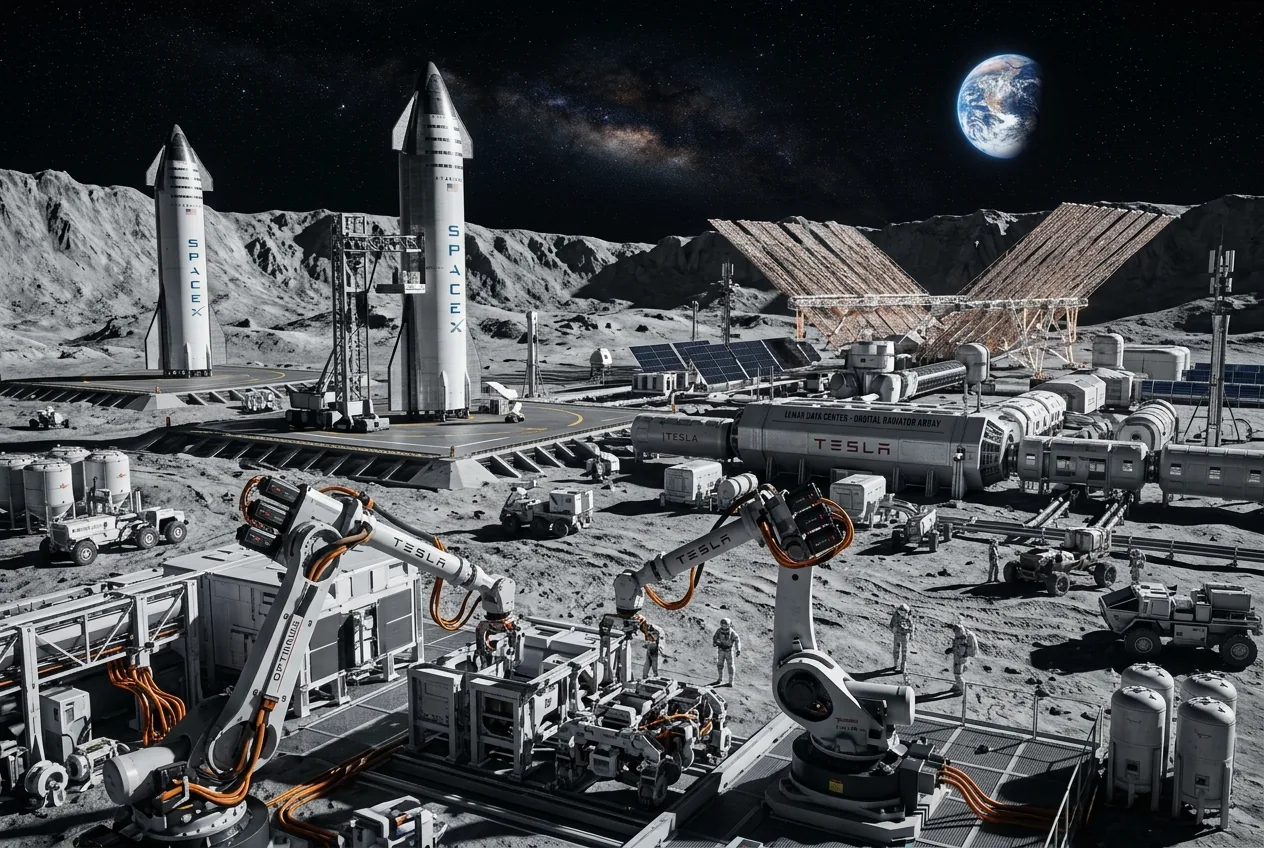
In the high-stakes theater of global industrial engineering, the lines between automotive manufacturing, aerospace deployment, and artificial intelligence are beginning to dissolve. Elon Musk, the chief architect of this convergence, is reportedly weighing a massive structural consolidation involving Tesla, SpaceX, and his AI startup, xAI. This potential merger comes at a critical juncture, occurring just weeks before what is anticipated to be the largest Initial Public Offering (IPO) in history. With SpaceX targeting a valuation that could soar as high as $2 trillion, the maneuver represents a calculated shift from a collection of independent ventures toward a unified, vertically integrated empire capable of monopolizing the next industrial frontier.
The Industrial Logic of the Moon Pivot
To prepare for a public market debut, SpaceX has undergone a strategic pivot that prioritizes economic viability over long-term exploratory idealism. While Mars has been the ideological north star for the company since its inception, the immediate focus has shifted toward the Moon. Musk recently confirmed that SpaceX is prioritizing a “self-growing city” on the lunar surface, citing that such a project can be achieved in less than half the time required for a Mars colony. From a mechanical engineering perspective, the Moon offers a less hostile testing ground for modular habitat construction and resource extraction, providing a closer proximity for supply chain management and technical oversight.
This shift is not merely a change in destination; it is a tactical reconfiguration of SpaceX’s revenue model to satisfy institutional investors. A lunar presence allows for the development of orbital data centers and satellite assembly plants that can generate cash flow in the near term. By positioning the Moon as an industrial base, SpaceX transitions from a high-risk exploration company to a critical infrastructure provider for the burgeoning space economy. This pivot provides the “airtight” narrative that investment banks require to market an offering of this magnitude, bridging the gap between science fiction and a viable balance sheet.
Integrating the Intelligence Layer with xAI
The reported merger is already well underway in the form of a $1.25 trillion agreement between SpaceX and xAI. This integration is the technical linchpin of Musk’s vision. Modern aerospace engineering is increasingly reliant on complex simulation and real-time optimization, areas where xAI’s Grok and other large-scale models provide a competitive edge. By folding xAI into the SpaceX framework, the company can automate mission control processes, optimize orbital mechanics in real-time, and manage the vast data streams generated by the Starlink constellation. This isn't just about software; it's about the intelligence layer that governs the hardware.
Tesla’s role in this consolidation is equally significant. The automotive giant recently announced a $2 billion investment in xAI, following its Q4 earnings beat. The synergy here is found in the cross-pollination of Autopilot and Full Self-Driving (FSD) codebases with SpaceX’s autonomous landing systems. The hardware commonality between Tesla’s Optimus robots and the automated systems required for lunar base construction suggests that Musk is building a singular technological stack. In this model, the robot that assembles a Model Y in Texas is effectively the same platform that will maintain a radiator on a lunar data center.
Economic Friction and the SEC Challenge
The scale of this proposed consolidation has not escaped the scrutiny of regulators and organized labor. The American Federation of Teachers, a union representing nearly 2 million members with significant pension fund interests, has recently urged the Securities and Exchange Commission (SEC) to apply “extraordinary scrutiny” to the SpaceX IPO. Their concern centers on the “overvalued, high-risk” nature of the $1.75 trillion to $2 trillion valuation target. Critics argue that the interlocking ownership structures between Musk’s various companies create significant risks regarding corporate governance and the potential for one entity to bail out another at the expense of public shareholders.
From an analytical standpoint, the valuation of SpaceX relies heavily on the projected success of Starlink and the untapped market for orbital services. While the company currently dominates the launch market, maintaining a $2 trillion valuation requires an unprecedented level of sustained growth and market capture. The SEC will likely investigate whether the private valuations assigned to xAI and SpaceX are based on fundamental revenue potential or are inflated by the “ecosystem effect” of Musk’s interconnected portfolio. For investors, the risk lies in the lack of transparency typically associated with private aerospace ventures now transitioning into the public eye.
Orbital Data Centers: The Missing Link in Revenue
One of the most compelling technical arguments for the merger is the development of orbital data centers. Musk has spoken frequently about using the Moon as a base for assembling large-scale radiators and solar arrays needed to power high-density compute clusters in space. Standard terrestrial data centers face immense cooling and energy costs; in the vacuum of space, while heat dissipation is a challenge that requires massive radiator surface areas, the access to constant, unfiltered solar energy is a massive advantage. This creates a direct link between xAI’s compute needs and SpaceX’s deployment capabilities.
If SpaceX can successfully deploy data centers in orbit, it would provide a unique value proposition for global AI companies that require massive compute power with minimal latency to Starlink-connected regions. This infrastructure would be built using Tesla’s expertise in thermal management and battery storage, further justifying a unified corporate structure. The technical specifications for these orbital clusters involve hardened electronics capable of withstanding cosmic radiation, a field where SpaceX is already the world leader. By combining these capabilities, Musk is essentially building a vertically integrated compute and delivery platform that spans from the Earth's surface to the lunar orbit.
Is a Multi-Trillion Dollar Conglomerate Sustainable?
The primary question facing Wall Street is whether a single entity can successfully manage the disparate risks of automotive manufacturing, artificial intelligence, and space exploration. Each of these industries operates on different timelines and capital expenditure cycles. Tesla is a high-volume manufacturing play; SpaceX is a high-CAPEX infrastructure play; xAI is a high-growth software play. Synthesizing them into one corporate entity could create a “too big to fail” scenario that might frighten more conservative institutional investors who prefer pure-play exposures.
However, Musk’s argument hinges on the idea that these are no longer separate industries. In his view, a car is a robot on wheels, a Starship is a robot that flies, and xAI is the brain that drives both. If the hardware becomes standardized and the software becomes universal, the efficiency gains from a merger could be astronomical. By consolidating now, Musk seeks to lock in a valuation that reflects the total addressable market of the entire human frontier, rather than just the sum of its parts. Whether the SEC and the public markets will accept this vision remains the trillion-dollar gamble of the decade.
As the June IPO date approaches, the financial world will be watching for more concrete filings regarding the SpaceX-Tesla-xAI link. If the merger proceeds, it will redefine the modern corporation, moving away from the conglomerate models of the 20th century toward a more integrated, technology-driven structure. For Noah Brooks and the team at Apollo Thirteen, the focus remains on the hardware: how these machines will be built, how they will be powered, and how they will fundamentally alter the mechanics of global industry.




Comments
No comments yet. Be the first!