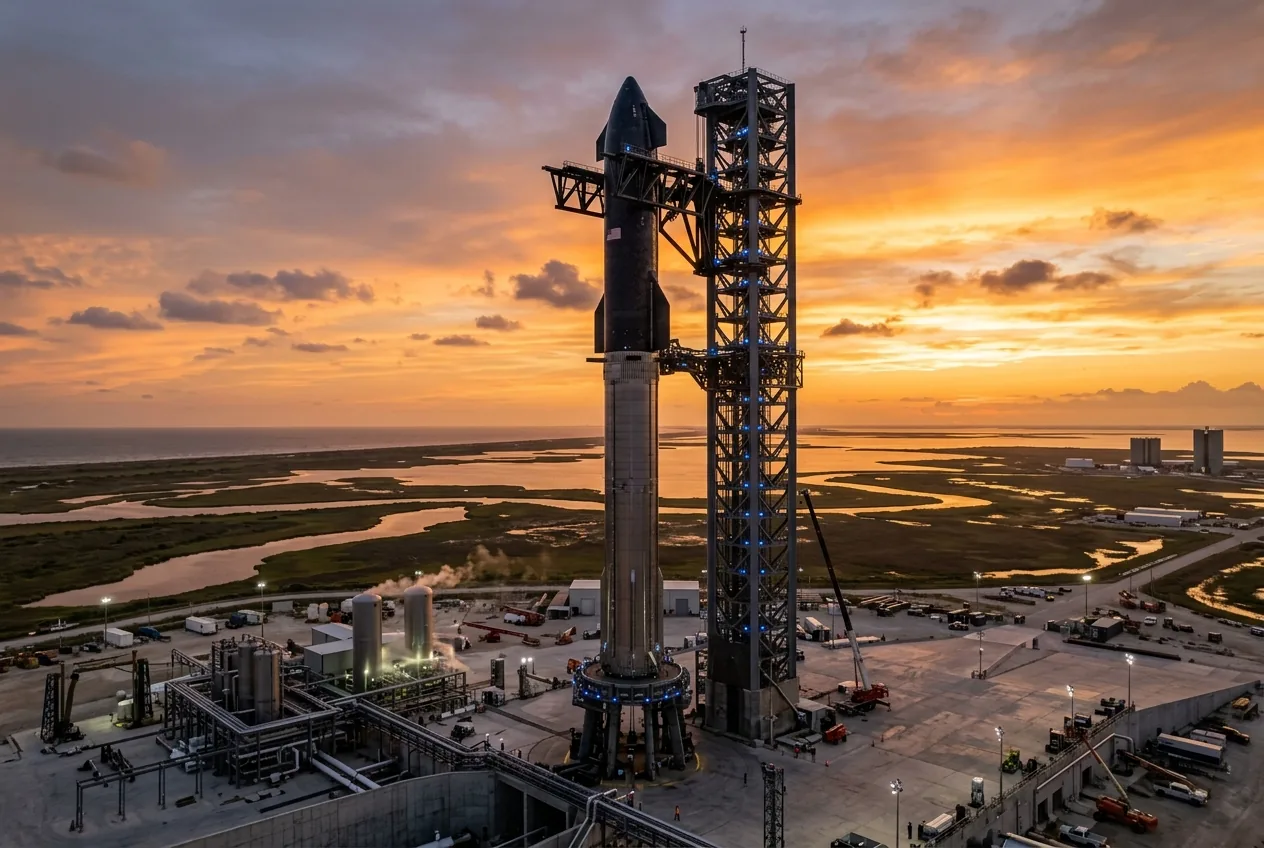
The long-rumored transition of SpaceX from a private aerospace disruptor to a public market titan has finally arrived. With the formal filing of its S-1 documentation and a set IPO price of $135 per share, the company is poised to execute the largest initial public offering in financial history. For those of us tracking the intersection of mechanical engineering and industrial scaling, this isn't just a financial milestone; it is the debut of the first true vertically integrated orbital infrastructure company on the public stage.
While the $135 price tag and the resulting trillion-dollar-plus valuation will dominate headlines, the real story lies within the granular data of the S-1 financials. For years, SpaceX has operated behind a veil of private capital, allowing it to take monumental risks on reusability and heavy-lift architectures. The public filing now lays bare the unit economics of the Falcon 9, the burgeoning profitability of Starlink, and the massive capital expenditure (CapEx) sink that is the Starship development program. As an industrial observer, the question isn’t whether the stock is a good buy, but whether the engineering pipeline can sustain the growth projected in these documents.
The Revenue Engine: Starlink’s Transition from Beta to Backbone
The most striking revelation in the S-1 is the sheer scale of Starlink’s contribution to the bottom line. No longer an experimental auxiliary service, the satellite constellation has become SpaceX’s primary revenue driver, effectively subsidizing the more ambitious launch goals. The financials indicate that Starlink’s gross margins have surpassed 60%, a figure that rivals high-end software-as-a-service (SaaS) companies rather than traditional telecommunications utilities.
This margin is achieved through a combination of aggressive vertical integration and the plummeting cost of mass-to-orbit. Because SpaceX owns the launch vehicle, their internal cost for deploying a bus of 22 Starlink V2 Mini satellites is estimated to be 40-50% lower than any competitor using external launch providers. This creates a feedback loop: high-margin data services fund the very rockets that lower the cost of deploying more data-providing assets. For industrial users, particularly those in remote mining, maritime logistics, and global supply chain management, Starlink has moved from a convenience to a critical piece of infrastructure.
Can Starship’s Industrial Utility Justify the Massive CapEx?
If Starlink is the cash cow, Starship is the ambitious project that requires every cent of that cash and more. The S-1 reveals that SpaceX has spent upwards of $5 billion annually on the Starship program at Starbase, Texas. To a traditional analyst, this looks like a bottomless pit; to a mechanical engineer, it represents the construction of the world’s first truly reusable industrial heavy-lifter.
The financials confirm that the path to profitability for the Starship platform depends entirely on its 'rapid reusability' metric. Unlike the Falcon 9, which requires weeks of refurbishment and a sea-based landing, Starship is designed for a 'launch-catch-launch' cycle that targets a 24-hour turnaround. The S-1 projections assume that by 2028, the cost per kilogram to LEO will drop below $100. If achieved, this fundamentally changes the physics of global industry. It makes orbital manufacturing—specifically for high-purity semiconductors and specialized pharmaceuticals—economically viable for the first time.
We see in the S-1 a strategic pivot toward 'Orbital Logistics' as a dedicated business unit. This isn't just about putting satellites up; it’s about the ability to move massive payloads between orbits or even point-to-point on Earth. The document outlines a vision where a Starship derivative could deliver 100 tons of industrial equipment to any point on the globe in under an hour. The technical specs for the 'Chopstick' catch system and the heat-shield tiling reliability are the key variables here. If the engineering fails to achieve 99% reliability, the IPO valuation could see significant volatility.
The xAI Synergy: Compute, Connectivity, and the ‘God-View’
It is no coincidence that this IPO is being analyzed through the lens of xAI and the broader artificial intelligence ecosystem. The S-1 financials include several 'Related Party Agreements' that hint at a deep, symbiotic relationship between SpaceX and Musk’s AI venture. The core of this synergy is data and compute. Modern AI models, particularly those designed for physical-world robotics and autonomous systems, require massive amounts of real-time telemetry from across the globe.
For the investor, this means SpaceX is being priced as more than a launch company. It is being priced as the physical layer of the AI revolution. If xAI succeeds in developing 'General Purpose Robotics' (via the Tesla Optimus link or other industrial hardware), those robots will likely communicate via the SpaceX network. The IPO at $135 reflects a market bet on this integrated future where aerospace, AI, and robotics converge into a single industrial stack.
Economic Viability: The Risk of the Launch Cadence
Every IPO has its 'Risk Factors' section, and the SpaceX S-1 is no exception. The most pressing technical risk is the required launch cadence. To hit the revenue targets set for 2027 and beyond, SpaceX must maintain a launch frequency of approximately one flight every 48 hours. This places immense strain on the mechanical integrity of the launch pads, the supply chain for liquid oxygen and methane, and the workforce at the Cape and Starbase.
From a pragmatic engineering perspective, the margin for error is razor-thin. A single catastrophic failure on the pad could ground the fleet for months, hemorrhaging cash and delaying the deployment of the Starlink Gen3 constellation. The S-1 acknowledges this, noting that 'achieving the flight rates necessary for our valuation requires unprecedented advancements in automated ground support systems and vehicle health monitoring.' In other words, SpaceX needs to automate the launch process as much as they have automated the rockets themselves.
There is also the matter of the 'Kessler Syndrome'—the risk that a collision in LEO could create a debris field that renders certain orbits unusable. The S-1 financials detail a significant investment in autonomous collision avoidance software and de-orbiting protocols for defunct satellites. These aren't just safety features; they are essential for the long-term economic viability of the company’s most profitable asset. If the orbital environment becomes too cluttered, the insurance premiums alone could devastate Starlink’s margins.
Is the $135 Price Tag Justified?
When you strip away the hype, is SpaceX worth $135 per share? Based on the S-1, the answer depends on your time horizon and your belief in the scalability of reusability. If you view SpaceX as a traditional satellite provider, the price is exorbitant. If you view it as the sole provider of the infrastructure that enables orbital manufacturing, global high-speed AI connectivity, and rapid intercontinental logistics, the price may actually be conservative.
The financials show a company that has successfully moved past the 'proof of concept' stage. They have a working revenue model (Starlink) that is already profitable on an EBITDA basis. They have a dominant market share in the global launch industry, with nearly 80% of all commercial mass-to-orbit currently flying on Falcon vehicles. The S-1 makes it clear: SpaceX is the only entity, government or private, that currently possesses the hardware and the operational experience to build a space-based economy.
The integration with xAI adds a layer of 'optionality' that is hard to quantify. If the future of industry is autonomous and data-driven, then the company that controls the network and the transport layer for that data holds a powerful position. The $135 IPO is the market’s first opportunity to put a definitive value on that position. For those of us in the engineering and tech sectors, the focus will remain on the 'how'—how the hardware performs, how the cadence holds up, and how the S-1's boldest technical claims translate into real-world industrial utility.




Comments
No comments yet. Be the first!