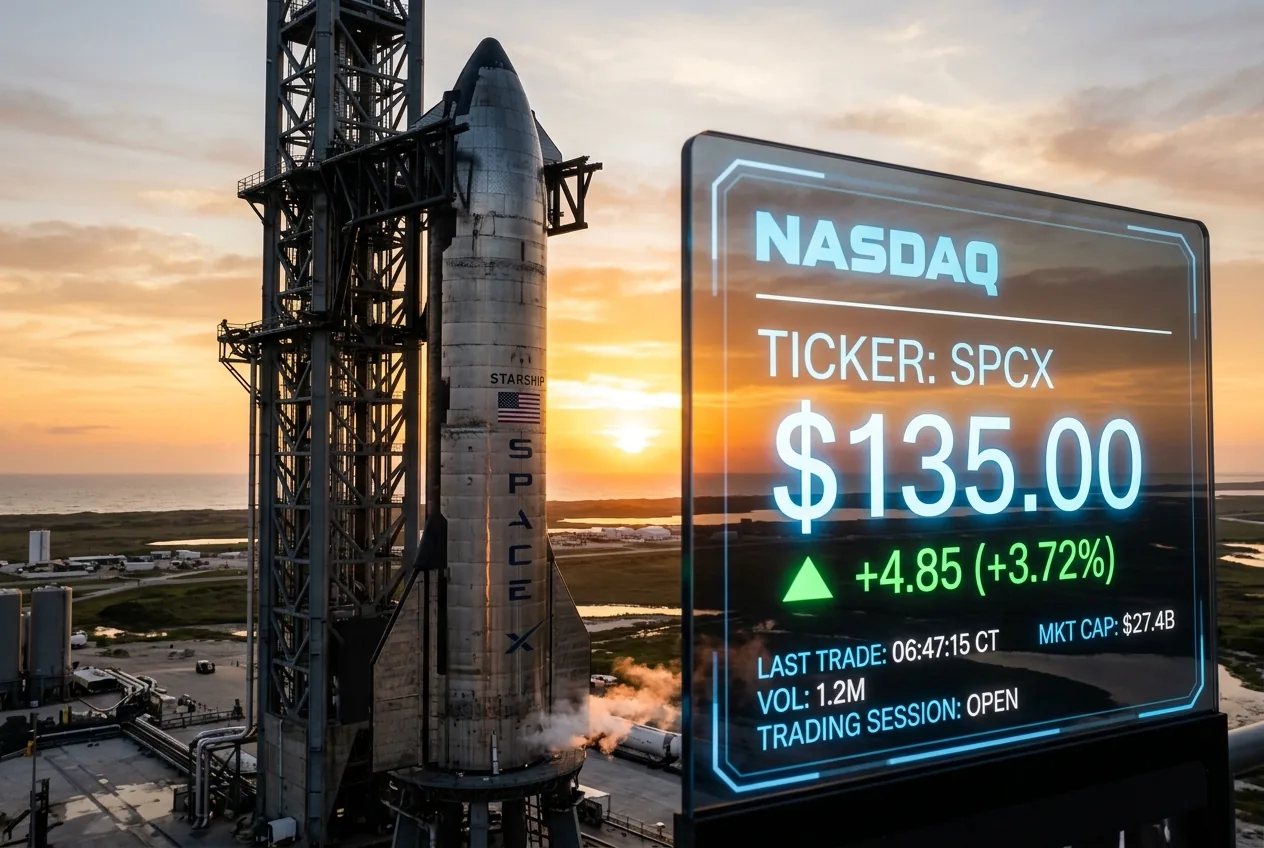
In a move that fundamentally recalibrates the intersection of aerospace engineering and global finance, SpaceX has officially priced its initial public offering at $135 per share. Trading is set to begin on the Nasdaq under the ticker symbol SPCX, signaling the arrival of the world’s most valuable private industrial entity into the public markets. With a total valuation of $1.75 trillion and a targeted raise of $75 billion, this listing stands as the largest IPO in history, eclipsing previous records held by state-owned energy giants and tech conglomerates alike.
As a mechanical engineer who has tracked the iterative development of the Falcon 9 and the gargantuan Starship program, I find the pricing reflects more than just investor enthusiasm. It is a valuation of a vertically integrated industrial ecosystem. This is no longer just a launch company; it is a conglomerate that manages the world’s largest satellite constellation and, following a strategic merger in February, one of the most resource-intensive artificial intelligence firms in existence: xAI. The $135 price point represents a calculated bet on the synergy between orbital infrastructure and generative intelligence.
The Mechanics of a $1.75 Trillion Listing
Starlink as the Foundation of Liquidity
While the rockets provide the brand recognition, Starlink provides the cash flow that justifies this IPO. The company recently reported $11.4 billion in annual revenue from its satellite internet division, supported by 10.3 million subscribers across 155 countries. This is a staggering achievement in telecommunications infrastructure. Unlike traditional terrestrial fiber optics, which require massive localized labor and right-of-way permissions, Starlink’s infrastructure is global by design and largely automated in its orbital maintenance.
The subscriber growth suggests that Starlink has moved past the early-adopter phase and is now a critical utility for maritime, aviation, and rural enterprise sectors. For investors looking at the SPCX ticker, Starlink represents the predictable, recurring revenue stream that offsets the high-risk nature of the Starship development program. The technical maturity of the V2 Mini and V3 Starlink satellites, which offer increased bandwidth and direct-to-cell capabilities, ensures that the company remains years ahead of competitors like Amazon’s Project Kuiper or the European IRIS² initiative.
The Strategic Logic of the xAI Integration
The most debated aspect of this public debut is the inclusion of xAI, which merged into the SpaceX corporate structure earlier this year. The combined entity is currently burning approximately $2.5 billion every quarter—a figure that would be unsustainable for almost any other firm. However, the technical logic behind the merger is centered on data and compute. High-speed, low-latency data transmission via Starlink provides the global nervous system for AI inference, while SpaceX’s advanced manufacturing facilities offer the perfect testbed for AI-driven robotics and autonomous systems.
Retail Participation and Market Stability
One of the most unusual features of the SPCX IPO is the reservation of 30% of shares specifically for retail investors. This is the highest allocation for the general public in the history of major listings. Typically, institutional investors—pension funds, hedge funds, and private equity—soak up the vast majority of an IPO’s float, leaving the public to buy in at a markup once trading begins. By prioritizing retail, SpaceX is attempting to foster a base of long-term 'believer' shareholders rather than high-frequency traders.
However, this strategy carries inherent risks. A high concentration of retail ownership often leads to increased volatility, as individual investors may be more prone to sentiment-driven selling during technical setbacks or launch failures. For those watching the Nasdaq on Friday morning, the opening price action will be a referendum on whether the public can stomach the $2.5 billion quarterly burn rate. Institutional players have already locked in their positions, meaning the 'true' market price will be discovered in the friction between these large holders and the 30% retail block.
Managing the Capital Burn of Frontier AI
The $2.5 billion quarterly loss attributed to xAI is the primary friction point in an otherwise stellar balance sheet. In the world of mechanical and systems engineering, such a burn rate is usually reserved for the construction of massive physical assets like gigafactories or nuclear plants. In this case, the capital is being liquidated into compute cycles and human talent. The question for the market is how long SpaceX can maintain this expenditure before the xAI products begin to contribute to the bottom line.
The path to profitability for xAI likely lies in the automation of the broader SpaceX supply chain. If the AI can optimize the welding schedules, thermal protection system (TPS) installations, and logistics for a fleet of reusable rockets, the operational savings could be in the billions. Furthermore, the integration of AI into the Starlink ground stations could significantly increase the network's efficiency, allowing more users to be served per satellite without increasing the physical constellation size. This internal utility is what differentiates the SpaceX-xAI merger from a purely speculative software play.
As trading commences, the industrial world will be watching to see if SpaceX can maintain its valuation in the face of public disclosure requirements. Moving from a private, closely-held firm to a $1.75 trillion public entity requires a shift in transparency that many aerospace companies find stifling. However, if the technical milestones of the Starship program continue to be met, and if Starlink’s subscriber base continues its vertical climb, the $135 entry price may eventually be viewed as a baseline for the dawn of the true space economy. The mission has always been to make life multi-planetary; on Friday, that mission officially becomes a publicly traded commodity.




Comments
No comments yet. Be the first!