The aerospace industry has long operated on the margins of government defense contracts and slow-moving multi-decade development cycles. However, the recent trajectory of SpaceX—culminating in discussions of a valuation exceeding $1.75 trillion—marks a fundamental shift from exploration to high-volume industrialization. For those of us focused on the mechanical engineering and robotic automation sectors, this isn't just about rockets; it is about the establishment of a vertically integrated supply chain that spans the terrestrial and orbital planes. If the reported IPO filings and secondary market valuations are accurate, SpaceX is no longer a launch provider; it is the central nervous system of a new industrial era.
To understand a valuation of this magnitude, one must look past the spectacle of a launch and examine the unit economics of the Starship architecture. The core of SpaceX’s dominance lies in the Raptor engine series, a masterpiece of metallurgical and mechanical engineering. By utilizing liquid methane and liquid oxygen (methalox), the Raptor engine achieves the high chamber pressures necessary for total reusability while minimizing the carbon coking that plagues kerosene-based engines like the Merlin. From an industrial standpoint, the transition to Raptor 3, which simplifies the plumbing and integrates more 3D-printed components, signifies a move toward mass production. When the factory at Starbase is capable of producing a ship a week, the cost-per-kilogram to orbit drops to a level that makes traditional satellite manufacturing look like a cottage industry.
The Convergence of xAI and Orbital Logistics
While the hardware is the muscle, the intelligence required to manage a constellation of tens of thousands of satellites and a fleet of reusable boosters requires a level of computational power that traditional software cannot provide. This is where the synergy with xAI becomes critical. In the context of the broader Musk ecosystem, xAI is being positioned as more than just a large language model provider. For SpaceX, the integration of xAI’s capabilities allows for real-time telemetry analysis and predictive maintenance schedules that are beyond human capability. When you are managing a constellation like Starlink, which already accounts for more than half of all active satellites in orbit, the logistical complexity is staggering.
The role of artificial intelligence in orbital mechanics is primarily one of collision avoidance and signal optimization. Using xAI-derived algorithms, SpaceX can automate the station-keeping of its Starlink fleet, ensuring that maneuvers are executed with minimal fuel expenditure. Furthermore, the industrial application of AI extends to the manufacturing floor. Robotic assembly lines at the Starlink factory in Bastrop, Texas, utilize vision systems and machine learning to identify defects in phased-array antennas at a speed that traditional quality control could never match. This integration of high-level AI into the physical manufacturing process is what justifies a trillion-dollar-plus valuation—it is the automation of the entire value chain.
Starship as an Industrial Platform
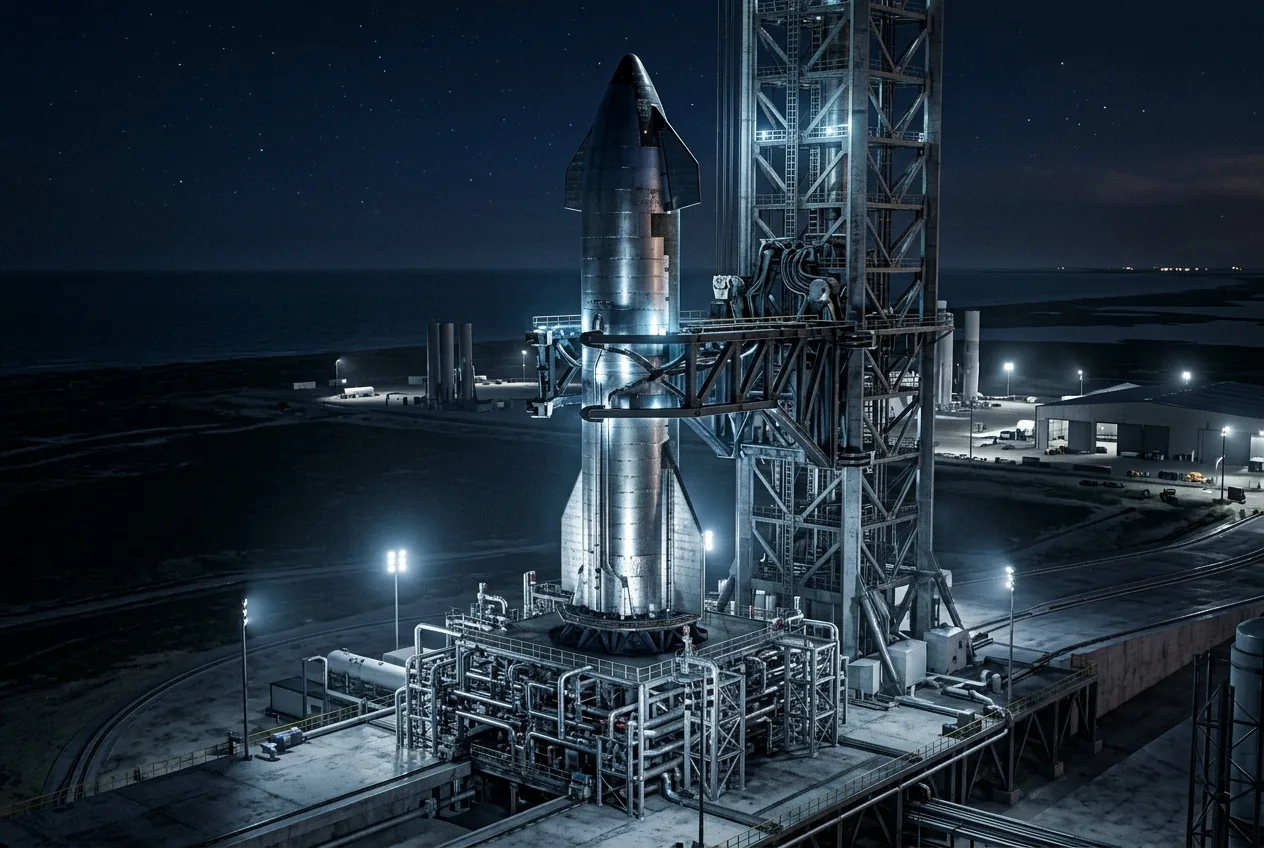
From a mechanical engineering perspective, the sheer scale of the Starship assembly—the 'Chopstick' arms on the launch tower known as Mechazilla—represents a leap in industrial automation. The ability to catch a 232-foot-tall Super Heavy booster mid-air removes the mass penalty of landing legs and allows for a rapid turnaround time. In a steady-state industrial environment, a booster could be refueled and reflown within hours. This 'gas station' model for orbital mechanics is the prerequisite for any multi-trillion dollar space economy. It turns launch into a commodity, much like shipping containers revolutionized global trade in the 20th century.
The Economic Moat of Vertical Integration
Challenges to the Trillion-Dollar Thesis
Is such a valuation sustainable? There are significant technical and regulatory hurdles that could dampen this industrial expansion. The primary mechanical challenge remains the reliability of the heat shield tiles on Starship. During high-velocity reentry, the plasma environment is unforgiving. If SpaceX cannot automate the inspection and repair of these thermal protection systems, the dream of 'airline-like' operations will remain out of reach. Furthermore, the environmental impact of frequent heavy-lift launches—specifically the deposition of soot and alumina in the upper atmosphere—will eventually face stricter regulatory scrutiny.
Additionally, the reliance on xAI and other automated systems introduces a 'black box' risk. As we move toward more autonomous orbital operations, the potential for algorithmic errors to cause catastrophic collisions in LEO (the Kessler Syndrome) becomes a non-zero probability. However, for the pragmatic engineer, these are not reasons to stop, but problems to be solved. The industrialization of space is a mechanical challenge first, and an economic one second. If SpaceX can maintain its lead in propulsion technology and structural efficiency, the valuation is not a reflection of what the company is today, but what the entire orbital economy will be worth tomorrow.
The Pivot Toward a Multi-Planetary Supply Chain
Finally, we must consider the long-term industrial goal: Mars. While often framed as a human-interest story, the colonization of Mars is, at its core, a logistics and manufacturing problem. It requires the transport of millions of tons of equipment across a vacuum. To do this, SpaceX is essentially building a trans-planetary supply chain. This involves orbital refueling, autonomous mining of Martian resources (In-Situ Resource Utilization, or ISRU), and the deployment of massive robotic colonies before a single human ever sets foot on the red planet.
This is where the valuation truly originates. If SpaceX becomes the sole provider of the logistics required for planetary expansion, it isn't just a company—it’s a sovereign-level infrastructure entity. The integration of xAI into this process ensures that the robotic precursors sent to Mars can operate with high degrees of autonomy, making decisions in real-time without the 20-minute light-speed delay of earth-based control. We are witnessing the birth of a new industrial vertical: orbital and extra-terrestrial manufacturing. Whether the valuation settles at $1.7 trillion or climbs higher, the mechanical reality is that the era of the expendable rocket is dead, and the era of the industrial spaceport has begun.




Comments
No comments yet. Be the first!