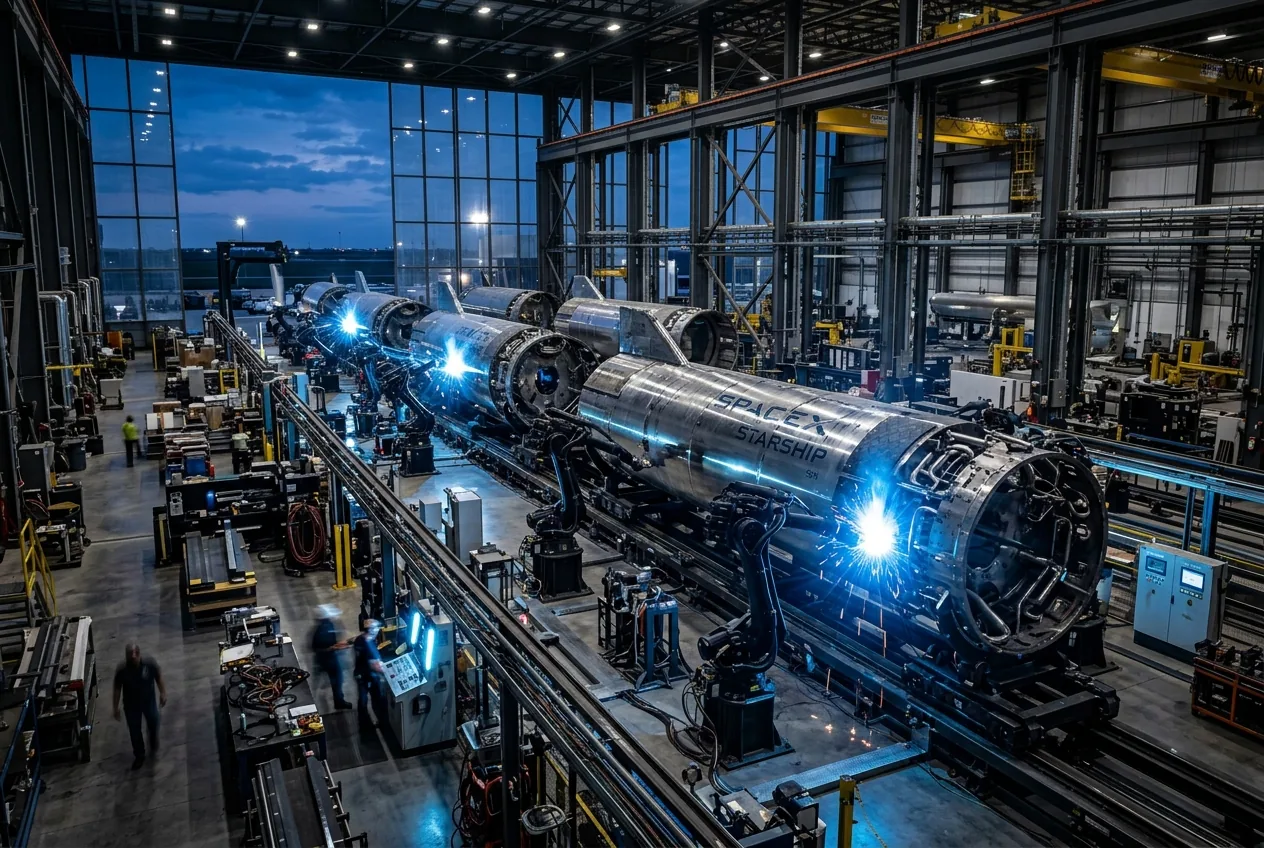
In the history of industrial finance, capital allocations of generational scale were once reserved for sovereign infrastructure projects, transcontinental railways, or wartime mobilization. When financial figures reaching the seventy-five-billion-dollar threshold enter the aerospace and deep-technology balance sheet, the narrative shifts from venture-backed speculation to industrial dominance. For Space Exploration Technologies Corp., securing or mobilizing capital of this unprecedented magnitude marks a structural inflection point. It is not merely a liquidity event or a headline valuation benchmark; it represents an aggressive capitalization of the physical means of orbital production.
The Astronomical Math Behind Orbital Industrialization
To contextualize the sheer weight of a seventy-five-billion-dollar capital event, one must contrast it against the historical benchmarks of public equity. When Saudi Aramco completed its record-shattering initial public offering in 2019, it raised just under thirty billion dollars to float a fractional percentage of the world's most lucrative state oil monopoly. Alibaba’s landmark 2014 listing raised twenty-five billion. An equity event commanding seventy-five billion dollars in incoming capital outstrips the combined initial raises of almost every major aerospace contractor in North America and Europe combined.
For years, SpaceX leadership maintained that the company would resist traditional public equity markets until its interplanetary transport architecture was executing regular, operational flights. The friction between quarterly public-market earnings pressures and high-risk hardware iteration cycles has historically broken deep-tech innovators. Yet, the convergence of Starlink’s massive positive operating cash flows, the capital-intensive scaling of the Starship program at Starbase, and the rapid technological integration with Elon Musk’s artificial intelligence venture, xAI, has radically altered that calculus. The capital requirements of next-generation physical infrastructure are simply too large for conventional private debt rounds and tender offers to sustain indefinitely.
Tooling the Starfactory for High-Rate Production
The true beneficiary of this monumental capital mobilization is not financial engineering, but physical hardware. At Boca Chica, Texas, SpaceX’s Starbase facility is transitioning from an experimental prototyping yard into an industrialized high-rate production center known as the Starfactory. Building a fully reusable, two-stage heavy-lift rocket capable of placing over one hundred metric tons into low Earth orbit requires manufacturing tolerances and automated assembly processes that have never before existed in aerospace.
A significant allocation of this capital directly targets the serial production of the Raptor 3 engine. Unlike earlier iterations that relied heavily on external sensor harnesses, complex tubing networks, and extensive bolt-on shielding, Raptor 3 integrates internal cooling circuits and secondary fluid paths directly into additively manufactured components. This design drastically reduces mass and simplifies assembly, but it shifts the manufacturing bottleneck onto capital-intensive precision machinery, high-throughput metal 3D printers, and specialized automated inspection cells. Achieving Musk’s stated goal of producing multiple Raptor engines per day requires an engine factory operating more like an automotive powertrain line than a bespoke rocketry shop.
Furthermore, launch infrastructure represents an immense capital sink that public capital markets rarely scrutinize with sufficient engineering rigor. Each orbital launch mount, propellant storage farm, and mechanical recovery system—the massive crane-like 'chopsticks' on the launch tower designed to catch the Super Heavy booster and Starship out of mid-air—demands hundreds of millions of dollars in cryogenic engineering, structural steel, and high-pressure fluid networks. Expanding this ground architecture across multiple pads at Starbase and Launch Complex 39A at the Kennedy Space Center requires uninterrupted, front-loaded capital deployment that only a massive financing event can comfortably guarantee.
Starlink as the Recurring Revenue Foundation
Institutional investors underwriting this historic financial scale are not doing so based solely on long-range visions of human settlements on Mars. The analytical bedrock of SpaceX’s commercial valuation rests squarely on Starlink, the low-Earth-orbit broadband megaconstellation that has effectively transformed the company from a launch provider into a global telecommunications utility. Starlink represents the recurring, high-margin software-adjacent revenue stream that justifies an astronomical balance sheet expansion.
The unit economics of Starlink depend on a continuous, aggressive launch cadence. As early generation satellites reach the end of their operational lifespan and de-orbit, they must be replenished with heavier, more capable units. The deployment of Starlink V2 satellites, equipped with larger phased-array antennas and direct-to-cell cellular transceivers, hinges entirely on the payload volume of Starship. Standard Falcon 9 fairings are physically incapable of accommodating the full aperture of these next-generation spacecraft, creating a strict mechanical dependency between SpaceX's satellite network profitability and Starship’s operational timeline.
At the satellite manufacturing plant in Bastrop, Texas, automated surface-mount assembly lines, precision robotic pick-and-place equipment, and automated optical inspection systems are producing thousands of user terminals and satellite bus components daily. Scaling this manufacturing throughput to satisfy millions of commercial, enterprise, maritime, and defense customers requires massive upfront supply chain capitalization. The infusion of fresh billions provides the inventory buffer and supplier leverage necessary to dominate terrestrial broadband bypass worldwide.
The Symbiotic Nexus with xAI and Orbital Compute
On the ground, xAI’s algorithmic architectures are increasingly integrated into the aerodynamic and mechanical design cycles at SpaceX. Computational fluid dynamics simulations for Starship's reentry dynamics—where the vehicle transitions through hypersonic, supersonic, and subsonic regimes while enduring plasma heating exceeding one thousand four hundred degrees Celsius—require immense processing power. Training neural networks to optimize trajectory paths, thermal protection tile geometries, and real-time autonomous recovery maneuvers turns raw computational power into tangible hardware safety margins.
Looking further into the decade, the intersection of massive capital, orbital payload capacity, and artificial intelligence points toward the realization of space-based compute infrastructure. Terrestrial data centers are rapidly approaching catastrophic bottlenecks in power generation, cooling water availability, and grid interconnect timelines. Starship’s target launch economics—aiming for launch costs below one hundred dollars per kilogram—theoretically open the door to deploying modular, solar-powered orbital compute nodes that reject heat directly into the spatial radiative heat sink, unconstrained by terrestrial real estate. By bridging the balance sheets of advanced rocketry and cutting-edge intelligence, SpaceX is actively positioning itself as the foundational logistics layer for the compute infrastructure of the coming century.
Consolidating an Industrial Monopoly
The macroeconomic fallout of this capital mobilization sends a clear signal across the global aerospace sector. Traditional aerospace conglomerates, anchored to bureaucratic supply chains and fractional government funding, are facing an insurmountable scale disadvantage. The capital barrier to entry in heavy-lift orbital mechanics and megaconstellation operations has officially grown too high for venture-backed startups to contest without severe dilution or insolvency.
SpaceX has achieved what industrial economists call self-reinforcing vertical velocity. Its launch cadence drives down internal satellite deployment costs; its satellite operations fund further launch vehicle iteration; and its unprecedented financial scale starves competitors of critical institutional capital. With balance sheet resources that rival mid-sized sovereign states, the company has insulated its factory floors from the traditional cycles of economic contraction, ensuring that the assembly lines in Boca Chica, Hawthorne, and Bastrop will continue to stamp out hardware regardless of terrestrial market conditions.




Comments
No comments yet. Be the first!