The Architectural Shift toward The Trinity
Wedbush analyst Dan Ives has highlighted that the framework for this merger began to solidify following SpaceX’s S-1 filing, which is poised to be the largest IPO in stock market history. The filing indicates that Musk will retain majority voting power and remain as CEO and CTO, ensuring that the unified company follows his long-term vision without the traditional friction of disparate boardrooms. This consolidation is likely to occur in 2027, following a stabilization period for the newly public SpaceX.
The SpaceX IPO: A $1.5 Trillion Catalyst
The sheer scale of the SpaceX IPO serves as the economic engine for this merger. With a potential valuation exceeding $1.5 trillion, SpaceX enters the public market as a peer to Tesla, rather than a subordinate subsidiary. This parity is crucial for a stock-for-stock merger that would not disproportionately dilute either side's shareholders. The S-1 filing lays out a staggering $28.5 trillion total addressable market (TAM), focusing heavily on space-enabled enterprise applications.
For industrial observers, the most interesting aspect of the filing is the emphasis on owning the “physical AI compute stack.” Unlike traditional software companies that rely on third-party data centers, the proposed Musk Trinity aims to build and control its own hardware from the silicon level up to the orbital level. This includes the deployment of V3 satellites scheduled for the second half of 2026, which are designed to function as edge computing nodes in space.
Building the Physical AI Compute Stack
To understand the necessity of this merger, one must look at the “physicality” of modern AI. High-performance computing requires three things: massive energy, high-speed data transfer, and sophisticated thermal management. Tesla excels at energy storage and thermal systems, developed through years of refining EV battery packs and the Dojo supercomputer. SpaceX excels at global data transfer and operating in the most extreme thermal environments known to man.
Furthermore, the manufacturing synergy cannot be ignored. Tesla’s expertise in high-volume production—specifically its work with large-scale aluminum die-casting and automated assembly lines—is increasingly relevant to SpaceX. As Starlink satellite production scales to thousands of units per year, the “Machine that builds the Machine” approach developed at Tesla’s Gigafactories becomes the blueprint for SpaceX’s satellite manufacturing facilities.
The Terafab: Where Robotics and Aerospace Converge
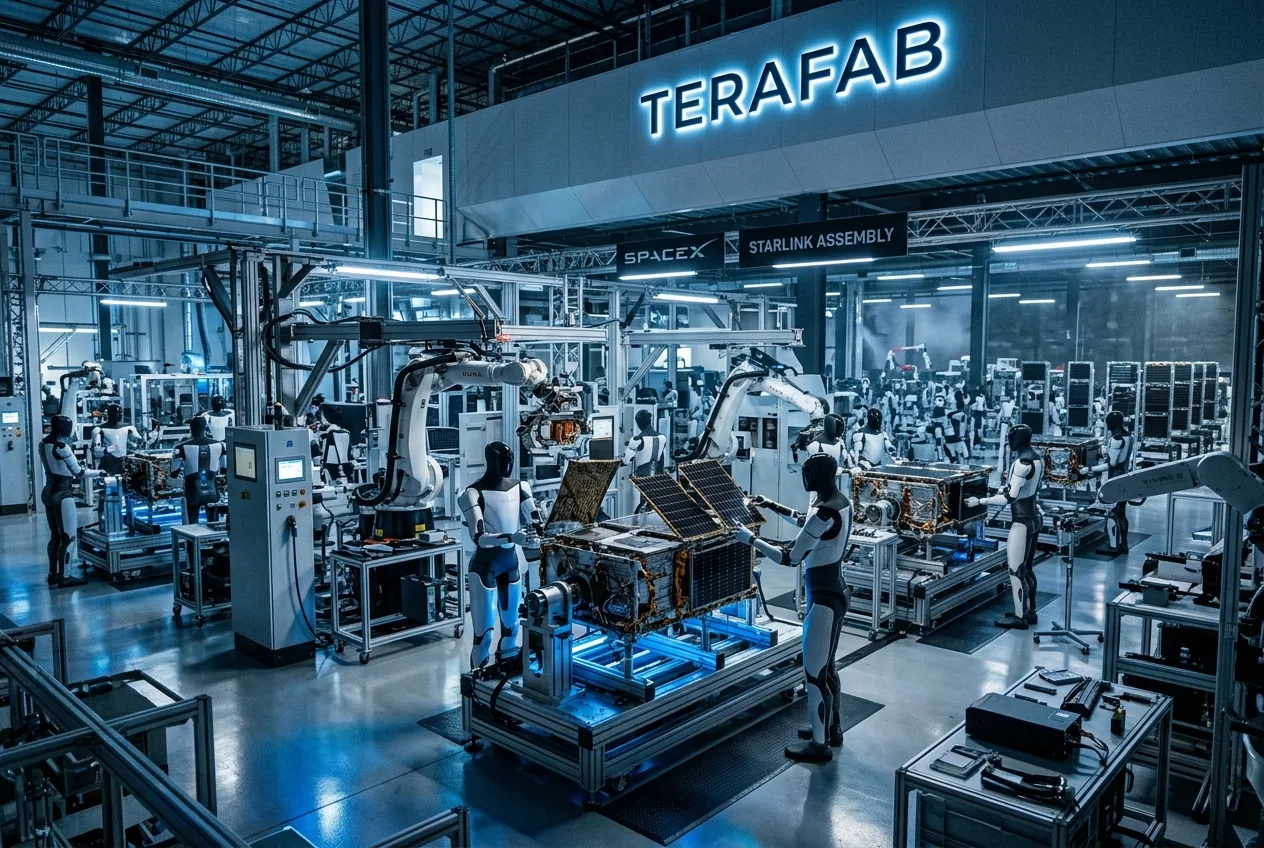
A tangible example of this convergence is the recently announced “Terafab” facility, a joint venture between Tesla and SpaceX. This facility represents a new class of industrial architecture, designed to produce both Tesla’s Optimus humanoid robots and SpaceX’s Starship components under one roof. The Terafab is the physical manifestation of the merger, utilizing shared supply chains for specialized alloys and high-performance electronics.
From a mechanical engineering standpoint, the Optimus project is perhaps the most significant bridge between the two companies. A robot designed to function in a Tesla factory is essentially the same mechanical platform needed for a lunar or Martian colony. By merging the companies, the development costs of Optimus can be amortized across both the automotive and aerospace sectors. The actuators, sensors, and neural networks developed for a robot walking on a factory floor in Texas are the exact same technologies required for a robot performing maintenance on a Starship in transit to Mars.
This cross-pollination of engineering talent is already happening. Engineers move between Tesla and SpaceX with regularity, but a formal merger would remove the legal and intellectual property barriers that currently slow down collaboration. It allows for a unified R&D budget focused on the fundamental challenges of robotics and AI, rather than managing the distinct interests of two separate sets of shareholders.
Financial Interconnectivity and Stakeholder Conflict
The path to this mega-merger is not without significant friction. Tesla shareholders have historically been sensitive to Musk’s “distractions,” and a merger with a capital-intensive rocket company could be seen as an additional risk. However, the narrative is shifting. As Tesla matures into an AI and robotics company, its valuation is increasingly tied to its software and intelligence capabilities rather than its car sales alone. In this context, SpaceX is not a distraction; it is the infrastructure that makes Tesla’s AI aspirations viable on a global scale.
Yet, the market seems to be pricing in the benefits. Tesla stock has shown resilience in the face of these merger reports, as investors begin to realize that a unified Musk entity would be the only company on Earth with a presence in the automotive, energy, aerospace, telecommunications, and AI sectors simultaneously. This level of diversification, paradoxically achieved through consolidation, creates a “too big to fail” technological fortress.
Is the $28.5 Trillion Addressable Market Realistic?
Critics point to the $28.5 trillion TAM mentioned in the SpaceX S-1 as an example of Musk’s characteristic hyperbole. To put that number in perspective, the entire global GDP is roughly $100 trillion. However, if one views the goal not just as “selling rockets” but as “owning the infrastructure of intelligence,” the number becomes more grounded. The enterprise application market for AI, global connectivity for the “internet of things,” and the transition to autonomous logistics are the pillars of the next industrial revolution.
If the merged entity can successfully deploy solar-powered AI compute satellites, it effectively becomes the world’s largest and most accessible cloud provider. Unlike Amazon or Microsoft, which are tethered to terrestrial power grids and fiber networks, a SpaceX-Tesla hybrid would own its power generation (Tesla Solar/Powerwall technology adapted for space) and its own transmission (Starlink). This is a level of vertical integration that the world hasn't seen since the era of Standard Oil, but with the added complexity of 21st-century robotics.
As we look toward 2027, the industrial world must prepare for the emergence of this titan. The merger of Tesla and SpaceX is not a mere corporate realignment; it is the construction of a new type of industrial machine—one that operates with equal facility on the factory floor and in the vacuum of space. For those of us in the mechanical engineering field, the technical possibilities are staggering. We are witnessing the birth of a unified platform that could define human industry for the rest of the century.




Comments
No comments yet. Be the first!