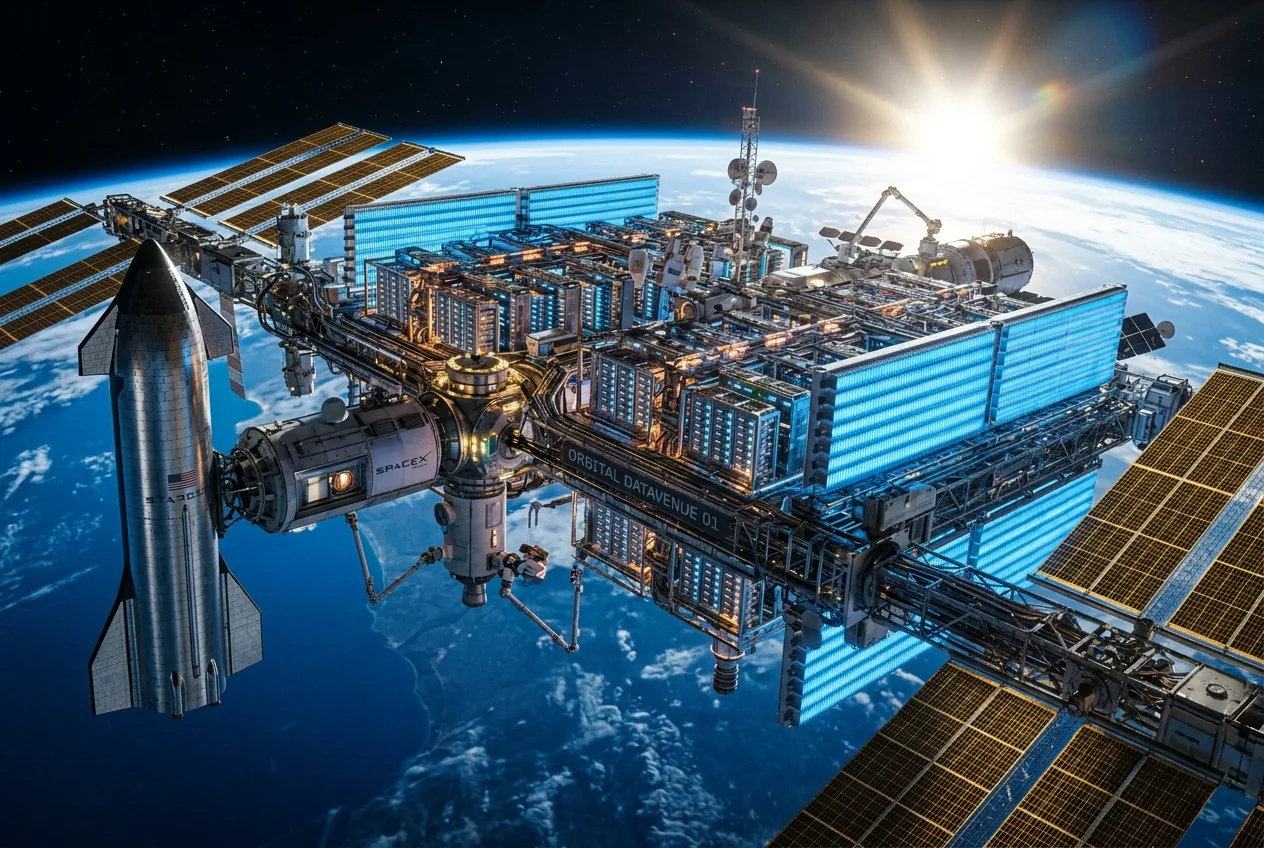
Elon Musk’s SpaceX is poised to redefine the public markets with a record-setting initial public offering (IPO) that signals a pivot from a pure-play aerospace firm to a vertically integrated artificial intelligence and infrastructure giant. According to sources familiar with the matter, the company plans to price its IPO at $135 per share, aiming to sell 555.6 million shares. The move is designed to raise a staggering $75 billion, which would represent the largest IPO in financial history, valuing the combined SpaceX and xAI entity at approximately $1.75 trillion.
This valuation is not merely a reflection of the company’s dominance in the launch market or its burgeoning Starlink satellite internet constellation. Instead, the $1.75 trillion figure is predicated on the successful integration of xAI, the artificial intelligence startup Musk founded and subsequently merged into SpaceX earlier this year. This merger, which valued xAI at $250 billion and the core SpaceX operations at $1 trillion at the time of the deal, creates a unique industrial powerhouse capable of deploying and maintaining massive compute resources in Earth’s orbit.
The Strategic Merger of Rockets and Reasoning
From a mechanical engineering perspective, the synergy is clear. Traditional data centers on Earth face significant bottlenecks regarding land acquisition, power grid stability, and water usage for cooling. By moving AI data centers into orbit, SpaceX intends to tap into the near-infinite supply of solar energy available above the atmosphere. However, the technical hurdles are immense. Operating high-density GPU clusters in a vacuum requires revolutionary thermal management systems, as convective cooling is impossible. Engineers at SpaceX are reportedly developing large-scale radiative cooling fins and closed-loop liquid cooling systems capable of dissipating the massive heat signatures generated by AI training and inference hardware.
The $28.5 Trillion Market Opportunity
While skeptics point to the sheer scale of the $1.75 trillion valuation, SpaceX executives are pointing toward a total addressable market (TAM) they estimate at $28.5 trillion. This figure encompasses not just the current global telecommunications market, but a future economy built on "Compute-as-a-Service" (CaaS) delivered from LEO (Low Earth Orbit). In this vision, the lag and latency of terrestrial fiber optics are bypassed by a mesh network of orbital servers that process data locally in space before beaming the results down to users on the ground.
The industrial utility of such a system is profound. For autonomous logistics, global supply chain tracking, and real-time robotics control, an orbital AI layer could provide a unified operating system for global industry. By utilizing xAI’s Grok chatbot and its underlying large language models (LLMs), SpaceX aims to offer specialized AI services for navigation, weather prediction, and resource management that are independent of terrestrial infrastructure.
Can SpaceX Justify the Premium?
Not everyone in the financial sector is convinced of the $1.75 trillion price tag. Analysts at Morningstar recently placed a $780 billion valuation on the company, nearly 48% below the current private-market expectations. The discrepancy lies in how one categorizes SpaceX. If viewed as a traditional aerospace and telecommunications company, the multiples applied to its revenue from Starlink and NASA contracts suggest a much lower valuation. However, if SpaceX is viewed as an infrastructure layer for the next century of computing, the math changes significantly.
The roadshow, scheduled to begin this Thursday, will be the critical arena where SpaceX executives must convince institutional investors that their unbuilt technologies—such as solar-powered orbital data centers—are not just theoretical. Investors will be looking for technical specifics on the radiation hardening of GPUs. Silicon chips are notoriously sensitive to cosmic radiation; in orbit, bit-flips and hardware degradation are constant threats. SpaceX’s ability to prove they have developed a cost-effective way to shield or redundantize these systems will be key to securing the $75 billion order book.
A Historic Retail Tranche and the Musk Lockup
In a move that mirrors the populist sentiment often associated with Elon Musk’s ventures, SpaceX is reportedly considering allocating as much as 30% of the IPO offering to individual retail investors. This is an unusually large percentage for a listing of this magnitude. It is a strategic effort to tap into Musk’s dedicated following, ensuring that a broad base of supporters—rather than just institutional whales—has a stake in the company’s extraterrestrial ambitions. This retail focus could also provide a layer of price stability, as individual investors often hold shares with a longer-term, more ideological commitment than high-frequency trading firms.
To further instill confidence, Musk will be required to adhere to a 366-day lockup period. This prevents him from selling any of his shares for a full year after the IPO, signaling his long-term commitment to the integrated SpaceX-xAI vision. For a leader who has often shuffled capital between his various enterprises, this lockup is a technical safeguard designed to reassure the market that the proceeds of the IPO will remain within the SpaceX ecosystem to fund the capital-intensive development of Starship and the orbital compute clusters.
Technical Challenges and Industrial Viability
The success of the SpaceX IPO ultimately rests on the physical reality of Starship. For the orbital data center model to be economically viable, the cost per kilogram to orbit must drop to levels previously thought impossible. Starship’s full reusability is the linchpin. If SpaceX can achieve a high launch cadence with Starship, the cost of deploying the heavy hardware required for AI data centers—including massive battery arrays for eclipse cycles and the aforementioned cooling radiators—becomes manageable.
Furthermore, the industrial automation required to maintain a constellation of thousands of server satellites is unprecedented. We are looking at a future where robotics and autonomous docking systems must perform routine maintenance and hardware swaps in orbit. This isn't just about launching a satellite and letting it sit; it is about managing a dynamic, evolving hardware fleet in the harshest environment known to man. The mechanical engineering expertise required for this task is exactly what SpaceX has been refining through its rapid iterative design process in Boca Chica, Texas.
As the roadshow commences, the global investment community will be watching closely. This IPO is more than just a financial event; it is a referendum on the feasibility of the next stage of human industry. If SpaceX successfully raises its $75 billion at the $135 share price, it will have the largest war chest in history to attempt the most audacious engineering project of the 21st century: moving the brains of our digital civilization into the stars.




Comments
No comments yet. Be the first!