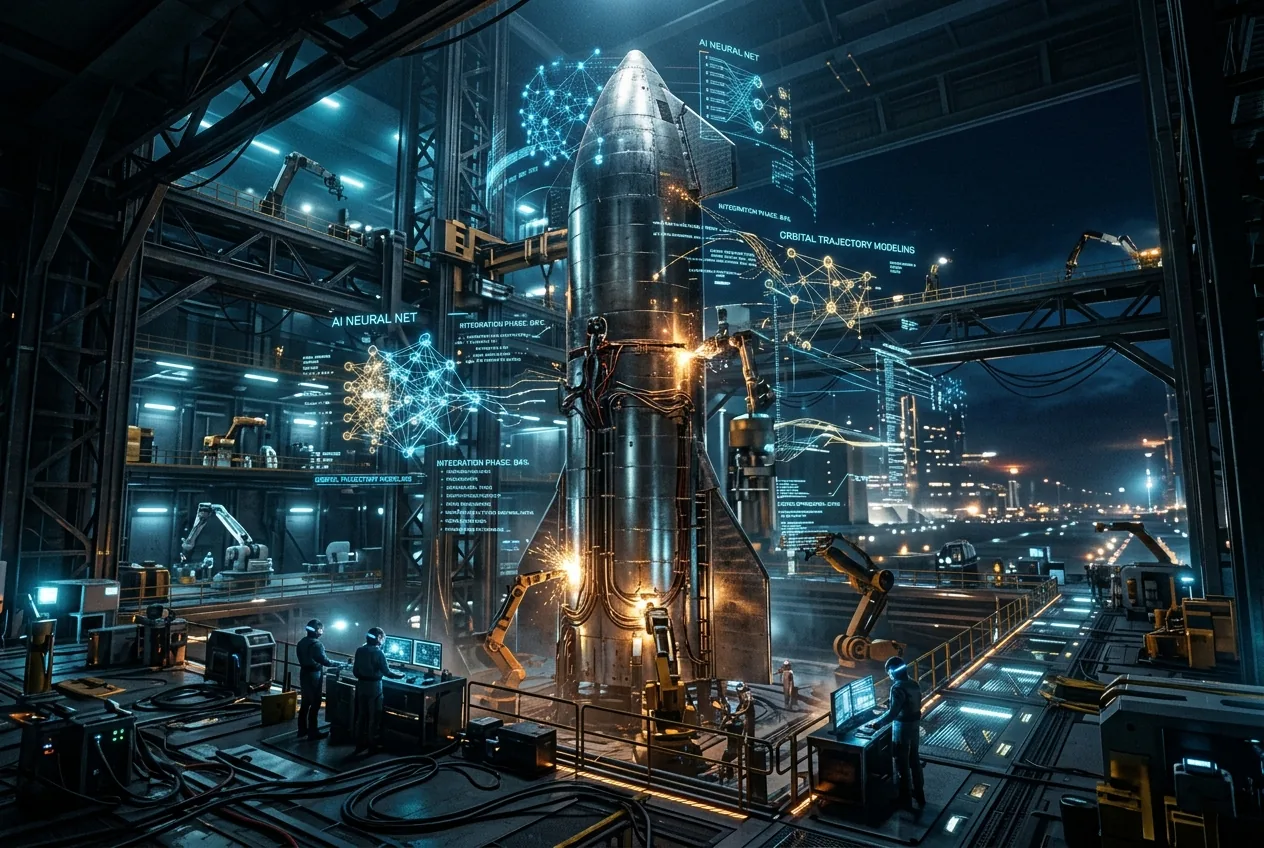
In the high-stakes world of industrial engineering and aerospace, the announcement of a merger between SpaceX and xAI represents more than just a financial consolidation. It is a strategic pivot that signals the end of general-purpose AI and the beginning of specialized, hardware-integrated intelligence at a planetary scale. By folding the world’s most advanced launch provider and the fastest-growing artificial intelligence startup into a single $1.25 trillion entity, Elon Musk is attempting to solve a fundamental problem in modern robotics: the bridge between massive data sets and physical execution in harsh environments.
From an engineering perspective, the logic of this merger is grounded in three pillars: latency, telemetry, and compute infrastructure. For years, SpaceX has operated as a hardware company with a massive data problem. Every Starship launch, every Starlink deployment, and every Falcon 9 landing generates terabytes of telemetry that require instantaneous processing. Until now, that processing has been a patchwork of proprietary algorithms and traditional cloud computing. By integrating xAI’s large-scale model capabilities directly into the SpaceX ecosystem, the goal is to create a closed-loop system where the 'brain' of the operation—xAI—is physically and digitally tethered to the 'body'—SpaceX’s rockets and satellites.
The Infrastructure of the Colossus Cluster
In mechanical engineering, we often talk about 'digital twins'—virtual replicas of physical machines used for testing. With xAI’s compute resources, SpaceX can now run millions of parallel simulations of a Starship reentry, adjusting for micro-variations in atmospheric density and flap actuator pressure in real-time. This reduces the 'trial by fire' cycle that has defined SpaceX’s development of the Starship program. When you can simulate failure with 99.9% accuracy before the rocket even leaves the pad, the pace of innovation accelerates by orders of magnitude. The economic value of saving a single Starship prototype from destruction is measured in the hundreds of millions; the value of a fully optimized fleet is measured in the billions.
Starlink as a Distributed Neural Network
The most compelling technical argument for this merger lies in the Starlink constellation. Currently, Starlink is a global internet service provider. However, in the context of an xAI merger, Starlink transforms into a decentralized edge-computing network. By equipping future Starlink satellites with xAI-optimized hardware, Musk can effectively wrap the Earth in a neural shell.
For industrial automation and robotics, this is a game-changer. Imagine an autonomous mining fleet in a remote region or a logistics drone swarm in a mid-ocean corridor. These machines cannot rely on ground-based data centers due to latency constraints. If the intelligence (xAI) is hosted on the satellite network (Starlink) directly above the machine, the latency drops from seconds to milliseconds. This merger creates a proprietary global nervous system that no other company—not Amazon, nor Google—can currently match. It is a vertical integration of the raw compute, the delivery mechanism, and the end-use hardware.
The Data Flywheel of Orbital Telemetry
Machine learning models are only as good as the data they ingest. While OpenAI and Google are scouring the public internet for text, xAI now has exclusive access to the most high-fidelity physical data set in existence. Every sensor on every SpaceX rocket provides a stream of real-world physics data: vibration frequencies, thermal gradients, and structural stress loads. This is the 'ground truth' data that is required to move AI from the digital realm into the physical realm.
As a mechanical engineer, I see this as the missing link for advanced robotics. If you want a robot to function in a factory or on the surface of Mars, it needs to understand the nuance of physical interaction. By training xAI models on SpaceX telemetry, the resulting software will possess an 'intuition' for physics that purely language-based models lack. This synergy likely explains a significant portion of the $1.25 trillion valuation; the entity isn't just selling software or launch services, it is selling the foundation of autonomous physical labor.
Economic Viability and the Trillion-Dollar Question
Critics point to the $1.25 trillion figure as a product of 'Musk-inflation,' but a cold analysis of the financials suggests a different story. SpaceX was already trending toward a $200 billion to $250 billion valuation based on its launch monopoly and the massive revenue potential of Starlink. xAI, despite its late start, has secured billions in funding from investors who see it as the only viable competitor to the Microsoft-OpenAI alliance. When merged, the valuation reflects a 'synergy premium.'
Regulatory Hurdles and the Monopoly on Innovation
The path forward is not without friction. The merger will undoubtedly face intense scrutiny from the FAA, the SEC, and antitrust regulators. The primary concern will be the concentration of power: a single entity that controls both the access to space and the artificial intelligence required to operate within it. There is also the matter of national security. Given SpaceX’s deep ties to the Department of Defense and NASA, the integration of a highly secretive AI arm will require new protocols for data compartmentalization.
Final Engineering Assessment
The merger of SpaceX and xAI is a pragmatic response to the limits of current technology. We have reached a point where the bottleneck for space exploration and global automation is no longer the strength of our alloys or the efficiency of our fuels, but the speed at which we can process and act upon data. By unifying the 'brain' and the 'rocket,' Musk is attempting to bypass this bottleneck entirely.
Whether the $1.25 trillion valuation holds up in the long term depends on the successful deployment of Starship and the ability of xAI to translate SpaceX’s telemetry into a generalized physical intelligence. If they succeed, this merger will be remembered as the moment the aerospace industry transitioned from a logistics business to a cognitive one. For those of us focused on the 'how' and 'why' of industrial tech, the blueprint is clear: the future of hardware is intelligent, and the future of intelligence is physical.




Comments
No comments yet. Be the first!