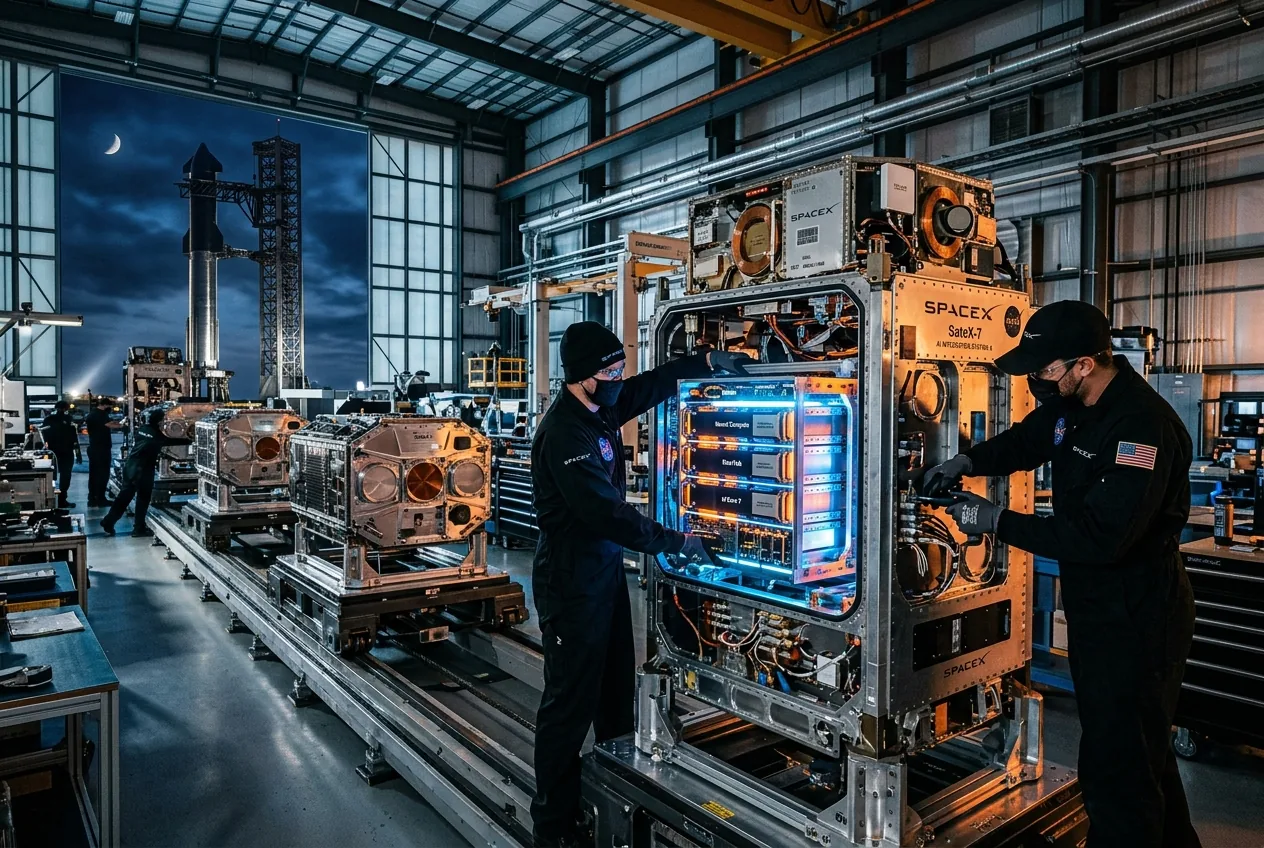
At 9:30 AM Eastern Time, the ticker symbol SPCX made its debut on the NASDAQ, signaling the arrival of the largest initial public offering in the history of capital markets. With an issue price of $135 and a staggering valuation of $1.8 trillion, the event marks a fundamental transformation in the identity of the company founded by Elon Musk. While SpaceX built its reputation on the back of reusable rockets and the Starlink satellite constellation, the prospectus reveals a company that has strategically refocused its entire industrial apparatus toward AI compute. The launch of SPCX isn't just about reaching orbit; it is a high-stakes play to build a global, and eventually orbital, AI cloud.
The Financial Engine: Starlink as a Compute Subsidy
To understand the $1.8 trillion valuation, one must look past the Starship launches and examine the internal flow of capital within the new SpaceX entity. The prospectus divides the company into three distinct segments: Connectivity (Starlink), Launch, and AI. The connectivity business is the only profitable arm, generating $11.39 billion in revenue last year with an operating profit of $4.42 billion. However, this profit is not being returned to shareholders; it is being aggressively reinvested into the AI segment.
The AI division, which incorporates the former xAI, reported a loss of $6.36 billion on revenues of $3.2 billion. The capital expenditure for this segment reached $7.7 billion in a single quarter—more than double Starlink's total revenue for the same period. From a mechanical engineering and industrial management perspective, this represents a massive redirection of resources. Starlink is being utilized as a "cash cow" to fund the hardware requirements of generative AI, effectively acting as a utility that powers a research-and-development furnace.
This internal subsidization is necessary because the cost of AI infrastructure is skyrocketing. The prospectus reveals that SpaceX has incurred approximately $30 billion in debt to build out its ground-based AI clusters, including $20 billion in bridge loans due within 15 months of the IPO. The public markets are now the primary source of oxygen for a company that is consuming capital at an unprecedented rate to secure its lead in the compute wars.
Industrial Speed: The Memphis Blueprint
While the long-term vision is orbital, the current revenue model for SpaceX's AI cloud is firmly grounded on Earth. The company has demonstrated a remarkable ability to deploy industrial-scale compute facilities with a speed that traditional data center providers cannot match. The prospectus highlights "Colossus 1" and "Colossus 2" in Memphis, Tennessee—supercomputing clusters that were built in just 122 and 91 days, respectively. These facilities represent about 1 gigawatt (GW) of capacity, a metric that is becoming more relevant to the company's valuation than kilograms of payload to orbit.
Perhaps the most surprising revelation in the filing is that SpaceX's primary AI revenue is coming from its direct competitors. Anthropic currently pays SpaceX $1.25 billion per month to rent computing power from the Colossus clusters, while Google has a contract for approximately 110,000 NVIDIA GPUs costing $920 million per month. These "Cloud Service Agreements" suggest that SpaceX has successfully positioned itself as a wholesaler of compute. By building faster and at a larger scale than traditional providers, SpaceX is capturing the spillover demand from the AI boom.
From an engineering standpoint, the Memphis facilities serve as a prototype for the modularity SpaceX hopes to bring to space. The ability to deploy thousands of interconnected GPUs in under 100 days suggests a standardized bus architecture and a highly optimized supply chain—skills that are directly transferable to the mass production of satellites equipped with AI accelerators.
The 100 GW Challenge: Why Compute Must Go to Orbit
The ultimate justification for the $1.8 trillion price tag is the "Orbital Data Center System." SpaceX recently applied to the FCC for a constellation of up to 1 million satellites designed specifically for data processing. Musk’s stated goal is to reach 100 GW of orbital computing power. To put that in perspective, the entire current Starlink constellation operates on a fraction of a percent of that energy. A 100 GW goal is equivalent to the power output of nearly 100 large nuclear reactors, all positioned in Low Earth Orbit (LEO).
Why pursue such an extreme technical challenge? The prospectus argues that space-based AI is the only way to scale compute without the terrestrial constraints of land use, environmental regulations, and local power grid capacity. "It's always sunny in space," the filing notes, referencing the 24/7 availability of solar energy outside the atmosphere. However, as any mechanical engineer knows, the primary hurdle in space isn't generating power; it’s thermal management. In a vacuum, heat can only be dissipated through radiation, which is far less efficient than the convection cooling used in terrestrial data centers.
To achieve 100 GW, SpaceX will likely need to pioneer massive, deployable radiators and perhaps even liquid-cooled satellite structures. This represents a new frontier in aerospace engineering: building a satellite that is more 'server' than 'spacecraft.' If SpaceX can solve the thermal and power density issues, it will own a computing platform that is physically immune to the geopolitical and environmental pressures facing ground-based clouds in Virginia or Dublin.
Vertical Integration and the Grok Synergy
The merger of xAI and SpaceX also solves a data bottleneck. The AI segment includes X (formerly Twitter), which provides a real-time stream of human discourse to train Grok, the company’s flagship model. By owning the data source (X), the training compute (Colossus), the launch vehicle (Starship), and the distribution network (Starlink), Musk has achieved a level of vertical integration that even titans like Microsoft or Google struggle to match.
The prospectus makes it clear that the launch business—once the core of SpaceX—is now a support function for this AI ecosystem. The rockets are the logistics arm that will ferry the next generation of AI-processing satellites into orbit. In this new corporate hierarchy, the Falcon 9 and Starship are effectively high-speed elevators for a global data center. This shift is reflected in the market cap targets set for Musk’s new compensation plan, which includes milestones for reaching a $7.5 trillion valuation and establishing a permanent Mars settlement. The message to investors is clear: the road to Mars is paved with the profits from an AI cloud.
A Governance Model Without Precedent
Investors entering the SPCX market are doing so with very little say in the company’s direction. Following the IPO, Musk retains approximately 42% of the shares but controls a massive 82% of the voting rights. The company’s articles of association explicitly state that Musk is not expected to prioritize SpaceX's business opportunities over his other ventures. This is a level of centralized control rarely seen in a public company of this scale.
Whether SpaceX can bridge the gap between its current terrestrial cloud and a 100 GW orbital network remains the central question. Today, orbital compute power is closer to a home router than an AWS region. But as the Memphis build-outs have shown, SpaceX has a unique ability to turn sci-fi concepts into industrial reality through sheer force of capital and engineering speed. For the investors who bought into SPCX today, they aren't just betting on a rocket company—they are betting on the architect of a new, orbital digital economy.




Comments
No comments yet. Be the first!