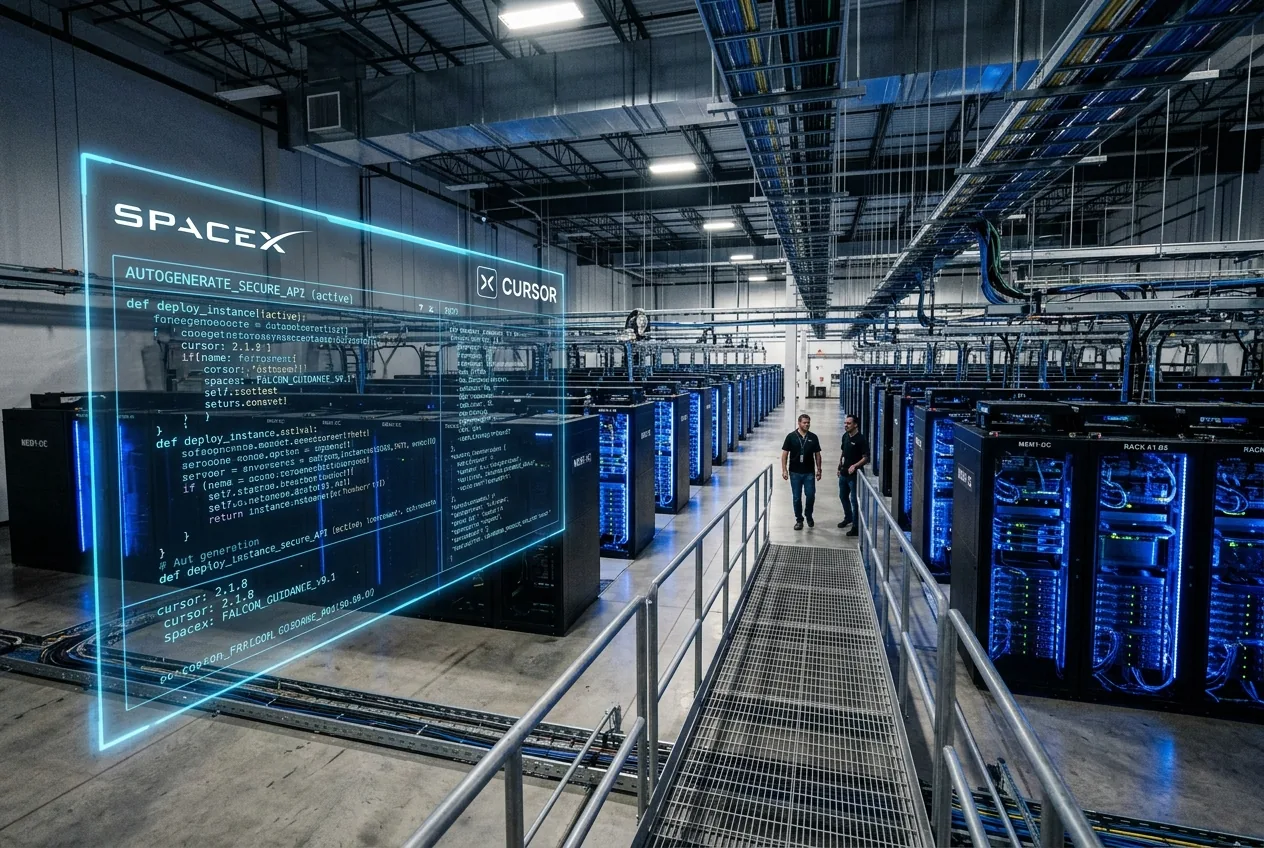
In a move that signals a profound shift from aerospace hardware to the underlying software infrastructure of the future, SpaceX has finalized an agreement to acquire Cursor, the AI-driven integrated development environment (IDE), for $60 billion. This all-stock transaction, announced just days after SpaceX completed the largest initial public offering in history, represents one of the most aggressive bets on artificial intelligence by a non-software primary firm. For SpaceX, the acquisition is less about diversifying its portfolio and more about a desperate technical pivot intended to salvage its embattled xAI division.
The deal follows an intricate preparatory phase. In April 2026, SpaceX and Cursor’s parent company, Anysphere, entered into a partnership that included a $10 billion investment option or a full acquisition. By June, the decision was made to bring the startup entirely under the SpaceX umbrella. The move comes as xAI, the artificial intelligence lab founded by Elon Musk and later absorbed by SpaceX, struggles to regain its footing after a disastrous 2025 characterized by the departure of all 11 original co-founders and high-profile failures in its flagship model, Grok. By integrating Cursor, SpaceX isn't just buying a tool; it is attempting to buy a functional engineering culture and a proven product to replace a foundation that Musk himself admitted was not built right the first time.
The Technical Synergies of Hardware and Code
To understand the $60 billion valuation, one must look at the mechanical and computational requirements of SpaceX’s broader mission. SpaceX is no longer just a rocket company; between Starlink’s global satellite constellation and the iterative development of the Starship platform, the company manages some of the most complex telemetry and automation codebases in existence. The integration of an AI-native coding environment like Cursor into these workflows is a logical, albeit expensive, progression in industrial automation. Cursor has built a reputation among software engineers for its deep integration of large language models (LLMs) directly into the coding interface, allowing for real-time debugging, code generation, and architectural suggestions that go beyond simple autocomplete functions.
From a technical standpoint, the marriage of Cursor’s software layer with xAI’s Colossus supercomputer in Memphis, Tennessee, creates a vertically integrated AI stack. Colossus is currently one of the most powerful training clusters in the world, utilizing what is estimated to be the equivalent of one million H100 GPUs. Until now, SpaceX possessed the raw compute power but lacked a sophisticated, widely adopted application to harness that power for professional use. Cursor provides that application. By feeding Cursor’s intuitive interface with the massive inference and training capacity of Colossus, SpaceX aims to create a closed-loop system where the AI doesn't just assist in writing code but effectively manages the software lifecycle of aerospace engineering.
Can a $60 Billion Acquisition Fix xAI?
The Economic Viability of a Strategic Acq-hire
Critics point to Cursor’s declining market share as a reason for skepticism regarding the $60 billion price tag. Data from Ramp indicates that Cursor’s share of the AI coding market fell from 41% in 2025 to roughly 26% by mid-2026, largely due to the rapid ascent of Anthropic’s Claude-based coding tools. Furthermore, despite raising $2.3 billion in previous rounds and being in talks for a fresh $2 billion from Andreessen Horowitz and Nvidia, Cursor was reportedly not on a path to breaking even. Its burn rate, driven by the massive cost of token inference and high-level talent acquisition, made it a risky bet for traditional venture capital.
However, for a trillion-dollar entity like the post-IPO SpaceX, the economic calculus is different. The $60 billion is paid in stock, effectively leveraging SpaceX’s high valuation to secure a critical technology. From a mechanical engineering perspective, this is akin to a manufacturer buying a machine tool supplier to ensure a steady supply of precision parts. If Cursor can accelerate the development of Starship’s flight control software or Starlink’s routing algorithms by even a marginal percentage, the long-term gains in operational efficiency could theoretically offset the astronomical purchase price. Furthermore, the deal eliminates a competitor for talent, bringing Anysphere’s engineers into the SpaceX fold to lead the rebuilding of xAI.
The Google Factor and the Compute Economy
Adding another layer to this industrial puzzle is SpaceX’s evolving relationship with other tech giants. Shortly before the Cursor acquisition, Google signed a deal to pay SpaceX approximately $920 million per month for access to compute capacity at xAI data centers. This 32-month agreement provides SpaceX with nearly $30 billion in guaranteed revenue, effectively subsidizing the hardware costs of the Colossus supercomputer. This suggests that SpaceX is positioning itself as a major player in the global compute market, rivaling Amazon Web Services and Microsoft Azure in specialized AI infrastructure.
The influx of Google’s capital provides SpaceX with the liquidity needed to manage the high operational costs of Cursor without straining its primary rocket development budgets. It also creates a curious ecosystem where Google, a leader in AI through DeepMind and Gemini, is actively funding the infrastructure of a direct competitor. This highlights a critical reality in the current AI landscape: the scarcity of high-end compute capacity is so severe that traditional competitive boundaries are blurring. SpaceX is leveraging its ability to build and power massive data centers faster than its rivals, using that infrastructure as a lever to acquire the software talent it previously lacked.
How Will This Change the Developer Landscape?
For the thousands of software engineers who currently use Cursor, the acquisition raises questions about the tool’s future. Most industry analysts expect SpaceX to maintain Cursor as a standalone product in the short term, if only to continue gathering the telemetry and usage data required to train more advanced versions of xAI’s models. However, there is a distinct possibility that Cursor will eventually become a more specialized tool tailored for the types of complex, low-latency, and safety-critical coding required in aerospace and robotics.
The focus on "knowledge work AI," as mentioned in SpaceX’s official communications, suggests that the ambition extends beyond just writing Python or C++. SpaceX likely views the Cursor interface as a precursor to a more advanced human-machine interface for industrial design. In this vision, an engineer could describe a mechanical part or a sensor network, and the AI—powered by the xAI backbone and the Cursor interface—would generate the CAD models, the control logic, and the testing protocols simultaneously. This level of automated engineering is the ultimate goal of the SpaceX-xAI-Cursor triad.
In the final analysis, the $60 billion acquisition of Cursor is a pragmatic admission of failure and a bold stride toward a new industrial paradigm. SpaceX recognized that it could build the world's largest rockets and its most powerful supercomputers, but it could not build the refined software interface necessary to connect the two. By acquiring Cursor, SpaceX is attempting to bridge that gap. Whether the culture of a fast-moving AI startup can survive within the high-pressure, hardware-focused environment of SpaceX remains to be seen, but the technical stakes could not be higher. This is no longer just a battle for the best chatbot; it is a battle for the automated future of engineering itself.




Comments
No comments yet. Be the first!