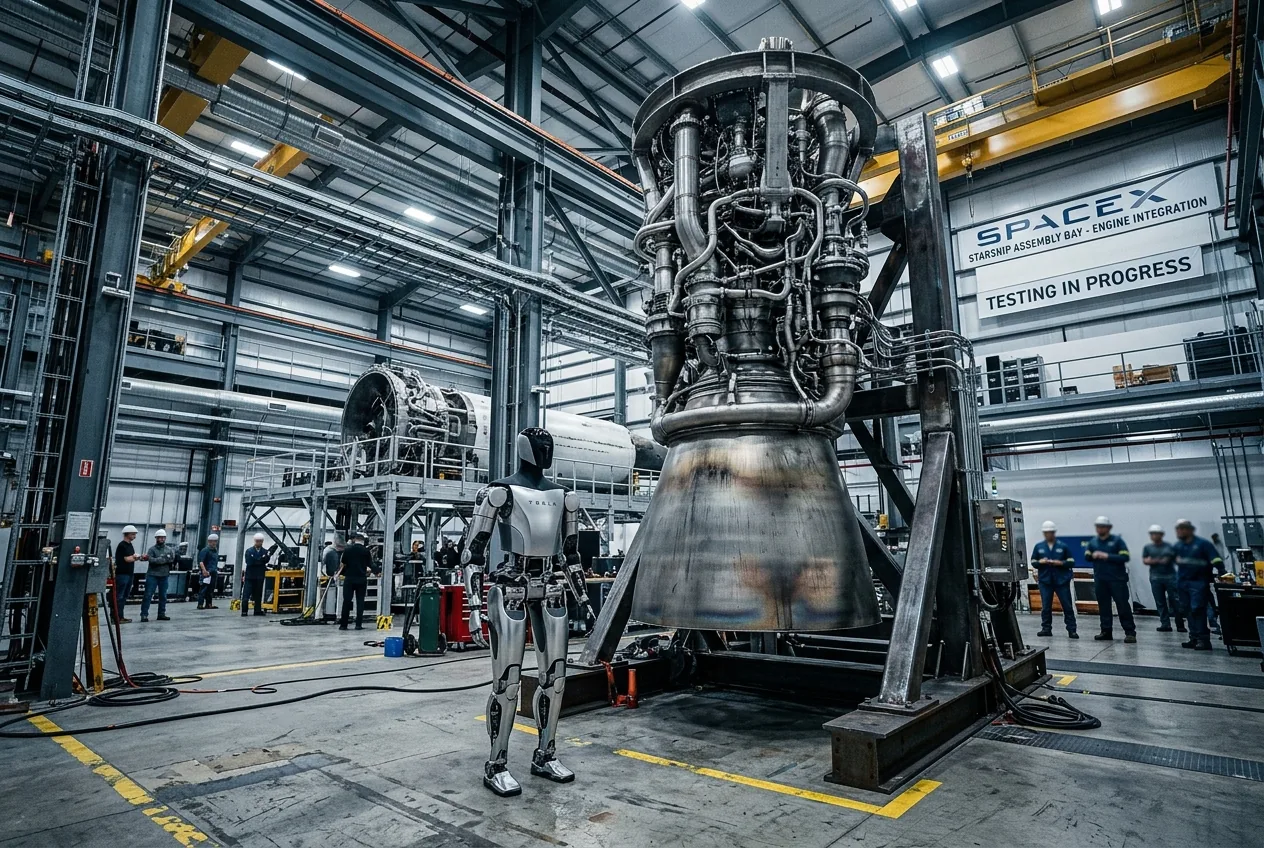
In the high-stakes arena of industrial technology, the boundaries between aerospace, automotive, and artificial intelligence are rapidly dissolving. For decades, Elon Musk’s primary ventures—Tesla and SpaceX—have operated as distinct entities, sharing a founder but maintaining separate balance sheets and corporate structures. However, recent financial shifts and a monumental shift in the artificial intelligence (AI) landscape suggest that the era of the “Musk Conglomerate” may be imminent. With SpaceX’s market valuation now rivaling the world’s largest tech titans and Musk’s voting power in Tesla climbing to a strategic 19.9%, the engineering of a formal merger is no longer a fringe theory; it is a live analytical debate on Wall Street and in the corridors of Silicon Valley.
The catalyst for this renewed scrutiny is the massive scaling of SpaceX. Following its much-anticipated public offering, the company has seen its market capitalization surge past the $2 trillion mark, briefly flirting with $3 trillion and overtaking legacy giants like Amazon and Microsoft. This valuation is not merely built on the success of the Falcon 9 or the nascent Starlink satellite constellation; it is increasingly driven by the company’s aggressive pivot into AI infrastructure. By absorbing xAI and leveraging its massive compute capabilities, SpaceX has transformed from a launch provider into a diversified technology platform with a projected total addressable market (TAM) of $28.5 trillion. For Tesla investors, the question is whether a merger offers a path to revitalizing the EV maker’s slowing growth or represents a risky dilution of focus.
The Mechanics of Voting Power and Strategic Control
To understand the feasibility of a merger, one must first look at the capital structure of Tesla. Elon Musk recently exercised over 303 million Tesla stock options, a move that boosted his voting power to 19.9%. While this falls short of his stated 25% target—a threshold he considers necessary to steer the company’s AI and robotics ambitions without the threat of a hostile takeover—it provides significant leverage for orchestrating a strategic tie-up. These shares are part of a long-term compensation package, meaning Musk is incentivized to ensure the long-term viability of the enterprise. By consolidating his voting block, Musk can more effectively pitch a merger as a necessary step for the development of Dojo, Tesla’s supercomputing project, and Optimus, the humanoid robot venture.
Analysts, most notably Dan Ives of Wedbush, have placed the odds of a Tesla-SpaceX merger at roughly 80% within the next twelve months. The rationale is largely rooted in the operational overlap that already exists. Tesla and SpaceX currently share AI projects, chip manufacturing facilities, and executive talent. From a mechanical engineering perspective, the hardware requirements for Starship and the Tesla Cybertruck share material science DNA, particularly in the use of high-strength stainless steel alloys. A merger would formalize these efficiencies, allowing for a unified research and development budget that could accelerate breakthroughs in battery density and thermal management—two critical bottlenecks for both orbital transport and long-range terrestrial vehicles.
However, the financial mechanics are complex. A stock-for-stock merger between a trillion-dollar automotive company and a multitrillion-dollar aerospace company is a transaction of unprecedented scale. Prediction markets remain more skeptical than the analyst community, pricing the odds of a deal closer to 25% in the near term. This skepticism stems from the differences in profitability profiles and regulatory environments. While Tesla is a high-volume manufacturing entity with razor-thin margins and intense global competition, SpaceX operates in a more protected, contract-driven sector where it currently enjoys a near-monopoly on heavy-lift launch services.
The xAI Bridge: Compute as the New Currency
Perhaps the strongest argument for integration lies in the recent performance of xAI, the artificial intelligence unit recently integrated into SpaceX. The company has successfully signed three major AI compute leasing agreements with industry leaders Anthropic, Alphabet, and Reflection AI. These contracts are reportedly worth $27.5 billion annually, a figure that could soon eclipse the revenue generated by SpaceX’s core rocket launch services. In a global economy currently starved for high-end Nvidia GPUs and the data center infrastructure to run them, SpaceX has managed to monetize its excess capacity with high efficiency.
This compute-centric revenue model provides a crucial bridge to Tesla. Tesla’s future value is increasingly tied to its ability to solve Level 5 autonomy and deploy a fleet of robotaxis. Both require immense amounts of training data and compute power. If Tesla were merged with SpaceX, it would gain direct, prioritized access to the world’s most robust AI training clusters without the need for high-cost external leasing. This vertical integration of the “brain” (AI) and the “body” (robotics/EVs) is the central pillar of Musk’s broader industrial strategy. By removing the corporate firewall between the two companies, Musk could theoretically treat compute resources as a fungible asset, shifting power to whichever project requires it most at any given time.
This pivot toward AI services has already begun to reshape investor sentiment. SpaceX’s IPO prospectus highlighted that while space launches remain the most visible part of the business, connectivity via Starlink and AI services represent the lion’s share of future growth. Musk’s forecast that SpaceX could generate $1 trillion in annual revenue by 2031 depends heavily on this diversified mix. For Tesla, which has faced “retail whiplash” as its traditional car-selling business matures, becoming a subsidiary or partner in a broader “Musk Empire” could provide the shield it needs to transition into a pure-play robotics and AI firm.
Operational Risks and Governance Challenges
Despite the technical synergies, a merger faces significant headwinds. SpaceX’s own IPO filing contains 38 pages of risk factors, many of which center on the company’s heavy dependence on Musk’s leadership and the inherent volatility of Starship development. Integrating Tesla—a company subject to the intense scrutiny of the public markets and federal safety regulators like the NHTSA—could introduce new legal liabilities to SpaceX’s balance sheet. Conversely, Tesla shareholders may be wary of being sidelined. If SpaceX, as the larger and more profitable entity, were to absorb Tesla, the terms of the deal would have to be meticulously negotiated to avoid lawsuits regarding fiduciary duty.
Furthermore, political and regulatory hurdles loom large. The “DOGE cuts” and Musk’s increasing involvement in federal cost-cutting initiatives have drawn fire from lawmakers like Rep. Ro Khanna, who has called for investigations into the humanitarian impacts of these moves. Any attempt to merge two of the nation’s largest and most strategically significant companies would likely trigger a massive antitrust review. The Department of Justice and the Federal Trade Commission would examine how a combined entity would dominate the satellite, EV, and AI sectors, potentially leading to forced divestitures that could nullify the benefits of the merger.
There is also the matter of corporate culture. SpaceX is a mission-driven, engineering-heavy organization that has historically operated with a “move fast and break things” mentality—a philosophy necessary for aerospace innovation. Tesla, while sharing this DNA, must also manage the realities of global supply chains, labor unions, and consumer safety standards. Merging these two cultures into a single entity could create operational friction that slows down both. SpaceX COO Gwynne Shotwell has frequently downplayed merger talk, emphasizing the need for the company to remain focused on its primary mission: making life multi-planetary.
The Path Forward: Collaborative Autonomy
If a formal merger does not occur, the likely alternative is a state of “collaborative autonomy.” In this scenario, the two companies would remain legally distinct but would deepen their technical and financial ties through joint ventures and cross-licensing agreements. We are already seeing the beginnings of this with Tesla’s $2 billion investment in xAI. This model allows both companies to benefit from shared R&D and compute power while insulating one from the specific regulatory and financial risks of the other. It also avoids the catastrophic potential for a single failure at one company to drag down the other.
From an engineering standpoint, the convergence is inevitable. The sensors used in Tesla’s Full Self-Driving (FSD) system are remarkably similar to the navigation systems used in autonomous docking for the Dragon spacecraft. The cooling systems developed for high-performance EV batteries are being adapted for use in Starship’s avionics. Whether these technologies are housed under one corporate roof or two is, in many ways, a secondary question to the technical reality of their integration. As Musk moves closer to his 25% voting goal at Tesla, his ability to force this convergence becomes more a matter of will than of permission.
The next twelve months will be a defining period for both companies. As SpaceX settles into its life as a public company and Tesla navigates a pivot toward robotaxis, the financial and technical pressures to merge will only increase. For those mapping the interface of robotics and human industry, the possible union of Tesla and SpaceX represents the ultimate test of vertical integration. It is a gamble on the idea that the future of technology is not found in specialized silos, but in a unified stack where rockets, cars, and robots are all powered by the same silicon and the same singular vision.




Comments
No comments yet. Be the first!