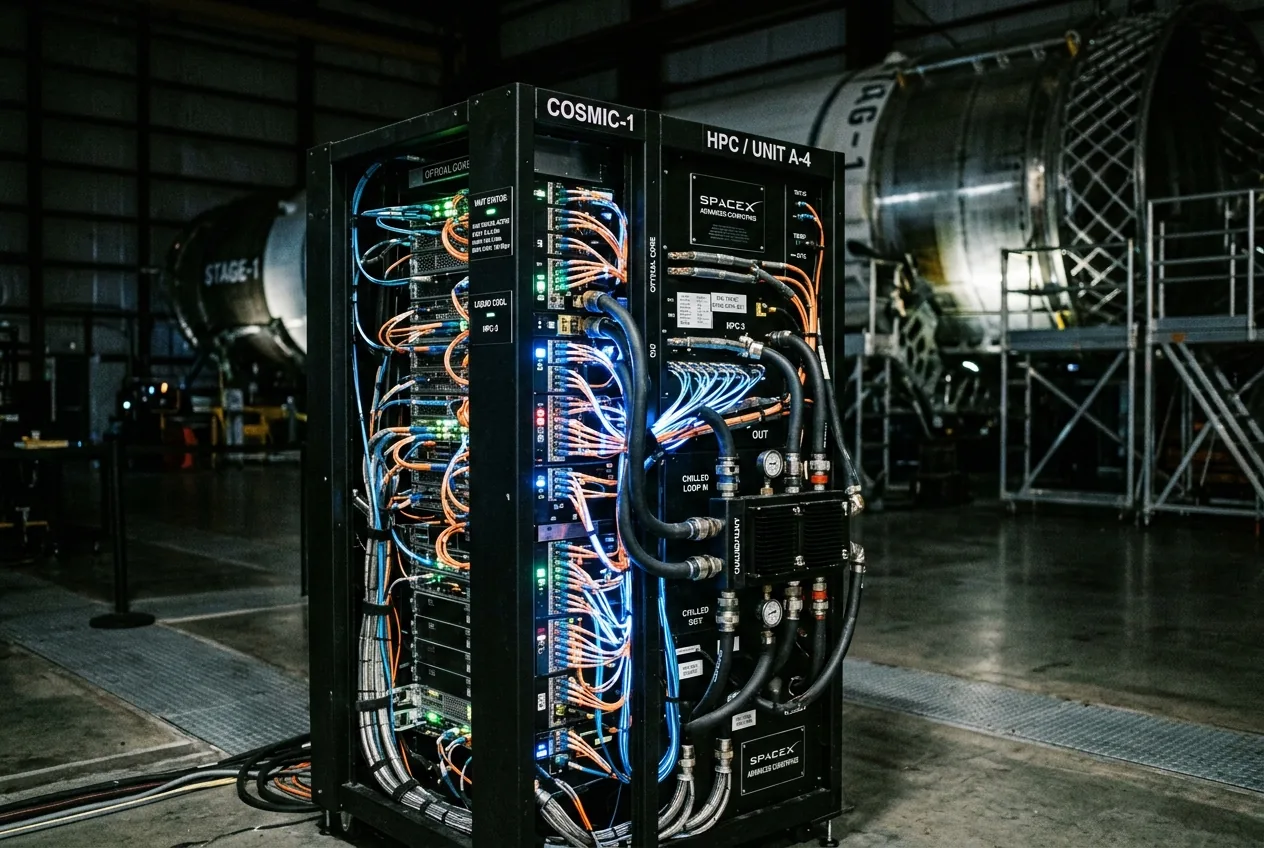
In the capital-intensive arena where advanced aerospace manufacturing converges with frontier artificial intelligence, computational capacity has become the ultimate strategic commodity. Reports of a long-term, $30 billion supercomputing and infrastructure framework between Alphabet’s Google and SpaceX point to a profound realignment in how industrial giants secure multi-gigawatt compute capacity. While both organizations have historically maintained distinct technological moats, the computational thresholds required to train next-generation spatial intelligence models, optimize orbital megaconstellations, and simulate complex fluid dynamics have outgrown conventional captive data centers.
The scale of the reported agreement underscores a structural shift in enterprise cloud economics. Rather than treating high-performance computing as an operational expense negotiated on annualized contracts, industrial aerospace is moving toward multi-decade compute reservations. For SpaceX, securing dedicated access to top-tier silicon and hyperscale power distribution provides the computational backbone needed as it scales Starship operations, expands Starlink’s direct-to-cell architecture, and prepares its corporate structure for eventual public capital market events.
For Google, locking in a foundational industrial partner validates its aggressive multi-billion-dollar investments in custom tensor processing units (TPUs), specialized liquid-cooled data center topologies, and high-bandwidth optical networking fabrics. The transaction represents more than a transaction for off-the-shelf cycles; it is a structural integration of cloud supercomputing into the physical logistics of automated aerospace manufacturing and autonomous vehicle control.
The Engineering Burden of Megaconstellation Dynamics
Modern orbital mechanics and telecommunications management operate at scales that quickly overwhelm standard algorithmic approaches. Starlink’s constellation now comprises thousands of active satellites in low Earth orbit, each executing real-time beamforming, dynamic ground-station handoffs, and autonomous collision avoidance maneuvers. Routing terabits of user data across laser inter-satellite cross-links while continuously repositioning phased-array antennas requires continuous predictive optimization across a rapidly shifting mesh network.
As the constellation expands toward tens of thousands of orbital nodes, the dimensionality of the routing problem scales exponentially. Edge compute aboard satellite buses can execute local inferencing, but the global optimization models that determine orbital phasing, predict localized atmospheric interference, and mitigate space debris threats require massive centralized training clusters. Ingesting continuous downlinked telemetry across thousands of spatial vectors demands petawatt-scale processing capabilities coupled to planetary-scale networking nodes.
Silicon Diversity and Computational Fluid Dynamics
Beyond orbital networking, the physical engineering of rocketry remains one of the most computationally hostile disciplines in modern industry. Designing full-flow staged combustion engines like SpaceX’s Raptor requires solving complex Navier-Stokes equations under extreme thermodynamic gradients, supersonic flow fields, and violent combustion instabilities. High-fidelity computational fluid dynamics (CFD) and magneto-hydrodynamic modeling have historically been throttled by available compute cycles, forcing engineers to rely on approximations or costly iterative physical hot-fire testing.
Scaling these simulations to capture microsecond-level combustion transients across three-dimensional combustion chambers demands specialized accelerator architectures. Google’s custom silicon—particularly its TPU v5p and subsequent TPU clusters—utilizes proprietary optical circuit switches (OCS) that dynamically reconfigure interconnect topologies based on the mathematical shape of the workload. This optical fabric reduces communication bottlenecks during massive parallel computations, a crucial capability when distributing single aerodynamic simulations across tens of thousands of interconnected chips.
While commercial GPUs continue to dominate broad machine learning workloads, the introduction of TPU-driven tensor architectures into aerospace engineering pipelines alters the iteration cycle. Computational runs that previously consumed weeks on private high-performance computing clusters can be compressed into hours. This throughput acceleration directly impacts the pace of structural hardware iteration at production facilities in Boca Chica, Texas, allowing automated tooling and 3D printing parameters to be updated based on near-real-time thermal stress modeling.
Pre-IPO Balance Sheets and Compute as Capital
The financial architecture of a $30 billion multi-year commitment serves strategic objectives that reach far beyond raw hardware utilization. As SpaceX continues to evaluate the financial structure of Starlink and potential public listings, shifting computational expenditures into clearly defined, long-term operational guidance offers predictable cost modeling for institutional investors. Hyperscale compute is no longer a peripheral line item; it is a primary cost of goods sold for autonomous systems and broadband networks.
In high-growth deep-tech companies, the scarcity of advanced GPUs and the electrical grid capacity to power them represent critical enterprise risks. Silicon allocations from suppliers like Nvidia are heavily constrained by foundry packaging limits, while interconnection queues for 100-plus-megawatt grid access in North America often stretch past three years. A structured deal of this magnitude secures guaranteed megawatts of power and dedicated chip allocations without forcing SpaceX to single-handedly fund and construct gigawatt-scale data center facilities.
Simultaneously, the arrangement diversifies ecosystem dependencies. Elon Musk’s concurrent investments in artificial intelligence infrastructure—notably the rapid buildout of the Colossus supercomputer cluster in Memphis for xAI—illustrate an insatiable appetite for hardware capacity. Establishing parallel infrastructure pipelines through Google Cloud ensures that SpaceX’s core aerospace, defense, and orbital telecommunications operations remain insulated from the resource demands of external frontier AI research ventures.
Autonomous Factory Workflows and Terrestrial Robotics
The industrial output of modern aerospace depends increasingly on automated manufacturing cells, robotic friction-stir welding, and automated non-destructive inspection systems. At SpaceX's production facilities, hundreds of robotic arms assemble rocket stages with minimal human intervention. Inspecting millions of weld lines, tile adhesives, and structural bulkheads produces vast visual and sensor datasets that require immediate processing to detect sub-millimeter defects.
Computer vision models trained on Google’s infrastructure can be deployed down to the edge on the factory floor, allowing automated quality control systems to identify material flaws before components enter the assembly stream. As manufacturing rates scale to support regular Starship launches, physical inspection cannot keep pace without machine-speed visual validation. The cycle creates a closed-loop engineering system: production data is piped into hyperscale clusters, models are refined, and optimized control code is pushed back down to the robotic tooling on the factory floor.
This synergy between high-bandwidth industrial sensing and remote supercomputing reflects the broader trajectory of heavy manufacturing. The boundary between physical robotics and cloud intelligence is dissolving, replaced by an integrated pipeline where mechanical actuators are directly driven by deep learning models trained across petabytes of historical manufacturing data.
The Geopolitics of Critical Digital Infrastructure
The convergence of commercial space operations and hyperscale computing carries unavoidable national security implications. Starlink has become critical global communication infrastructure, relied upon by civilian populations, commercial aviation, maritime shipping, and defense departments worldwide. Integrating this space-based layer with one of the world's most resilient cloud backbones creates an unprecedented nexus of orbital and terrestrial data control.
As sovereign entities scrutinize data sovereignty, orbital surveillance, and AI supply chains, commercial alliances between satellite operators and cloud providers will face heightened regulatory oversight. Securing sensitive aerospace payloads, commercial communications, and defense telemetry across commercial data centers requires rigid cryptographic separation and hardware-enforced isolation layers.




Comments
No comments yet. Be the first!