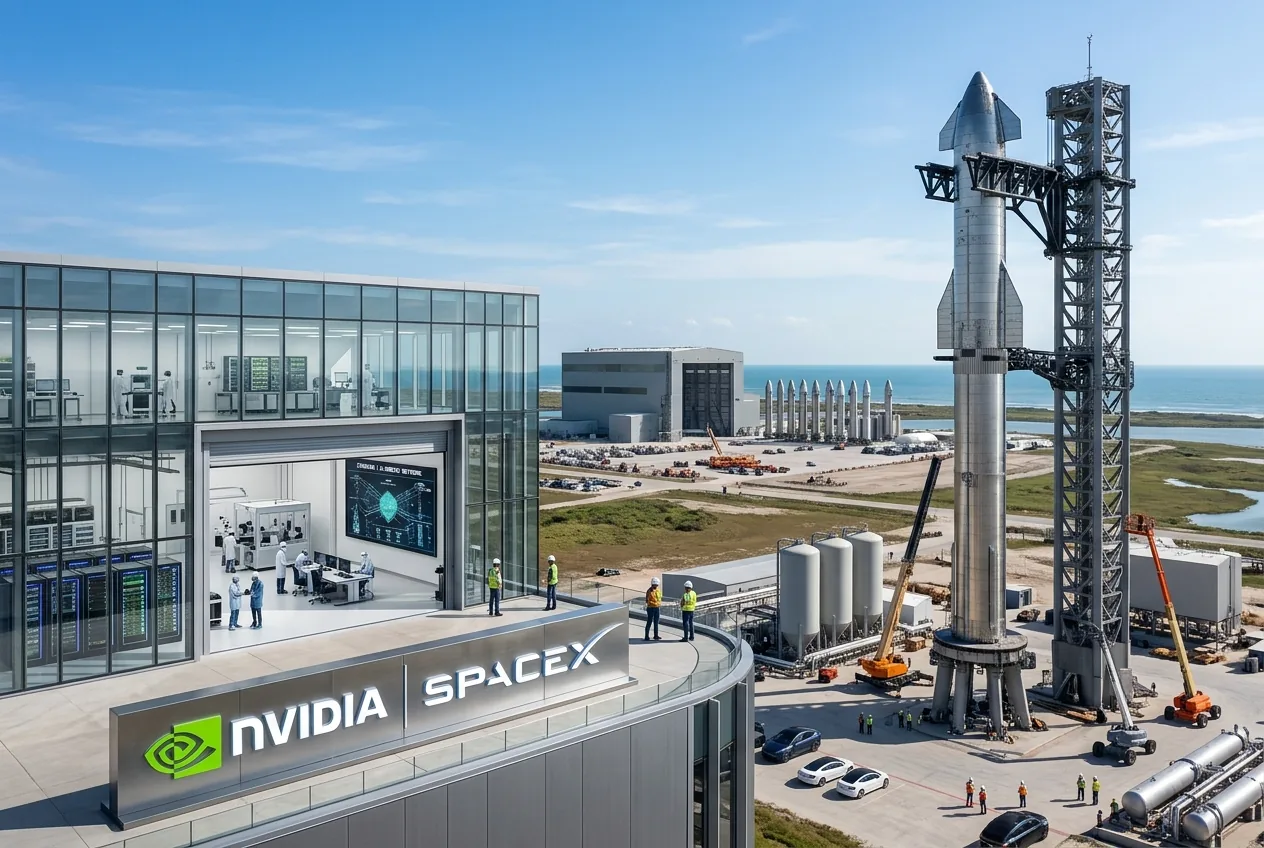
Capital allocation at the absolute peak of the technology sector has ceased to follow traditional venture boundaries. When semiconductor giant NVIDIA disclosed a staggering multi-billion-dollar position in SpaceX—pegged at approximately $21 billion across structured equity, strategic financing vehicles, and asset-backed allocations—the broader market paused to parse the sheer scale of the balance sheet maneuver. Yet, for engineers and industrial analysts who track the physical realities of modern high-performance computing, the tie-up represents something far more functional than financial engineering. It marks the formal fusion of the world’s dominant artificial intelligence silicon architect with the planet's most prolific aerospace and orbital logistics infrastructure.
The financial mechanics of this disclosure underline how closely intertwined deep-tech balance sheets have become. In an era where leading-edge silicon serves as the global economy’s most valuable technical commodity, equity allocations are increasingly driven by strategic hardware commitments. For SpaceX, an enterprise currently valued well in excess of $200 billion as it ramps up Starship test operations and expands its Starlink constellation, absorbing institutional participation of this magnitude from an enterprise compute vendor cements its capital runway. For NVIDIA, transforming balance sheet liquidity and silicon capital into a significant ownership stake in humanity’s primary launch provider secures long-term strategic placement within an industrial empire that spans private aerospace, terrestrial energy, and cutting-edge artificial intelligence.
The Silicon Pipeline Fueling Starbase and Memphis
To understand why this cross-sector alliance makes operational sense, one must look at the computing demands of modern launch systems and their adjacent AI ecosystems. SpaceX’s physical testing velocity relies heavily on computational fluid dynamics, real-time telemetry processing, and automated flight envelope prediction. The sheer volume of telemetry streamed during an integrated flight test of the Starship and Super Heavy booster generates petabytes of high-frequency vibrational, thermal, and sensor data. Converting that telemetry into actionable mechanical design alterations within a single iterative cycle requires vast GPU clusters capable of parallel multi-physics simulations.
Furthermore, the operational boundaries separating Elon Musk’s corporate entities—most notably SpaceX and the AI venture xAI—have grown increasingly porous on an infrastructure level. The Colossus supercomputer in Memphis, Tennessee, assembled in a blistering 122 days using 100,000 liquid-cooled NVIDIA H100 and H200 accelerators, represents the vanguard of modern distributed computing clusters. SpaceX relies directly on neural architectures to automate dynamic routing across the Starlink mega-constellation, parsing millions of variable RF links and ground station handoffs every second. By securing a monumental equity alignment with SpaceX, NVIDIA guarantees that its proprietary computing architecture remains the foundational layer across Musk’s entire hardware ecosystem, from ground-level rocket factories to the constellation’s dynamic routing hubs.
From an engineering perspective, this financial disclosure formalizes what had previously been an equipment supplier relationship into an interlocking industrial engine. NVIDIA does not merely sell accelerated computing hardware; it provides an end-to-end full-stack networking topology through its Quantum-X and Spectrum-X InfiniBand fabrics. Launching, managing, and maintaining tens of thousands of operational orbital nodes requires compute densities that terrestrial data centers struggle to manage without deep, customized hardware-software co-design. This capital alignment secures direct access to operational feedback loops, allowing NVIDIA engineers to tune high-bandwidth memory interfaces and distributed compute logic against some of the most demanding physical systems operational today.
Industrial Automation Meets Modern Digital Twin Architectures
The manufacturing floor at Starbase in Boca Chica, Texas, functions more like a high-rate automotive assembly plant than a traditional aerospace cleanroom. Starship production depends on massive automated robotic gantry systems, friction-stir welding rigs, and optical quality-assurance sensors that inspect 4mm-thick cold-rolled stainless steel welds in real time. Operating these automated cells at high cadence without human intervention requires deep-learning vision models and complex digital twin environments.
SpaceX’s rapid iteration model demands that production automation be software-defined. If an engineering review determines that a structural ring stiffener requires an adjusted wall thickness or a modified weld pattern, the robotics cells must reprogram their toolpaths autonomously without weeks of manual teach-pendant calibration. Machine vision pipelines accelerated by local enterprise tensor cores allow robotic weld heads to compensate dynamically for microscopic gaps or thermal warping in the steel rings. The integration of high-tier computing directly into the physical tooling machinery proves that real-world automation is the ultimate proving ground for high-performance silicon.
Can Orbital Silicon Transcend Terrestrial Thermodynamic Limits?
Beyond terrestrial factories, the alliance between a computing pioneer and an orbital transport titan inevitably sparks questions regarding the physical migration of data infrastructure into space. Computing on orbit has historically been constrained by two immovable physical bottlenecks: thermal dissipation in a vacuum and ionizing cosmic radiation. Terrestrial data centers lean on atmospheric cooling towers or massive liquid-to-air heat exchangers to dump megawatts of heat generated by dense GPU racks. In the vacuum of low Earth orbit, conduction and convection do not exist; heat can only be rejected into the cosmic background via radiative surface area.
Radiation hardening presents an equally complex materials engineering barrier. Modern leading-edge microchips fabricated on sub-3nm nodes feature gate oxides only a few atoms thick. High-energy protons and heavy cosmic ions passing through silicon can cause single-event upsets, bit flips, or catastrophic latch-up events that permanently burn out semiconductor junctions. Industrial aerospace components typically rely on legacy process nodes—often measuring 28nm to 65nm or larger—with redundant physical logic gates to survive decades in harsh orbital environments. Bridging this gap to deploy cutting-edge accelerators in space requires radical packaging redesigns, gallium-nitride power switching stages, and fluid-loop thermal radiators designed directly into spacecraft structural trusses.
If high-density inference or dynamic routing silicon is to function reliably in satellite constellations, the mechanical integration must be co-engineered from the wafer level up. SpaceX’s demonstrated ability to launch unprecedented volume and mass via Starship fundamentally alters the mass-budget economics of orbital radiators and physical radiation shielding. When launch costs drop to tens of dollars per kilogram, wrapping critical compute modules in dense shielding and expansive pumped-loop heat radiators becomes mechanically viable. NVIDIA’s massive capital exposure to SpaceX suggests both leadership teams are looking beyond terrestrial real estate constraints to model the long-term feasibility of orbital data nodes, space-based sensor fusion, and inter-satellite laser compute fabrics.
The Geopolitics and Economics of the Compute-Launch Axis
The strategic implications of this balance sheet alignment stretch deep into macroeconomic and geopolitical spheres. Advanced computing capacity and sovereign orbital launch capability are widely recognized as the two primary pillars of modern strategic autonomy. By linking its corporate capital so intimately with SpaceX, NVIDIA protects itself against terrestrial supply chain vulnerabilities while aligning with the only Western launch entity capable of heavy orbital deployment. At the same time, SpaceX gains an equity partner with unparalleled cash generation capabilities, deep expertise in advanced packaging technologies, and immense leverage over global silicon foundries.
As regulatory scrutiny around massive tech partnerships intensifies across domestic and international markets, the nature of this stake will face deep examination. Regulators will watch carefully to ensure that hardware allocations for critical components—such as advanced networking controllers and high-bandwidth accelerators—remain competitive rather than exclusive. However, from an operational perspective, the technical momentum generated by this capital infusion is already fundamentally reshaping the landscape. The boundary between the machines that compute the future and the machines that build it has officially dissolved.



Comments
No comments yet. Be the first!