The foundation model race has entered an era where capital requirements resemble sovereign infrastructure projects rather than traditional software venture cycles. Recent secondary market trading, strategic partner allocations, and surging enterprise demand have pushed private valuations of top frontier artificial intelligence laboratories toward figures once reserved for legacy industrial conglomerates. Among these developments, Anthropic's meteoric ascent has ignited a fierce debate over which architecture, corporate governance model, and commercial philosophy will dominate the next decade of automation. The narrative that OpenAI maintains an unassailable lead in generative computing is no longer taken as an article of faith across Silicon Valley or enterprise boardrooms.
While speculative secondary transactions and high-water valuations—some aggressive projections even approaching the trillion-dollar benchmark—often reflect market froth, the underlying shift in enterprise capital allocation is grounded in concrete technical performance. Chief information officers and engineering directors are systematically evaluating model steerability, deterministic API performance, and long-context reasoning rather than consumer-facing novelty. In those categories, Anthropic’s Claude model family has established an operational foothold that is actively redirecting corporate budget lines away from its primary competitor.
The Enterprise Migration Toward Deterministic Infrastructure
This technical distinction carries severe economic ramifications. When an automated agent generates code or parses structured JSON within a continuous integration pipeline, a single hallucinated token or unparsed syntax error breaks the execution chain, requiring expensive human intervention. By driving down error rates across rigorous coding benchmarks and complex agentic tasks, Claude transformed from an interesting alternative into the primary workhorse for enterprise developer tooling. Startups building autonomous coding engines, legal review workflows, and analytical middleware increasingly construct their core microservices on Anthropic’s backend, translating technical superiority into recurring API consumption at an industrial scale.
Furthermore, Anthropic’s deliberate corporate posture as a safety-first, research-focused public benefit corporation has ironically functioned as its most potent enterprise sales asset. Risk-averse enterprise legal departments, particularly within financial services, healthcare, and critical infrastructure, view Anthropic's predictable governance structure as a stabilizing force compared to the corporate volatility and product pivots that have characterized OpenAI over the past eighteen months. Enterprise procurement is rarely about raw benchmark bragging rights; it is about vendor risk mitigation and operational continuity.
The Silicon and Megawatt Realities of Frontier AI
Regardless of whether a company is valued at fifty billion or several hundred billion dollars, frontier AI development remains rigidly bound to physical capital expenditure. Valuations in this sector cannot be analyzed through the lens of traditional software-as-a-service margins, which typically feature gross margins north of seventy percent. Foundation model developers operate under the brutal economics of heavy industrial processing, where the raw materials are compute clusters, high-bandwidth memory, and dedicated power generation assets.
Anthropic’s technical scaling strategy relies on deep infrastructural syndication. Rather than attempting to construct and finance its own proprietary datacenter footprint from scratch, the company has anchored its computational backbone within the cloud environments of its major backers: Amazon Web Services and Google Cloud. This dual-pipeline architecture provides Anthropic with flexible access to heterogeneous accelerator hardware. On one side, it leverages massive clusters of NVIDIA H100 and forthcoming Blackwell B200 GPUs across both providers; on the other, it increasingly optimizes training runs and high-throughput inference on custom silicon, including AWS Trainium and Google TPU architectures.
Optimizing for bespoke silicon represents a critical margin defense. As inference workloads begin to dwarf initial training costs across enterprise deployments, the cost-per-token profile dictates whether an AI developer generates operational cash flow or incinerates investor capital. Custom application-specific integrated circuits (ASICs) like Trainium2 and TPU v5p deliver superior performance-per-watt metrics compared to general-purpose GPUs. By architecting its models to run efficiently across these diverse hardware fabrics, Anthropic mitigates the catastrophic supply constraints and exorbitant pricing power exercised by merchant silicon vendors, providing a sustainable pathway to support its ballooning enterprise scale.
From Conversational Chatbots to Agentic Automation
The primary battleground separating Anthropic from OpenAI is no longer the quality of conversational prose, but the transition toward autonomous execution. The introduction of Anthropic's 'Computer Use' capability marked a critical inflection point in human-machine interface design. Rather than restricting model output to text strings within an API payload, this architecture enables the model to interpret visual display data, direct cursor movements, click interface elements, and execute multi-step software tasks across standard operating systems in real time.
For industrial automation and supply chain logistics, this capability represents the bridge between legacy enterprise software and modern autonomy. Millions of industrial back-offices run on antiquated enterprise resource planning software, warehouse management systems, and proprietary terminal interfaces that lack accessible APIs. Rebuilding these systems for programmatic integration would cost billions and take decades. A foundation model capable of interacting with human-facing graphical user interfaces as an autonomous agent unlocks brownfield automation across global supply chains, logistics coordination, and administrative data entry without requiring fundamental software overhauls.
OpenAI has pursued a parallel vision with its focus on advanced reasoning architectures and operator agents, but Anthropic's direct integration of operating-system-level interaction has provided enterprise engineers with an immediate sandbox for building production-grade workflows. The transition from static predictive text to dynamic software manipulation alters the commercial ceiling of the technology. When an AI system can perform end-to-end knowledge work rather than merely drafting documents, the total addressable market expands from the software sector to the global labor economy itself, lending theoretical justification to otherwise unfathomable capital valuations.
Can Foundation Model Unit Economics Support Trillion-Dollar Expectations?
The central question confronting engineers and financial analysts alike is whether any standalone foundation model provider can maintain sovereign-scale valuations without direct ownership of energy generation, silicon manufacturing, and consumer hardware distribution. The history of computing suggests that value often shifts away from core platform architectures toward either the underlying component suppliers or the specialized application layers built on top of them.
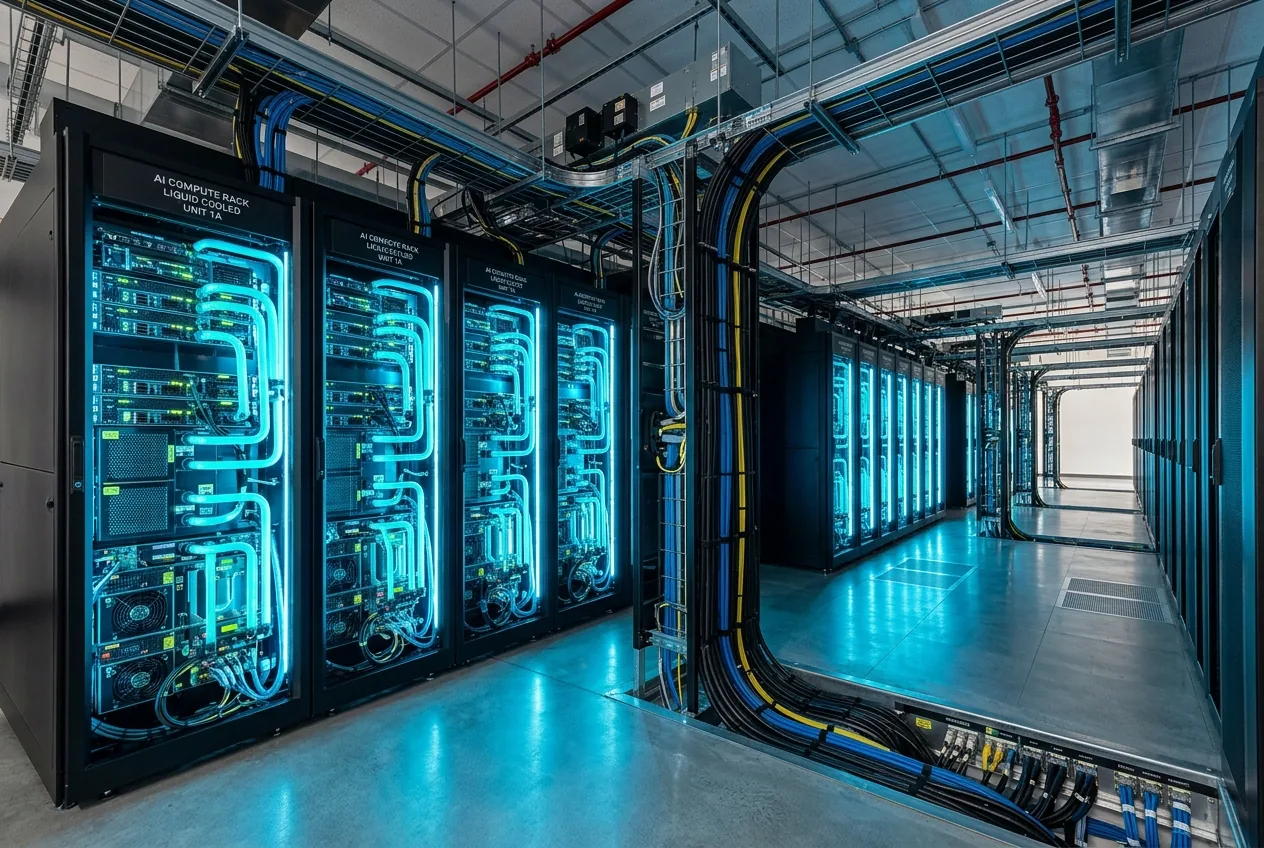
Frontier model labs face relentless operational head-winds. The capital cost of training state-of-the-art models scales exponentially with every generation, requiring hundreds of megawatts of continuous electrical power, advanced liquid cooling infrastructure, and gigawatt-scale grid interconnections that take years to permit and build. Concurrently, inference costs are continually driven downward by open-weight alternatives, post-training quantization techniques, and architectural optimizations that reduce token production expenses. If the core intelligence layer undergoes rapid commoditization, foundation model providers risk becoming high-capex utilities with compressed operating margins.
For Anthropic to consolidate its position and realize astronomical market expectations, it must maintain a widening technological moat that open-weight models cannot easily duplicate. That moat cannot consist merely of parameter count or dataset volume; it must be built on proprietary alignment frameworks, low-latency reasoning engines, automated self-improvement loops, and flawless enterprise tool integration. If Anthropic can sustain its reputation as the most reliable, secure, and computationally efficient intelligence layer for global industry, its ongoing surge in valuation will not be viewed as an anomaly of market speculation, but as the opening chapter in the industrialization of machine intelligence.




Comments
No comments yet. Be the first!