The landscape of artificial intelligence is no longer confined to the digital ether of chatbots and image generators. Recent reports, most notably from The Times, suggest that OpenAI is laying the groundwork for a public flotation that could value the company at a staggering $1 trillion. This shift comes as the San Francisco-based firm moves beyond the legal shadows cast by its founding disputes, most notably the high-profile lawsuit from Elon Musk which was recently dropped. For the industrial sector, this isn't merely a financial milestone; it represents a fundamental pivot in how machine intelligence will be deployed across the global supply chain and manufacturing floors.
The Economic Architecture of a Trillion-Dollar AI
Achieving a $1 trillion valuation requires more than just high-quality text synthesis. It demands a level of industrial utility that OpenAI is currently scrambling to build. To justify such a price tag, the company must transition from a provider of creative tools to the operating system of the physical world. This transition is predicated on three technical pillars: massive-scale compute infrastructure, the maturation of reasoning-based models, and the reentry into robotics. The financial math of a $1 trillion flotation rests on OpenAI becoming the primary architectural layer for autonomous systems across every vertical of the global economy.
Historically, OpenAI’s corporate structure was an anomaly—a non-profit board overseeing a capped-profit subsidiary. This arrangement, while perhaps suitable for research, was a significant friction point for a traditional public offering. The reported moves toward a more conventional for-profit structure are a pragmatic response to the capital-intensive nature of next-generation AI. Training a model like GPT-5 or the rumored Project Strawberry requires capital outlays that rival the GDP of mid-sized nations. By clearing legal hurdles and streamlining its corporate governance, OpenAI is signaling to institutional investors that it is ready to operate with the discipline and scale of a hardware giant like NVIDIA or a software titan like Microsoft.
Why Robotics Is Central to the Flotation Strategy
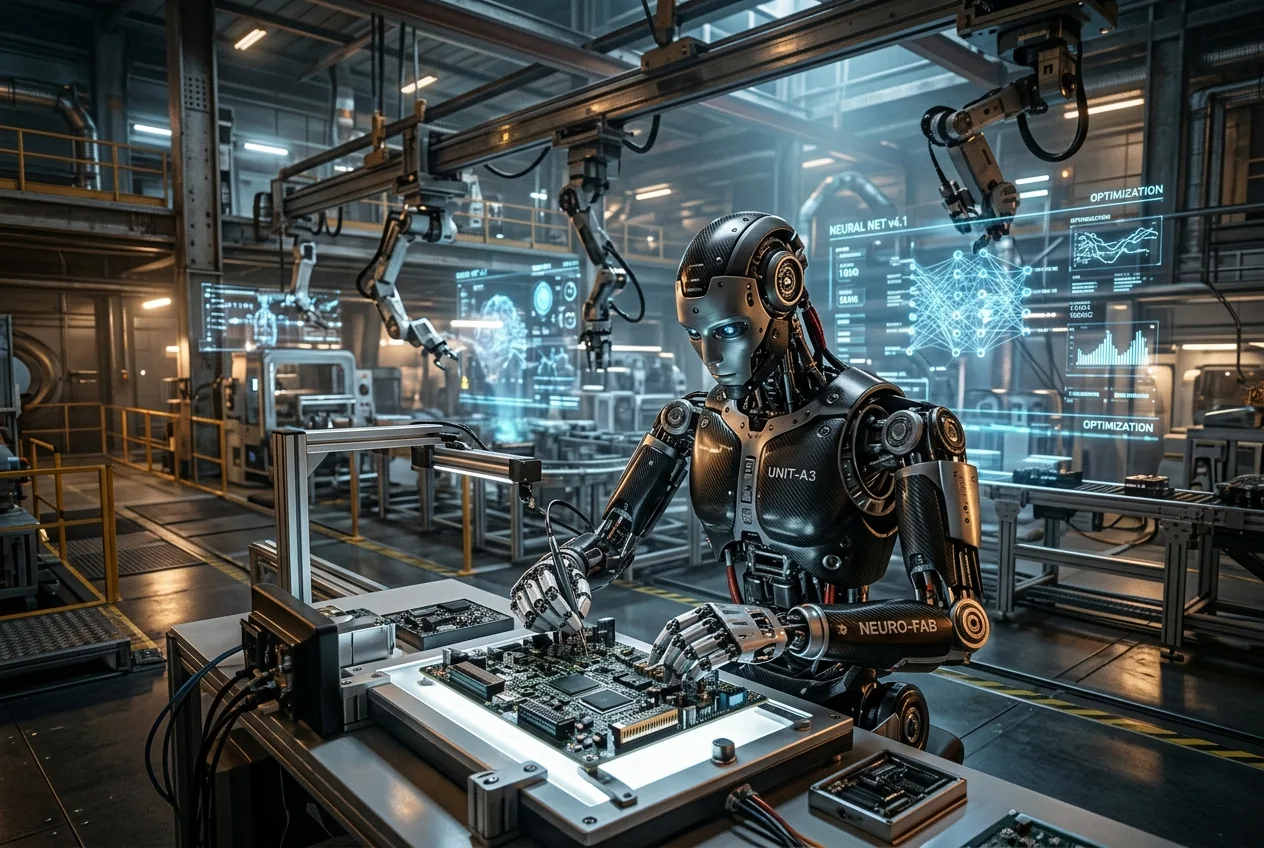
For those of us tracking the mechanics of automation, the most significant indicator of OpenAI’s $1 trillion ambition is the quiet re-formation of its robotics team. Years ago, OpenAI abandoned its internal robotics efforts to focus on large language models (LLMs), citing a lack of high-quality data. However, the success of GPT-4 and subsequent models has provided the missing piece: a cognitive engine capable of understanding complex, unscripted environments. OpenAI is no longer satisfied with keeping AI in a box; they are now investing heavily in the hardware interface.
The technical challenge here is the translation of digital reasoning into "low-level" motor control. Traditional robotics relies on hardcoded routines; OpenAI’s approach utilizes end-to-end neural networks that learn physics through simulation and real-world observation. This shift from deterministic programming to probabilistic learning is what will allow a $1 trillion entity to dominate the industrial sector. The valuation reflects a bet that OpenAI will solve the "generalization" problem in robotics—creating machines that can perform any task a human can, without needing to be reprogrammed for every new widget on the line.
The Hardware Constraint and the Stargate Project
An often-overlooked aspect of OpenAI’s road to IPO is the sheer physical infrastructure required to sustain its growth. Reports of the "Stargate" project—a $100 billion supercomputer initiative in partnership with Microsoft—highlight the massive capital expenditure (CapEx) involved. As a mechanical engineer, I look at these projects not just as software achievements, but as massive thermal and electrical engineering challenges. A $1 trillion company must own or have exclusive access to the most efficient compute clusters on the planet to maintain its competitive moat.
Can Reasoning Models Replace Human Logic in Supply Chains?
A core component of the valuation story is "Project Strawberry," a new model architecture designed to enhance the reasoning capabilities of AI. Current LLMs are essentially sophisticated pattern matchers—they predict the next token based on statistical probability. While effective for writing emails, this is insufficient for complex industrial logic, such as optimizing a global supply chain during a disruption or managing the multi-variable stresses of a high-speed manufacturing cell.
Strawberry aims to introduce what researchers call "System 2" thinking—deliberate, multi-step reasoning. This would allow the AI to pause and "think" through a problem before responding, rather than just generating the most likely sequence of words. For the industrial world, this means an AI that can troubleshoot a mechanical failure by deducing the root cause through logical elimination, rather than just reciting a manual. This level of utility is what institutional investors are looking for: an AI that doesn't just assist, but manages.
Navigating the Competitive and Regulatory Minefield
Despite the optimism surrounding a potential $1 trillion flotation, significant headwinds remain. The resolution of the Musk lawsuit is a victory, but the regulatory environment in the European Union and the United States is tightening. Issues regarding data copyright, safety guardrails, and the environmental impact of massive data centers are constant threats to the bottom line. Furthermore, competitors like Anthropic and Google are not standing still. The "compute wars" are an arms race where the cost of entry is rising exponentially.
From an industrial perspective, the biggest risk is the reliability of these systems. A "hallucination" in a chatbot is a minor annoyance; a hallucination in a five-ton industrial robot is a catastrophic safety event. OpenAI’s path to a trillion dollars depends on its ability to prove that its neural networks are deterministic enough for the factory floor. They must move from "generative" AI to "verifiable" AI. This will likely involve a hybrid approach where neural networks handle the high-level planning while traditional, safety-rated controllers handle the final motor execution.
The prospect of an OpenAI flotation marks the end of the first era of AI—the era of novelty and experimentation. We are entering the era of industrialization. A $1 trillion valuation is a declaration that artificial intelligence is the new electricity, and OpenAI intends to be the primary grid. For those of us in the robotics and engineering fields, the focus now shifts from what these models can say to what they can do. The real test of OpenAI’s value won't be found in its stock price, but in the precision of the robotic hands its software eventually controls.




Kommentare
Noch keine Kommentare. Seien Sie der Erste!