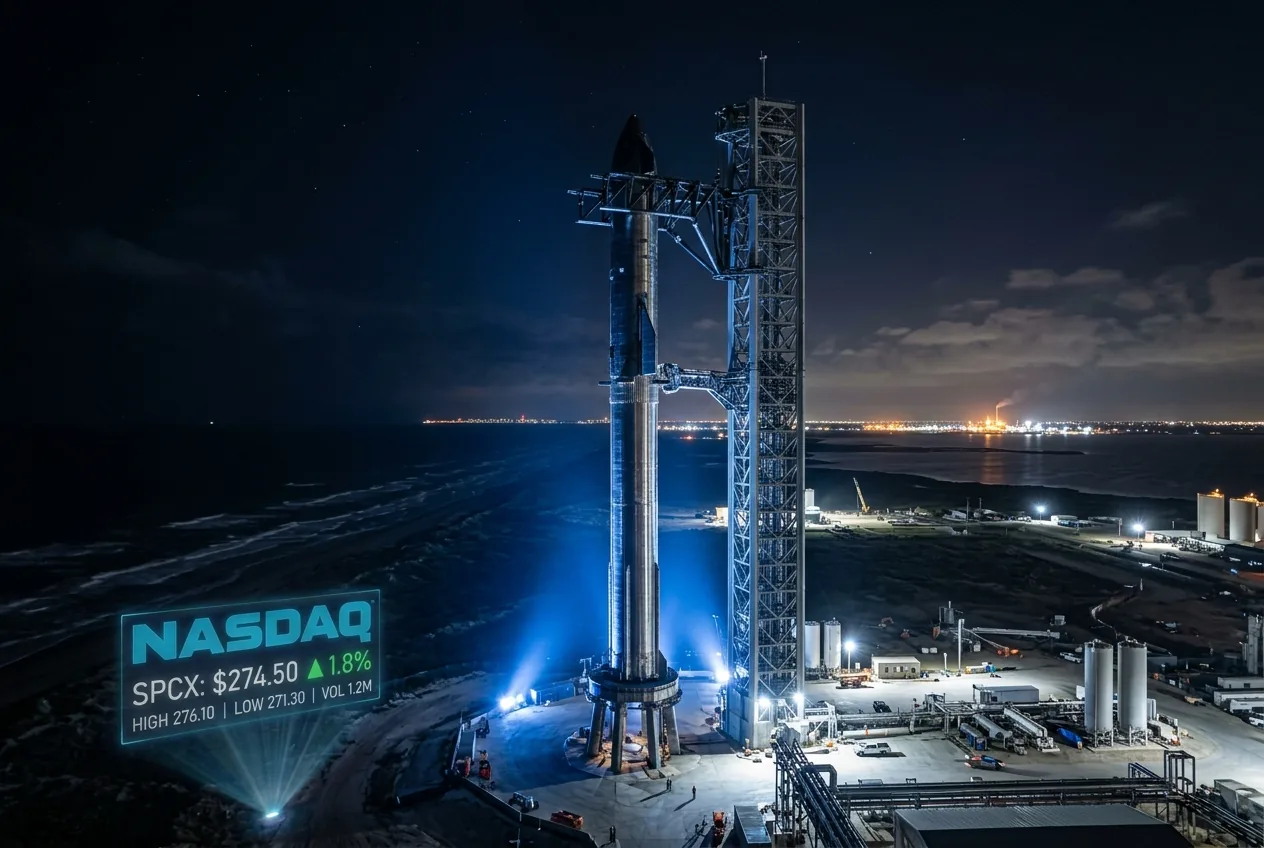
On May 20, 2026, Space Exploration Technologies Corp., better known as SpaceX, submitted its S-1 registration statement to the Securities and Exchange Commission, signaling the commencement of what is poised to be the most significant initial public offering in the history of global finance. Trading under the ticker symbol SPCX on the Nasdaq, the company has set a tentative listing date of June 12. The filing reveals a target valuation exceeding $1.75 trillion, with plans to raise approximately $75 billion in fresh capital. To put this in perspective, this offering seeks to raise more than two and a half times the capital of the previous record-holder, Saudi Aramco, which raised $29 billion in 2019.
From a technical and mechanical engineering perspective, this IPO represents more than just a liquidity event for early investors; it is the financial validation of a vertically integrated orbital infrastructure. For over two decades, SpaceX operated as a private entity, insulating its R&D cycles—and its frequent, explosive test failures—from the quarterly scrutiny of public markets. However, the 2025 fiscal data included in the filing suggests a company that has moved beyond the experimental phase and into a period of aggressive industrial scaling. The company reported $18.67 billion in revenue for 2025, with net profits estimated near $8 billion, driven largely by the maturity of the Falcon 9 launch cadence and the global expansion of the Starlink satellite constellation.
The xAI Merger and the Logic of Orbital Compute
The economic viability of xAI within the SpaceX ecosystem is a point of intense analytical debate. At the time of the merger, xAI was reportedly consuming $1 billion per month in operational expenses, primarily driven by the massive compute requirements of training large language models. For a traditional aerospace firm, such a burn rate would be catastrophic. However, the SpaceX filing suggests a strategic pivot toward "orbital edge computing." By leveraging Starlink’s low-earth orbit (LEO) position, the combined entity aims to provide AI-driven data processing with lower latency than traditional terrestrial data centers for remote and industrial applications. This technical moat—owning the launch vehicle, the satellite, and the AI software—is the primary justification for the $1.75 trillion price tag.
Can Starlink Sustain the xAI Burn Rate?
For investors, the critical question lies in the cash-flow balance between the highly profitable Starlink division and the capital-intensive xAI division. Starlink has successfully transitioned from a high-risk venture into a dominant global ISP, serving millions of customers in regions where fiber-optic infrastructure is non-existent or cost-prohibitive. The revenue generated by these subscriptions provides the steady cash flow necessary to offset the high CapEx of Starship development and xAI’s R&D. The filing confirms that Starlink’s margins have improved significantly as the company has optimized its satellite manufacturing processes and increased the lifespan of its v2 Mini and v3 hardware iterations.
Starship as the Ultimate Industrial Enabler
While the financial headlines focus on the xAI merger, the mechanical heart of the company remains Starship. The filing provides the first concrete look at the unit economics of the most powerful rocket ever built. SpaceX’s long-term valuation is tethered to the successful operationalization of Starship’s full reusability. The ability to launch 100+ tons of cargo to LEO at a marginal cost that is an order of magnitude lower than the Falcon 9 is the prerequisite for the company’s more ambitious goals, including the colonization of Mars and the construction of large-scale orbital manufacturing facilities.
The engineering milestones achieved in 2025, including successful propellant transfer trials and heat shield reliability improvements, have clearly emboldened the company to pursue this public offering. From a mechanical standpoint, the transition from experimental flights to a high-frequency launch architecture is the most difficult phase of any aerospace program. The IPO capital—approximately $75 billion—is expected to be funneled directly into the mass production of Raptor engines and the construction of multiple "Starfactory" sites in Texas and Florida. This level of industrial scaling is unprecedented in the aerospace sector, effectively treating rocket production with the same assembly-line philosophy that Musk applied to automotive manufacturing at Tesla.
The OpenAI Legal Backdrop and Market Competition
The timing of the SpaceX IPO is inextricably linked to the broader legal and competitive landscape of the AI industry. As SpaceX filed its papers, Elon Musk remained embroiled in a high-profile legal battle against Sam Altman and OpenAI. The trial, which began in late April 2026 in Oakland, California, centers on allegations that OpenAI abandoned its original nonprofit mission in favor of a for-profit model backed by Microsoft. This legal friction underscores the intense rivalry between xAI (now a core part of the SpaceX value proposition) and OpenAI.
If the SpaceX IPO is successful, it will provide Musk with a massive war chest to compete directly with OpenAI and Microsoft. The public market’s reception of the "SPCX" ticker will serve as a referendum on which vision of AI humanity prefers: the closed-loop, big-tech model represented by OpenAI, or the hardware-integrated, frontier-focused model represented by the SpaceX-xAI conglomerate. The S-1 filing does not shy away from this competition, listing the rapid advancement of artificial general intelligence (AGI) as a core objective that will be facilitated by SpaceX’s unique ability to deploy massive compute clusters into orbit, away from the constraints of terrestrial power grids and cooling limitations.
Is a $1.75 Trillion Valuation Rationally Defensible?
Skeptics on Wall Street argue that the $1.75 trillion figure is more a reflection of Musk’s personal brand than the company’s current fundamentals. At nearly 94 times its 2025 revenue, the valuation is astronomical by traditional industrial standards. However, SpaceX has never been a traditional industrial company. It is a infrastructure play that spans telecommunications, defense, transportation, and now, artificial intelligence. The technical moat created by reusable rocketry is currently unchallenged; no other entity, government or private, has a flight-proven equivalent to the Falcon 9, let alone Starship.




Kommentare
Noch keine Kommentare. Seien Sie der Erste!