The rumors circulating through the upper echelons of Silicon Valley and Wall Street have finally coalesced into a singular, gravity-defying narrative: OpenAI is reportedly preparing to file for an initial public offering (IPO) this September. While the tech industry is no stranger to high-stakes debuts, the projected valuation of $1 trillion places this event in a category of its own. To put this in perspective, a trillion-dollar valuation would immediately position OpenAI alongside the ‘Magnificent Seven’—the cohort of tech titans that currently dominate the global economy. For those of us focused on the mechanical and industrial underpinnings of technology, this isn’t just a story about a chatbot. It is a story about the massive scaling of compute, the restructuring of global supply chains, and the physical reality of powering the next industrial revolution.
From a technical standpoint, the transition of OpenAI from a non-profit research collective to a trillion-dollar public entity represents the most significant shift in corporate structure since the emergence of the modern semiconductor industry. This move is not merely about raising capital for software development; it is about the capital-intensive demands of hardware. Training the next generation of Large Language Models (LLMs), such as the anticipated GPT-5 or the video-generation engine Sora, requires an unprecedented amount of compute density. A trillion-dollar valuation reflects the market's belief that OpenAI can move beyond being a software provider and become the foundational layer for the world’s digital and physical automation systems.
The Economic Reality of Compute Density
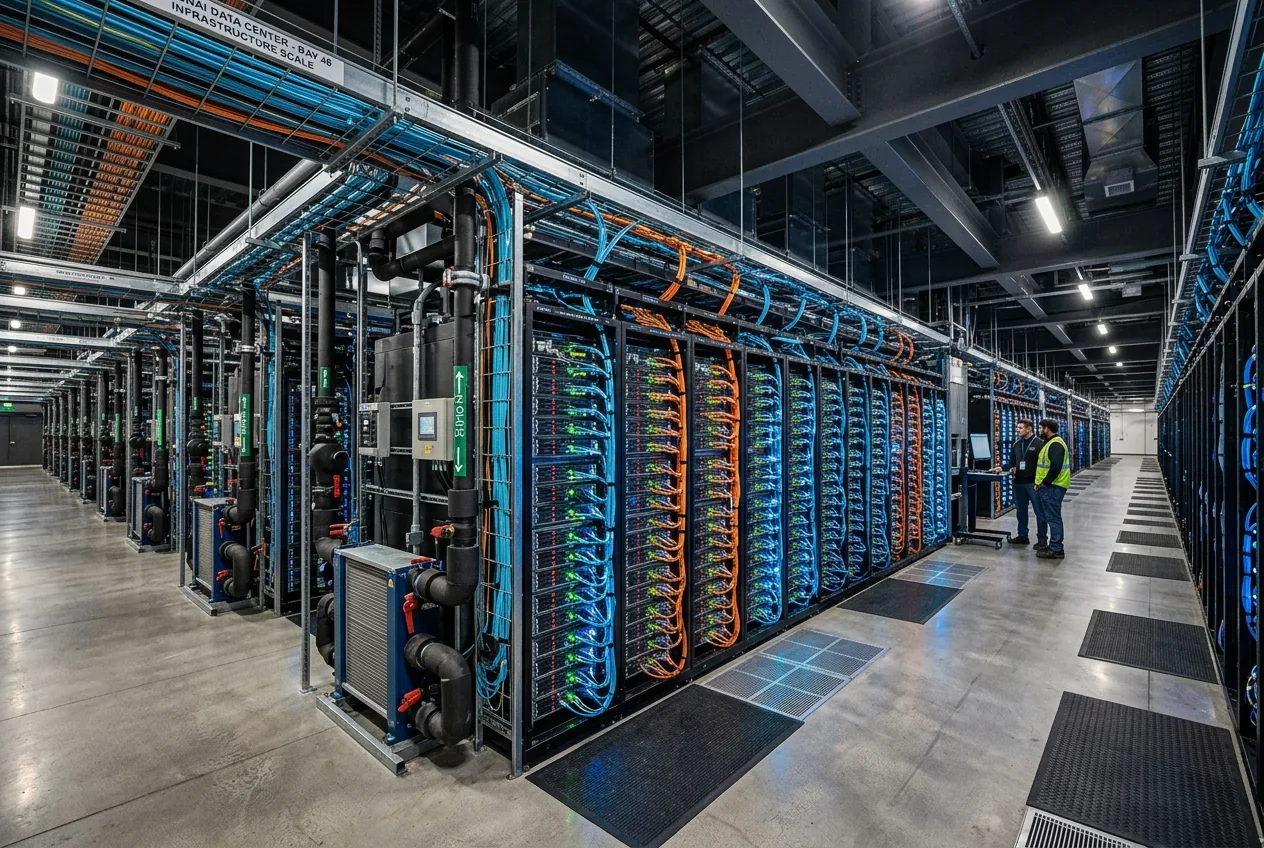
To understand the $1 trillion figure, one must look past the user interface of ChatGPT and into the data center. The primary constraint on OpenAI’s growth has never been the code—it has been the silicon. The company’s reliance on NVIDIA’s H100 and upcoming Blackwell architecture is well-documented, but the sheer scale of the hardware procurement required to justify a trillion-dollar valuation is staggering. We are talking about clusters of GPUs numbering in the hundreds of thousands, requiring specialized cooling systems, massive power draws, and a logistical network that rivals traditional heavy manufacturing.
As a mechanical engineer, I view these data centers not as mere buildings, but as high-performance machines. The thermal management challenges alone are immense. Shifting from air-cooled racks to liquid-immersion cooling is no longer an experimental choice; it is a thermal necessity when packing kilowatts of heat into every square inch of rack space. OpenAI’s valuation is, in many ways, a bet on their ability to manage this physical infrastructure more efficiently than their competitors. If they can solve the throughput issues of data movement between these massive nodes, they effectively own the fastest 'factory' for intelligence on the planet.
Restructuring for the Public Market
However, from a pragmatic industrial perspective, this restructuring is a prerequisite for the scale OpenAI intends to reach. You cannot build a global network of specialized AI chip foundries or secure multi-gigawatt energy contracts through a non-profit structure. The capital requirements for Altman’s rumored 'Stargate' project—a $100 billion supercomputer—require the kind of liquidity and debt-capacity that only a massive public company can command. The September filing is the first formal step in acknowledging that AI has moved out of the laboratory and into the industrial mainstream.
Can the Revenue Support the Valuation?
A $1 trillion valuation requires a clear path to tens of billions in annual revenue. Currently, OpenAI generates significant income through its enterprise subscriptions and API licensing, but the question remains: is the utility of LLMs high enough to sustain this growth? The skepticism lies in the difference between 'interest' and 'integration.' For OpenAI to hit its targets, AI must move beyond being a creative assistant and become a core component of industrial automation, supply chain optimization, and predictive maintenance.
The Hardware Independence Gambit
One of the most compelling aspects of OpenAI’s current strategy is the move toward hardware independence. Reports have long suggested that Sam Altman is seeking to raise trillions of dollars to reshape the global semiconductor supply chain. While the IPO itself won't reach those multitrillion-dollar heights, it provides the necessary equity base to lead a coalition of investors and sovereign wealth funds. The goal is clear: bypass the bottlenecks of the current foundry system.
Building a chip fabrication plant (a 'fab') is one of the most complex engineering feats human beings undertake. It requires precision at the atomic scale, stable power grids, and a highly specialized workforce. If OpenAI intends to design its own silicon tailored specifically for transformer architectures, they are entering a domain dominated by giants like TSMC and Intel. The IPO proceeds will likely be channeled into these deep-tech ventures, aiming to create a vertically integrated stack where OpenAI owns everything from the weights of the model down to the transistor gate. This vertical integration is the classic playbook for industrial dominance, reminiscent of the early days of the Ford Motor Company or the vertically integrated energy giants of the 20th century.
Regulatory Hurdles and Global Competition
Entering the public market also invites unprecedented scrutiny from regulators. The SEC will demand transparency regarding OpenAI’s data acquisition methods, its energy consumption, and its competitive practices. Furthermore, the geopolitical dimension cannot be ignored. AI is now a matter of national security. A public OpenAI will be at the center of the export control debates regarding advanced chips and 'model weights' being shared with adversarial nations. This political friction adds a layer of risk that speculative investors must weigh against the technical potential.
The Physical Bottleneck: Energy
Perhaps the most understated challenge to OpenAI’s trillion-dollar ambition is the global energy crisis. Training and running models of this magnitude require gigawatts of power. In an era where many regions are struggling with grid stability and transitioning to renewables, OpenAI’s growth is physically limited by how much electricity it can secure. This is why we see Sam Altman investing in fusion energy startups like Helion. The IPO isn’t just about the software; it’s about securing the future of energy production.
From a mechanical engineering perspective, the efficiency of the power conversion chain—from the grid to the transformer to the chip—is where the real battles will be won. Every percentage point gained in power usage effectiveness (PUE) translates to millions of dollars in saved operational expenditure at the scale OpenAI is operating. A public company with a trillion-dollar market cap will have the leverage to negotiate directly with utility providers and perhaps even build its own modular nuclear reactors to power its data centers. This is the level of industrial thinking required to sustain the AI boom.
The upcoming September filing is a watershed moment. It marks the end of the era of AI as a digital curiosity and the beginning of its era as a physical, industrial powerhouse. Whether OpenAI can navigate the transition from a nimble research lab to a regulated, publicly traded trillion-dollar titan will be the defining story of the decade. For those of us watching the machines, the hardware, and the energy grids, the message is clear: the infrastructure of the future is being built now, and it carries a very heavy price tag.




Kommentare
Noch keine Kommentare. Seien Sie der Erste!