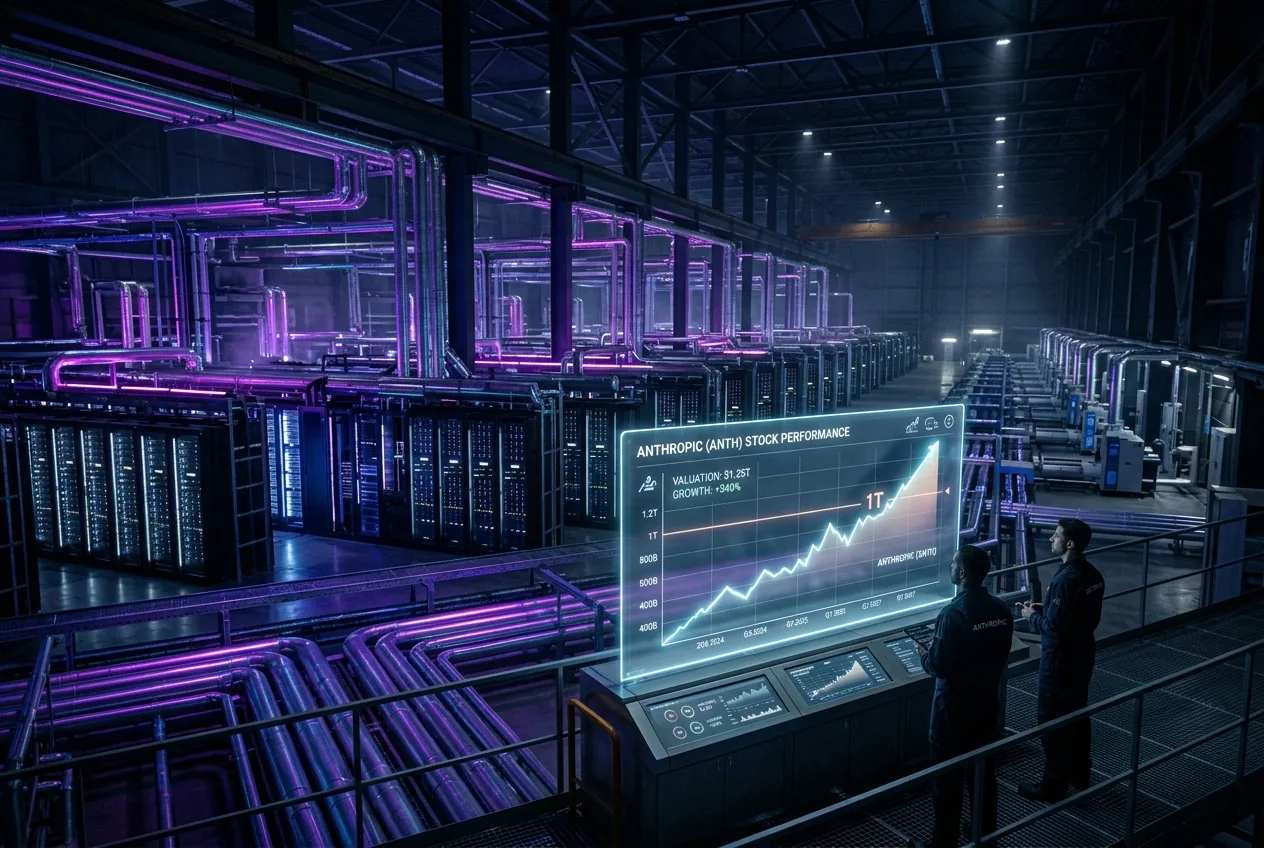
In a move that redefines the scale of venture-backed industrial growth, Anthropic has reportedly secured a $65 billion funding round, catapulting its valuation to approximately $965 billion. This surge not only places the company on the cusp of the trillion-dollar threshold but also represents a pivotal moment in the competitive hierarchy of the artificial intelligence sector. For the first time, Anthropic has effectively surpassed OpenAI in valuation, signaling a market shift toward the company’s specific brand of safety-first, enterprise-grade model architecture.
The scale of this capital injection is difficult to overstate. In the history of private technology financing, a $65 billion single-round raise is virtually unheard of, reflecting the massive capital expenditures required to maintain leadership in the large language model (LLM) space. As hardware requirements for training the next generation of foundational models continue to scale exponentially, Anthropic is positioning itself as the primary beneficiary of a compute-driven supercycle, backed by the industrial might of Amazon, Google, and a burgeoning strategic partnership with SpaceX.
The mechanics of industrial-scale AI financing
The sheer magnitude of Anthropic’s latest funding round underscores a pragmatic reality of the current AI landscape: the transition from experimental software to global infrastructure requires capital levels typically reserved for sovereign wealth funds or national defense projects. This $65 billion is not merely a cushion for operational expenses; it is a war chest for the acquisition of high-end compute clusters and the energy infrastructure necessary to power them. As a mechanical engineer by training, I view this less as a venture capital event and more as a massive build-out of digital industrial capacity.
Anthropic has demonstrated a unique ability to convert capital into high-efficiency output. While early criticisms of the LLM market focused on the high cost of inference and training, Anthropic’s recent financial disclosures suggest a tightening of the compute-to-revenue ratio. With projected Q2 revenues nearing $10.9 billion and a total annual revenue run rate approaching $45 billion, the company is proving that large-scale AI can move beyond the research laboratory and into a sustainable, profitable business model. The reporting of a $559 million profit is a critical milestone, suggesting that the era of the "AI money pit" may be ending for those who can achieve sufficient scale.
Why has the market flipped from OpenAI to Anthropic?
For several years, OpenAI was the undisputed bellwether of the industry. However, the valuation flip suggests that institutional investors are increasingly favoring Anthropic’s "Constitutional AI" approach. This methodology, which embeds a set of core principles directly into the model's training process to ensure safety and alignment, has proven highly attractive to the enterprise and industrial sectors. For a Fortune 500 company or a government entity, the predictability and reliability of a model are often more valuable than raw creative flair.
OpenAI has faced increasing pressure regarding its corporate structure and the timeline of its eventual initial public offering (IPO). In contrast, Anthropic’s steady focus on its Claude series of models has allowed it to capture a significant portion of the high-stakes enterprise market. While OpenAI’s revenue is formidable at an estimated $25 billion, Anthropic’s $45 billion figure indicates a faster adoption rate within industrial supply chains and automated decision-making systems. The market is effectively betting that Anthropic’s architecture is more suitable for the rigorous demands of the global economy.
The role of strategic infrastructure and the SpaceX deal
A significant factor in Anthropic’s valuation surge is its integration with physical infrastructure providers. Beyond its well-documented ties to Amazon and Google, the emergence of a strategic deal with SpaceX has introduced a new dimension to Anthropic’s utility. In the context of industrial automation and aerospace, the need for low-latency, high-reliability AI at the edge is paramount. By aligning with SpaceX, Anthropic gains a potential pathway to integrate its models into the Starlink satellite network, providing a global, decentralized compute fabric that rivals traditional terrestrial data centers.
Is a trillion-dollar valuation sustainable in the AI sector?
The $65 billion raise allows Anthropic to skip several steps of traditional growth. It provides the liquidity to secure long-term contracts for the most advanced semiconductors before they even leave the fab. In a market where compute is the new oil, Anthropic has just secured the largest reserves on the planet. The economic viability is tied directly to the productivity gains seen by its users. If a Claude-based system can optimize a global supply chain or accelerate the design of a new propulsion system by even a few percentage points, the ROI on a $1 trillion valuation begins to look remarkably conservative.
What should stakeholders watch for in the coming months?
Moving forward, the primary metric for Anthropic’s success will be its ability to maintain profit margins while continuing this aggressive expansion. The recent $559 million profit is a good start, but as training costs for models like Claude 4 or 5 inevitably climb, the efficiency of the underlying hardware will be the deciding factor. We should closely monitor Anthropic’s announcements regarding custom silicon or proprietary data center designs. If they follow the path of other tech giants by designing their own chips, their valuation could see another significant jump as they decouple their costs from the external semiconductor market.
Additionally, the competitive response from OpenAI and other players like xAI or Google’s DeepMind will be fierce. OpenAI’s IPO timeline appears to be under pressure, and how they choose to recapitalize will determine if they can regain their lead. However, for now, the momentum is clearly in Anthropic's favor. The transition from $965 billion to a trillion dollars is more than just a psychological milestone; it is a signal that the AI industry has reached a level of maturity where it can command the same level of capital and respect as the energy and aerospace titans that preceded it.




Comments
No comments yet. Be the first!