The landscape of artificial intelligence has shifted on its axis. In a move that defies traditional venture capital logic and resets the parameters of industrial competition, Anthropic has reportedly secured a $65 billion funding round, catapulting its post-money valuation to an unprecedented $965 billion. This figure does not merely place Anthropic in the upper echelons of the tech world; it positions the company as a near-trillion-dollar entity, effectively leapfrogging OpenAI in a contest defined by capital intensity and raw compute power. For those of us tracking the intersection of mechanical engineering and high-scale automation, this isn’t just a financial headline. It is a signal of the transition from AI as a software experiment to AI as the primary industrial infrastructure of the 21st century.
To understand the gravity of a $965 billion valuation, one must look past the interface of the Claude chatbot and into the physical requirements of modern large language models (LLMs). A capital injection of $65 billion is not destined for marketing or headcount in the traditional sense. Instead, this capital is a direct bet on the scaling laws of transformer-based architectures. In the engineering world, we recognize that to double the performance of a complex system, one often needs to quadruple the energy and physical resources dedicated to it. Anthropic’s massive war chest suggests they are preparing for a scale of hardware deployment that was previously the sole domain of nation-states or the world's three largest hyper-scalers.
The Industrialization of Large-Scale Compute
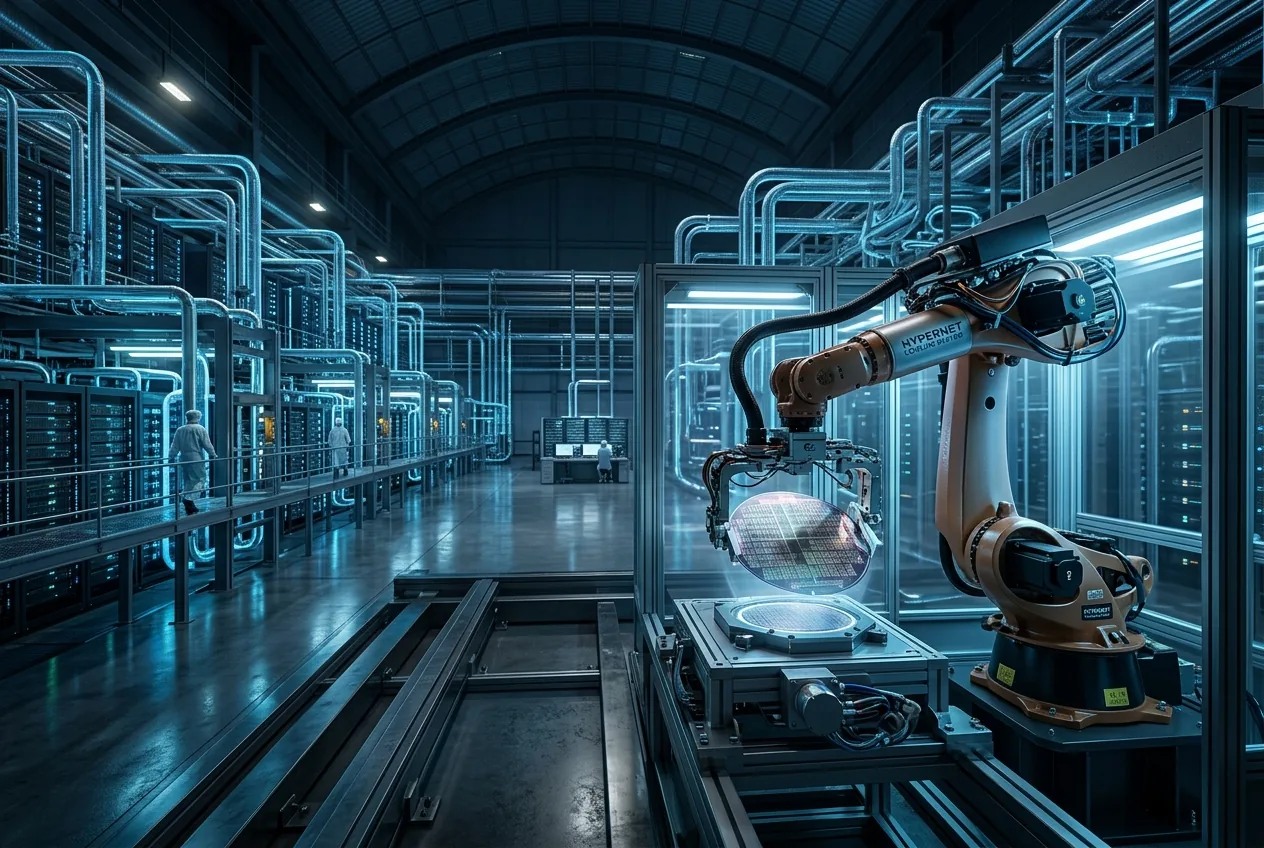
The cooling requirements for a cluster capable of training a multi-trillion parameter model—which this funding suggests is on the horizon—require liquid-to-chip cooling solutions that dwarf current industrial standards. We are moving away from traditional air-cooled racks toward closed-loop manifold systems that can dissipate the immense heat generated by dense compute clusters. For Anthropic, this $65 billion isn't just about software; it’s about securing the physical supply chain of silicon, specialized copper interconnects, and the very electricity required to keep the lights on in Virginia or Iowa. It is an industrial play disguised as a software valuation.
Does Constitutional AI Scale Economically?
One of the primary differentiators for Anthropic has always been its focus on "Constitutional AI"—a method of training models to follow a set of rules and principles to ensure safety and alignment. While this has been viewed as a moral or safety-oriented choice, the recent valuation suggests it is now being viewed as an economic one. In the world of industrial automation and enterprise deployment, reliability is the only metric that truly matters. A robot in a fulfillment center cannot afford a 5% hallucination rate; a structural engineering firm cannot use a model that occasionally ignores the laws of physics for the sake of creative prose.
The Shift from LLMs to Large Action Models
A significant portion of this valuation likely stems from Anthropic’s recent breakthroughs in "computer use" and agentic workflows. As an engineer, I view the transition from text-generating models to action-oriented models as the most critical hurdle in robotics. For years, the bottleneck in robotic automation has not been the hardware—we have excellent servos, actuators, and sensors—but the reasoning engine that tells the hardware what to do in unstructured environments. Anthropic’s trajectory suggests they are building the brain for the next generation of general-purpose robots.
When a model can navigate a GUI, understand CAD drawings, and manipulate software tools as a human would, the distance between the digital and physical worlds vanishes. This $65 billion allows Anthropic to integrate their reasoning engines directly with industrial hardware manufacturers. Imagine a scenario where the model isn't just suggesting a part for a machine but is actively coordinating with a CNC mill or a 3D printer to prototype a replacement in real-time. This is the industrial utility that justifies a trillion-dollar market cap: the total automation of the design-to-manufacture pipeline.
The Geopolitical and Supply Chain Moat
This puts immense pressure on OpenAI and other players. If the "Seven Magnificents"—the tech giants that have dominated the last decade—find themselves competing with a startup that has the bankroll of a sovereign wealth fund, the acquisition market for AI talent and specialized hardware will become even more cutthroat. We are seeing a consolidation of power where only those who can afford the multi-billion dollar entry fee for the next generation of compute can stay in the game. From a market perspective, this capital injection suggests that the "winner takes most" dynamic of the digital age is being replicated in the AI age, but at a scale that is an order of magnitude larger.
Infrastructure as the Ultimate Bottleneck
Despite the optimism reflected in the $965 billion valuation, the path forward is not without severe technical constraints. The primary challenge remains energy. A model capable of justifying this valuation will require gigawatts of power. We are reaching the point where AI companies may need to become energy companies, investing in modular nuclear reactors (SMRs) or massive dedicated solar arrays to ensure their data centers remain operational. The mechanical overhead of managing these facilities is a discipline in itself.
Furthermore, the data used to train these models is hitting a plateau. The next frontier for Anthropic will likely involve synthetic data generation and the use of physical robots to "learn" from the real world. This is where the BSc in Journalism meets the MSc in Mechanical Engineering: the story of AI is no longer about chatbots; it is about the physical manifestation of intelligence in our world. As Anthropic deploys its $65 billion, the focus will move from the cloud to the concrete. The question is no longer whether the software works, but whether our physical infrastructure can handle the sheer force of the intelligence we are trying to build. For now, the market has placed its bet: Anthropic is not just a software company; it is the new architect of the automated world.




Comments
No comments yet. Be the first!