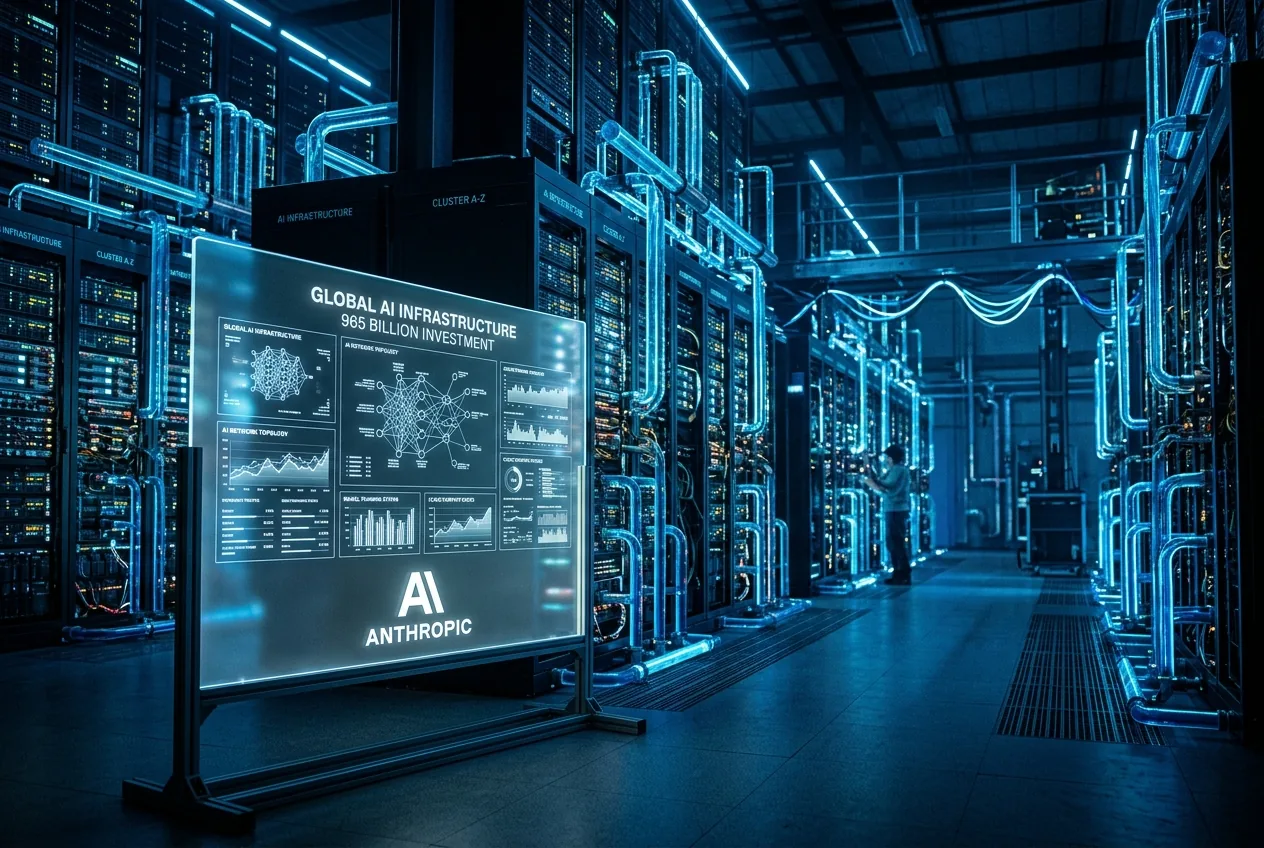
The landscape of generative artificial intelligence has undergone a tectonic shift as Anthropic, the San Francisco-based AI safety and research lab, announced a massive $65 billion funding round. This infusion of capital has propelled the company to a valuation of $965 billion, effectively positioning it as a near-trillion-dollar entity and leapfrogging its primary rival, OpenAI, which was last valued at $852 billion. The funding, led by a coalition of Silicon Valley’s most influential venture capital firms including Sequoia Capital, Altimeter Capital, and Greenoaks, marks a pivot in the industry’s trajectory—moving away from consumer-facing chatbots and toward deep, industrial-scale enterprise integration.
For those tracking the intersection of high-end hardware and software architecture, this valuation is not merely a reflection of algorithmic superiority. It is a bet on the logistical and infrastructural reality of modern computing. Anthropic’s strategy, led by CEO Dario Amodei, has increasingly focused on the "how" of AI deployment within existing corporate and industrial frameworks. By securing strategic partnerships with semiconductor leaders like Samsung, Micron, and SK hynix, Anthropic is addressing the physical bottleneck of AI: the hardware supply chain. These firms produce the high-bandwidth memory (HBM) and specialized processing components essential for scaling large language models (LLMs) like Claude, ensuring that Anthropic’s software layer is vertically aligned with the hardware that powers it.
The Economics of Enterprise Stickiness
The core of Anthropic’s nearly trillion-dollar thesis lies in enterprise reliability. While OpenAI captured the public’s imagination with ChatGPT, Anthropic has focused on the more lucrative—and more difficult—task of making AI "boring" enough for the Fortune 500. This means prioritizing safety, predictable outputs, and seamless integration into established workflows. The recent funding round included $15 billion in previously committed investments from cloud providers, including a significant $5 billion stake from Amazon. This suggests a future where Claude is not just a tool but a foundational layer of the global cloud infrastructure.
Anthropic has become the first frontier AI developer to have its models available across all three major cloud platforms: Amazon Web Services (AWS), Google Cloud, and Microsoft Azure. From a mechanical engineering perspective, this is akin to a manufacturer ensuring their proprietary engine fits into every chassis on the market. By removing the friction of cloud exclusivity, Anthropic has expanded its total addressable market to include virtually every major industrial and financial sector currently utilizing cloud computing. This ubiquity is a key driver behind the $965 billion figure, as it hedges the company’s success against the fluctuations of any single cloud provider’s market share.
The Hardware-Software Bridge and Supply Chain Resilience
The participation of Samsung and SK hynix in this funding round is perhaps the most telling aspect of Anthropic’s current trajectory. As the global demand for AI compute continues to outstrip supply, the relationship between model developers and chip manufacturers has become the most critical link in the technology stack. In the world of robotics and industrial automation, we often speak of the importance of the physical interface; for Anthropic, that interface is the silicon. By involving semiconductor firms as strategic partners, Anthropic is essentially pre-negotiating its place in the queue for the next generation of AI chips.
This strategic positioning is vital for the company’s upcoming next-generation model, Mythos. Unlike Claude, which is designed for broad utility, Mythos is reportedly being developed with unprecedented cybersecurity capabilities and a focus on high-stakes industrial environments. Because of its potential for both offensive and defensive applications, Anthropic has restricted access to a select group of security partners. This move reflects a broader trend toward "sovereign AI," where the reliability and security of the model are more important than its creative flair. In a manufacturing or supply chain context, a model that can predict a failure in a robotic arm or a vulnerability in a global shipping network with 99.9% accuracy is worth significantly more than one that can write poetry.
Geopolitical Friction and the Pentagon Dispute
However, the road to a trillion-dollar IPO is not without its mechanical failures. Anthropic is currently embroiled in a high-profile legal dispute with the United States Pentagon. The Department of Defense recently designated the company as a supply chain risk, a move that Anthropic has challenged in court as unconstitutional retaliation. The friction stems from Anthropic’s refusal to grant the military unfettered access to its core models, citing its foundational commitment to AI safety and ethical boundaries.
From an industrial standpoint, this dispute highlights the tension between private innovation and national security. If a model like Mythos becomes a critical component of the national infrastructure, the government’s desire for control becomes a significant business risk. For investors, this creates a complex valuation puzzle: can a company reach a trillion-dollar market cap while simultaneously being at odds with one of the world's largest purchasers of technology? Anthropic’s bet is that its enterprise utility will outweigh these geopolitical headwinds, but the outcome of the lawsuit will likely set the standard for how AI companies interact with sovereign entities moving forward.
Is the Trillion-Dollar Valuation Sustainable?
The sheer scale of this valuation has prompted skepticism from some corners of the investment community. With an annualized revenue estimated at $47 billion, Anthropic is trading at a significant multiple. Critics argue that the cost of building and maintaining these models—which require hundreds of billions of dollars in data center investment—may eventually lead to a bubble. There is also the burgeoning threat from China, where companies like Moonshot are producing models that match the capabilities of Western LLMs at a fraction of the cost.
Chinese President Xi Jinping recently emphasized China’s intent to dominate global AI standards, and data suggests that Chinese models are already capturing a significant share of usage on marketplaces like OpenRouter. If the underlying technology becomes commoditized, Anthropic’s premium pricing model could be threatened. To counter this, Anthropic is betting that the "next trillion-dollar business" isn’t in building the models, but in installing them. This is the difference between selling a robotic component and designing the entire automated factory floor. By focusing on the integration and reliability of AI within the industrial stack, Anthropic is attempting to build a moat that is harder to cross than a simple benchmark score.
The IPO Horizon
With a confidential filing now submitted to the SEC, Anthropic is preparing for what could be one of the most significant public offerings in history. It joins a crowded field of high-valuation tech firms, including SpaceX and OpenAI, all vying for capital in a market that is increasingly wary of over-hyped tech. The timing of the IPO, expected as early as this fall, will be a litmus test for the entire AI sector. Investors will be looking beyond the "black box" of LLMs to see if Anthropic can demonstrate a clear path to profitability that doesn't rely solely on massive infusions of venture capital.
For the engineering and tech-focused audience, the key takeaway is that the AI race has moved into its industrial phase. The focus is no longer just on what these models can say, but on what they can do within the complex, interconnected systems of global trade and manufacturing. Anthropic’s $965 billion valuation is a testament to the belief that AI will be the primary operating system for the next century of industrial progress. Whether it can maintain that lead while fighting a multi-front war with the Pentagon, rival developers, and international competitors remains the central question for the coming year.




Comments
No comments yet. Be the first!