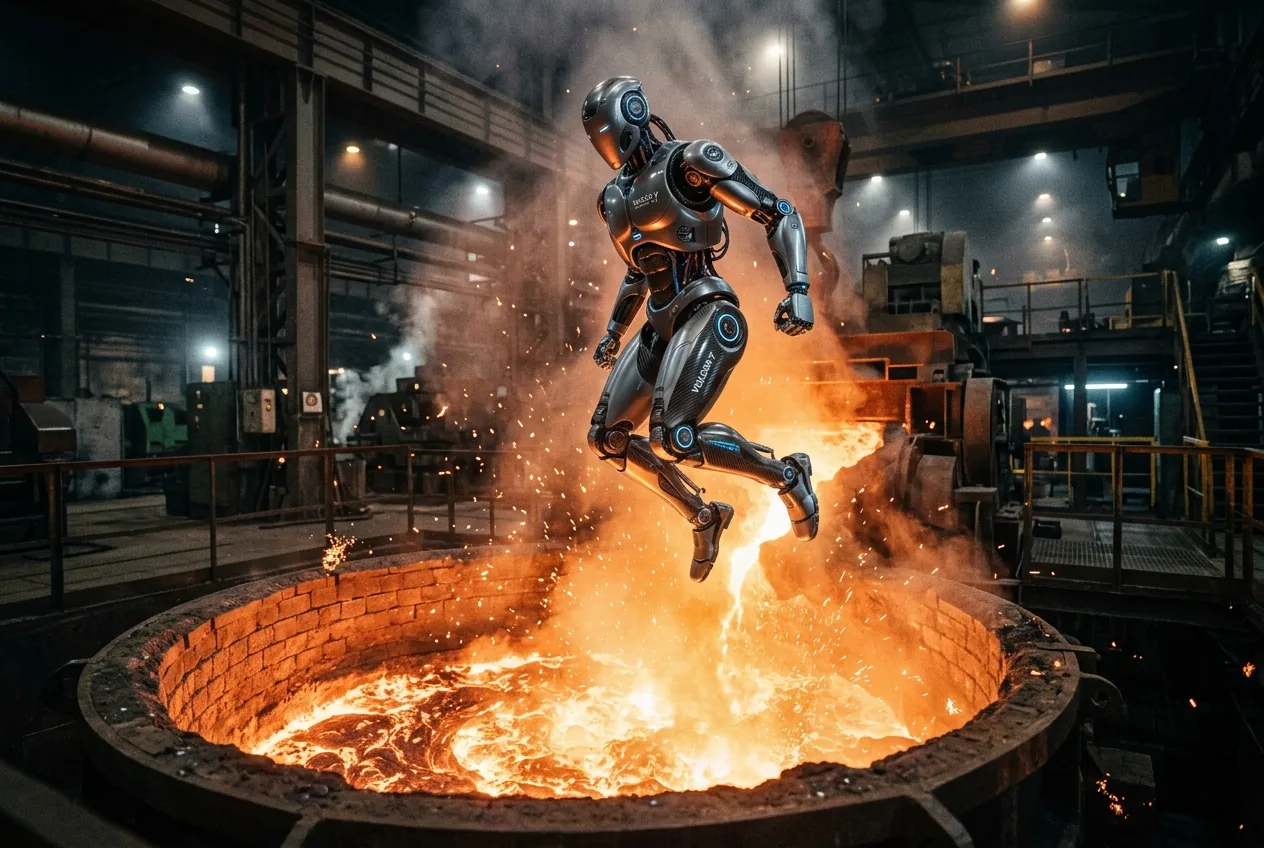
In the heavy industrial sector, the decommissioning of retired production equipment is almost universally mundane. Traditional six-axis industrial arms, computer numerical control mills, and hydraulic presses typically meet their end on secondary liquidation auctions or under the indifferent jaws of an industrial shredder. Prototype humanoid robots packed with closely guarded mechanical architectures, however, present an entirely different operational headache. When robotics developer Figure AI decided to retire its fleet of Figure 02 bipedal humanoids, the company bypassed the standard salvage yard in favor of an unmistakable cinematic reference: training the machines to leap autonomously into an industrial crucible of liquid steel.
While the visual of walking robots plunging into incandescent iron carries deliberate echoes of science fiction cinema, the underlying engineering drivers point to serious modern manufacturing dilemmas. As rapid development cycles compress the operational life of physical artificial intelligence hardware, robotics firms are encountering novel problems surrounding intellectual property protection, battery hazmat protocols, and high-velocity simulation training for non-standard locomotion tasks.
The Intellectual Property Trap in Bespoke Actuation
Figure AI introduced the Figure 02 platform as a testbed for dynamic industrial labor, validating the system through rigorous logistics trials, domestic manipulation experiments, and a prominent manufacturing pilot at BMW’s automotive assembly plant in Spartanburg, South Carolina. The platform served as the foundational hardware baseline for training Helix, the company’s vision-language-action neural model. Yet with the rapid introduction of the Figure 03 production architecture and active research shifting toward Figure 04, the older fleet became an operational liability.
Maintaining an active bench of legacy bipedal platforms consumes engineering labor that high-growth hardware firms can rarely spare. Every legacy robot requires custom calibration routines, firmware maintenance, and continuous physical inspections. More critically, the Figure 02 chassis houses custom-wound electric actuators, specialized planetary gear reductions, proprietary kinematic cable routing, and discrete sensor clusters. Liquidating these platforms or selling them into the academic market carries severe corporate espionage risks. In the intensely competitive physical AI market, reverse-engineering an actuator’s structural metallurgy, winding density, or torque sensor placement can hand competitors months of design progress.
Figure considered manual teardowns, but the prospect of assigning senior mechanical and electrical engineers to physically disassemble dozens of tightly packaged humanoid skeletons represented hundreds of hours of high-value engineering downtime. The firm needed total, irreversible hardware destruction that minimized human labor while guaranteeing zero hardware leakage.
Sim-to-Real Kinematics of a Terminal Leap
The suggestion to melt the machines originated when Figure founder and chief executive Brett Adcock polled observers online regarding decommissioning strategies. Arnold Schwarzenegger, whose iconic T-800 character concluded its operational life inside a molten steel pit in cinematic canon, urged the company to literally melt the machines. Schwarzenegger subsequently coordinated with the team, transforming what could have been a standard disposal exercise into an applied autonomy challenge.
Executing the stunt required far more than simply guiding a machine to the edge of an industrial vat with a wireless gamepad. Figure’s engineering group treated the final dive as an autonomous locomotion milestone. The team trained a dedicated neural network policy within physics simulators, ingesting motion-capture data from professional stunt performers to map human jumping dynamics onto the robot’s rigid kinematic linkages.
The control challenge in an explosive leap lies in high-torque transient delivery. Bipedal humanoids typically optimize for stable limit-cycle walking or steady-state manipulation, where ground reaction forces remain tightly regulated to protect the cycloidal or planetary drive gears from shock loads. Instigating a dynamic leap demands instantaneous peak torque from the hip pitch, knee, and ankle actuators, pushing current through the motor windings to the absolute thermal and electrical boundaries of the inverters. The policy had to stabilize the chassis during the deep crouching phase, coordinate an aggressive vertical thrust, and ensure flight stability without relying on corrective ground contact. The resulting policy was flashed directly to the target hardware, allowing the Figure 02 units to identify the target boundary and launch themselves into the crucible unassisted.
The Hazardous Metallurgy of Smelting Battery Packs
While dynamic motion planning proved successful in digital twins, the physical realities of modern foundries nearly halted the project entirely. An industrial furnace is an intolerant, volatile chemical environment. Casting foundries rely on hyper-precise metallurgical chemistry, and dumping foreign assemblies into molten steel risks fatal industrial accidents.
The primary engineering hurdle was the robots' onboard energy storage. The Figure 02 relies on high-energy-density lithium-ion battery packs embedded directly within the torso chassis to optimize center-of-mass dynamics. When submerged in liquid iron, which typically sits above 1,400 degrees Celsius, the organic solvents within a lithium-ion cell undergo instantaneous phase changes. The resulting catastrophic expansion can trigger an explosive pressure wave capable of ejecting hundreds of kilograms of white-hot slag across a foundry floor.
Consequently, metal processing facilities across the United States and Mexico flatly rejected the proposal. The chemical profile of the battery cells presented severe slag contamination risks, while the rapid thermal decomposition of polymer casings, printed circuit boards, and fluoropolymer wire coatings threatened to overwhelm standard industrial scrubbers. The company engaged in extensive outreach, consulting materials scientists and industrial safety experts before ultimately contracting an advanced metallurgical facility in Finland capable of safely capturing volatile off-gassing and containing violent boil-overs within enclosed induction chambers.
Rapid Iteration and the Disposable Humanoid
Beyond the theatrical execution, the project highlights a stark difference between traditional factory robotics and the emergent physical AI frontier. Industrial automation has historically prized hardware longevity; heavy automotive weld guns and Cartesian gantry robots are engineered to endure twenty-year production runs with predictable preventive maintenance. Humanoid robotics, by contrast, behaves far more like cutting-edge semiconductor computing hardware. The kinematic limits, compute density, and sensor integration architectures evolve so rapidly that a two-year-old chassis is mechanically obsolete long before its structural materials experience fatigue failure.




Comments
No comments yet. Be the first!