The era of treating a flagship large language model as a monolithic, one-size-fits-all API endpoint is quietly coming to an end. With the general availability rollout of GPT-5.6, the ecosystem has shifted toward an explicit tripartite architecture: Sol, Terra, and Luna. Rather than pushing an undifferentiated, trillion-parameter beast into every query pipeline regardless of task complexity, this release formalizes what hardware engineers and systems architects have demanded for years: structural tiering engineered around thermal envelopes, latency budgets, and real-world deployment costs.
For industrial automation and distributed computing, this release represents more than an incremental benchmark bump. It marks an intentional acknowledgment that the compute profile needed to run high-level generative reasoning across complex engineering schematics is fundamentally incompatible with the sub-50-millisecond execution loop required on a manufacturing floor or an autonomous logistics platform. By decoupling the architecture into three dedicated tiers, GPT-5.6 attempts to bridge the stubborn chasm between central cloud reasoning and field-level deterministic execution.
The Structural Anatomy of Sol, Terra, and Luna
The flagship variant, Sol, represents the unconstrained frontier of the GPT-5.6 architecture. Designed strictly for hyperscale data centers equipped with dense liquid-cooled accelerator clusters, Sol handles maximum-context synthesis, complex multimodal physics calculations, and multi-step symbolic reasoning. It operates with the highest parameter density and memory bandwidth requirements in the family, serving as the foundational model from which its smaller siblings are downstream-distilled. In testing environments, Sol demonstrates significant gains in long-horizon planning, code synthesis across sprawling legacy codebases, and non-linear logic verification, making it the primary engine for high-level technical analysis and design generation.
Terra occupies the enterprise middle tier, configured as a high-throughput, balanced workhorse designed for private cloud deployments, on-premise enterprise server racks, and scalable API pipelines. Terra retains the vast majority of Sol's operational understanding while stripping away the computational overhead associated with niche, highly theoretical edge cases. Engineered with an aggressive Mixture-of-Experts (MoE) routing schema, Terra activates only a fraction of its total parameter count per token, drastically cutting inference costs and memory consumption. It is tailored for continuous industrial operations—handling enterprise resource planning, automated telemetry diagnostics, dynamic supply chain routing, and high-frequency software verification.
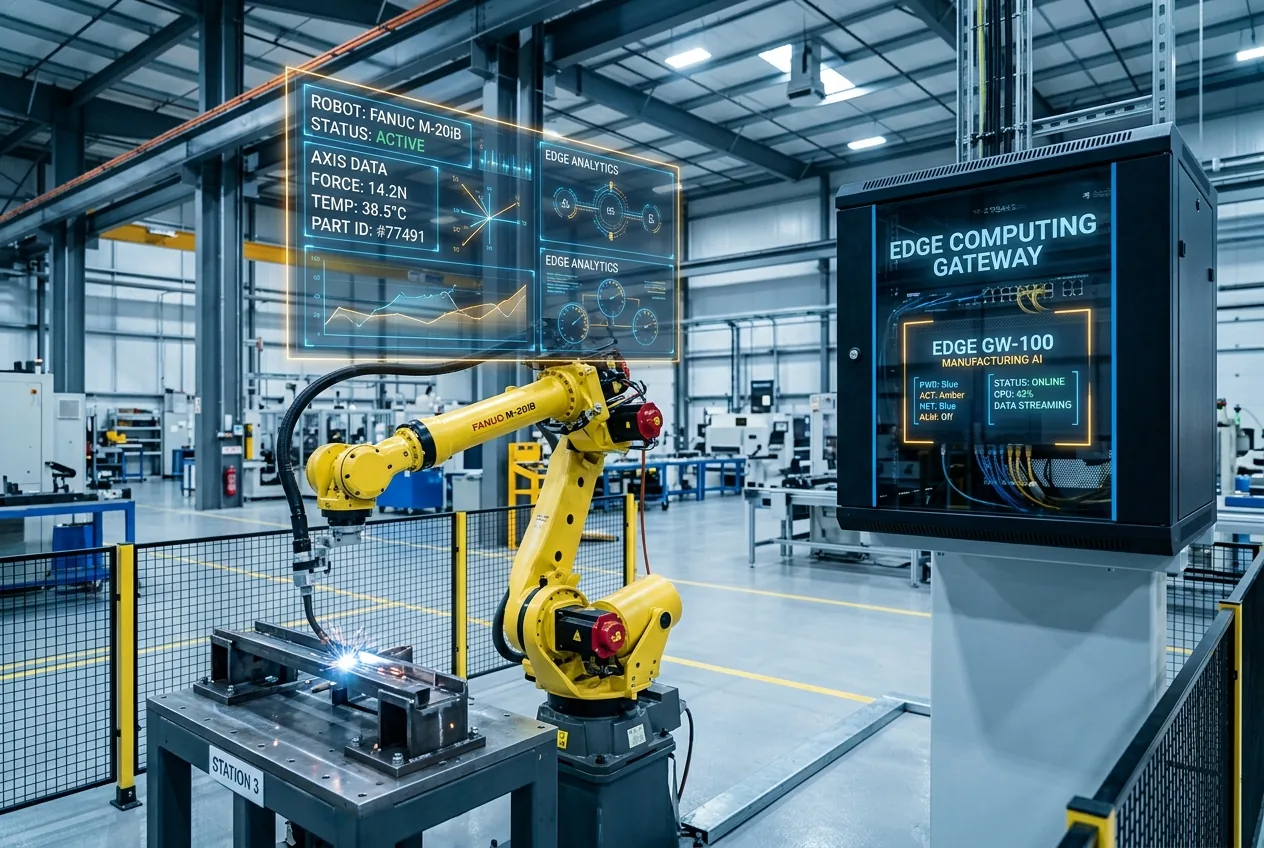
The most disruptive member of the family is Luna, a compact, radically pruned, and quantized variant built explicitly for edge hardware and low-latency local execution. Running comfortably within the constrained memory footprints of embedded systems, industrial PCs, and robotic compute platforms, Luna can execute fully on-device without an active uplink. By prioritizing rapid time-to-first-token metrics and near-deterministic response latencies, Luna strips the frontier model down to its operational core, focusing on direct task execution, local sensor fusion interpretation, and immediate natural-language instruction parsing.
Bridging the Latency Gap in Cyber-Physical Systems
In mechanical engineering and industrial robotics, latency is not merely an inconvenience; it is a hard safety constraint. A robotic workcell operating an articulated arm cannot wait 800 milliseconds for a cloud-hosted frontier model to return an inference token while a conveyor belt advances at two meters per second. Traditional large language models have struggled to penetrate physical operational technology because non-deterministic network jitter and unpredictable queue times introduce unacceptable operational risk.
This structural division allows Luna to operate as a local translator and supervisor, while Terra or Sol operates asynchronously in the background. If an unexpected vibration anomaly occurs in a CNC spindle, Luna can flag the transient telemetry data instantly, cross-reference it with local machine parameters, and slow the feed rate. Meanwhile, the raw telemetry packet is dispatched upstream to Terra for fleet-wide comparative analysis, ensuring that immediate physical operations are never held hostage by cloud round-trip times.
The Economic Calculus of Scaled Inference
Beyond technical hardware constraints, the economics of continuous enterprise inference have pushed infrastructure teams toward a breaking point. Querying a monolithic, top-tier model for mundane, high-frequency tasks—such as parsing structured JSON payloads, validating API inputs, or transcribing telemetry metrics—burns through capital at an unsustainable rate. Token economics at scale demand that compute costs align proportionally with the economic value of the specific query being solved.
Furthermore, the GPT-5.6 rollout introduces dynamic model routing protocols that allow seamless handoffs between Luna, Terra, and Sol. An edge gateway running Luna can process routine sensor logs indefinitely at zero marginal API cost. The moment the local model detects a complex anomaly that exceeds its internal confidence threshold, it can package the contextual trace and escalate the problem to Terra for intermediate diagnosis. If Terra identifies a structural system flaw requiring deep causal reasoning, the task is escalated to Sol. This hierarchical pipeline ensures that peak compute is consumed only when peak complexity is genuinely required.
Hardware Optimization and Local Edge Deployment
The engineering breakthroughs that make Luna viable on local hardware rely heavily on advancements in low-bit quantization and specialized weight caching. Historically, compressing a model down to 4-bit or 3-bit precision led to severe performance degradation in reasoning consistency and syntactic coherence. The quantization techniques applied in the GPT-5.6 distillation process preserve structural logic by retaining higher precision across critical attention heads while aggressively compressing linear feed-forward layers.
This optimization directly reflects the hardware limitations of industrial environments. In a clean, climate-controlled hyperscale data center, high-bandwidth memory (HBM) and liquid cooling loops mask inefficiencies. On a factory floor, compute units are enclosed in sealed, fanless NEMA-rated chassis designed to withstand dust, oil mist, and ambient temperatures exceeding 40 degrees Celsius. In these enclosures, thermal dissipation is the hard ceiling. A model that consumes excessive memory bandwidth generates heat that edge hardware simply cannot shed.
Can Dynamic Multi-Tier Routing Remain Stable in Production?
While the architectural separation into Sol, Terra, and Luna solves fundamental compute and latency challenges, it introduces a new category of engineering risk: systemic routing instability. When an enterprise software stack relies on a single monolithic model, the operational parameters, failure modes, and reasoning styles are relatively uniform. Dividing that intelligence across three separate models with vastly different parameter scales means that the system's behavior can shift unexpectedly depending on which tier handles the request.
The primary concern among systems engineers is non-deterministic cascading failure. If a local instance of Luna misinterprets an anomalous reading and fails to escalate the context to Terra, the higher-tier reasoning engine will never have the opportunity to intervene. Conversely, if Luna’s escalation thresholds are tuned too aggressively, an edge network can easily flood the cloud tier with unnecessary queries, re-introducing the exact network latency spikes and API cost explosions that the architecture was designed to eliminate.
Additionally, semantic drift between the tiers presents a rigorous testing challenge. A prompt structured to elicit deterministic, machine-readable output from Sol may produce subtle syntactic errors when executed on Terra, or fail entirely under Luna's compressed attention window. Engineering teams deploying GPT-5.6 will need to spend substantial resources benchmarking not just individual models, but the entire multi-tier arbitration pipeline, validating that context handoffs remain hermetic across the physical-to-cloud boundary.
A Maturing Path for Applied Artificial Intelligence
The release of GPT-5.6 and its tripartite framework reflects a technology moving out of its speculative, brute-force growth phase and into an era of pragmatic systems engineering. For the past several years, the race has been characterized by single-minded parameter expansion—building larger compute clusters to train larger models to post higher scores on abstract academic benchmarks. But raw intelligence in a vacuum is of limited use to the physical industries that drive the global economy.




Comments
No comments yet. Be the first!