Sensational headlines frequently ripple through technology forums and digital asset news feeds, claiming that artificial general intelligence has finally arrived behind the closed doors of frontier research labs. Recent industry chatter, circulating through financial blogs and speculative aggregators, pointed toward Nvidia chief executive Jensen Huang supposedly declaring the dawn of AGI through an unannounced convergence of OpenAI frontier systems and real-time multimodal architectures. While the breathless claims of an overnight leap to superintelligence often conflate speculative project codenames like Astra with next-generation model roadmaps, the discourse highlights an escalating tension in enterprise computing: the gap between software marketing and physical engineering.
Huang has spent the past several quarters offering a very specific, pragmatic, and decidedly un-mystical definition of what general intelligence means from an engineering perspective. To the hardware manufacturer powering the global compute buildout, intelligence is not an ethereal philosophical breakthrough. It is an engineering deliverable measured by task completion, operational latency, and standard benchmark dominance. When market observers parse executive commentary to declare that human-level parity is accomplished, they typically misunderstand both the hardware constraints holding frontier models back and the deliberate semantic shift taking place across the semiconductor sector.
The Operational Redefinition of General Intelligence
This operational framing changes the conversation entirely. Passing a standardized bar exam or outperforming radiologists on two-dimensional image classification requires massive associative pattern matching over high-dimensional vector spaces. It does not require continuous real-world adaptation, self-directed physical agency, or an underlying causal understanding of mechanics. By shifting the goalposts from true general cognition to algorithmic performance on structured human evaluations, computing executives can accurately claim that the silicon is already crossing historic thresholds, even while the models themselves remain brittle when pushed beyond their training distributions.
When external market observers conflate this targeted benchmark success with the arrival of genuine human-grade autonomy, sensational narratives take hold. Speculative reports frequently blend real architectural developments—such as Google DeepMind's low-latency multimodal initiative, Project Astra, and OpenAI's continuous iterations beyond the GPT-4 family—into mythical software entities that supposedly solve cognition outright. The reality is far more incremental, constrained not by a lack of conceptual ambition, but by the brutal physics of silicon, thermal management, and power generation.
The Silicon Wall Behind Frontier AI Architectures
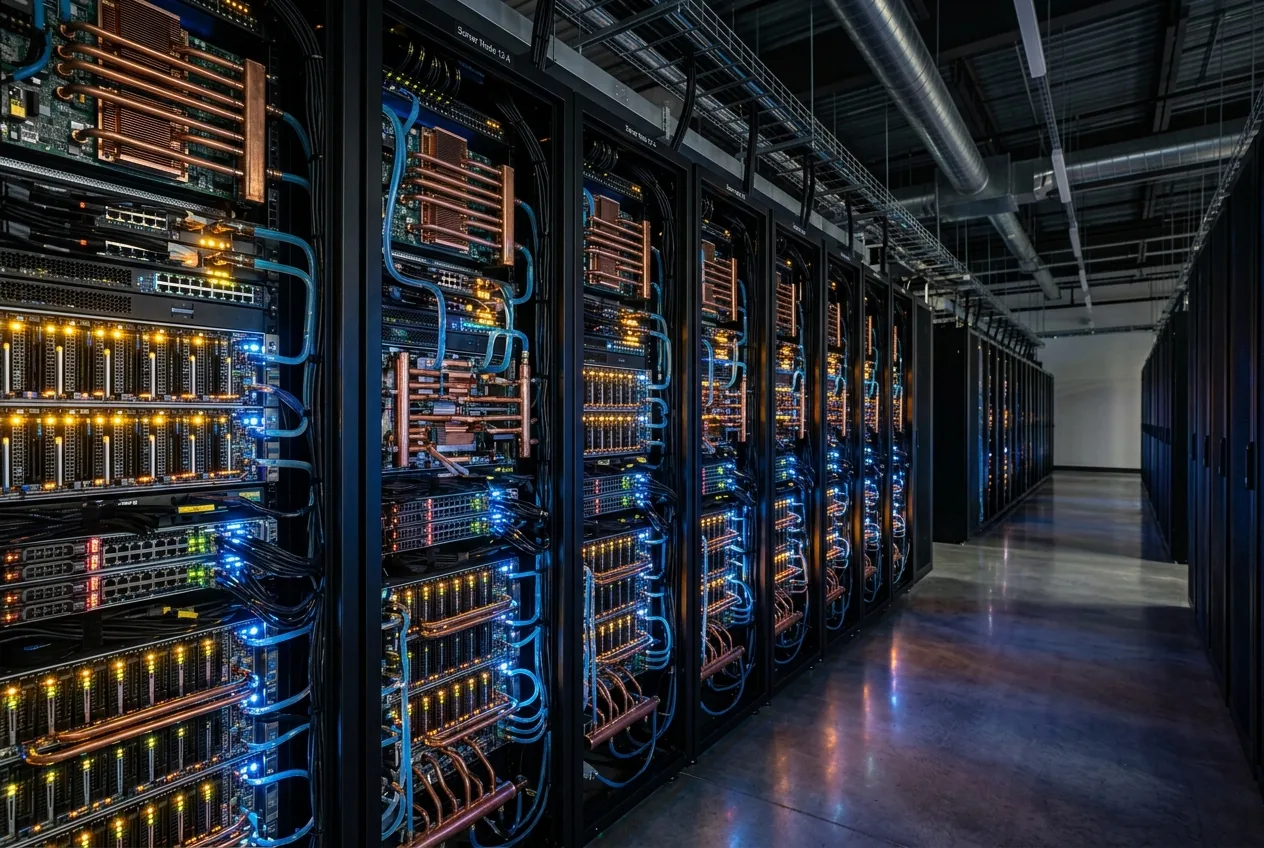
To understand why claims of sudden AGI breakthroughs fail to withstand technical scrutiny, one must look at the data center floor. The transition from the Hopper microarchitecture to Nvidia's Blackwell platform illustrates the extreme mechanical and electrical demands required to push model scaling even marginally forward. A dual-die Blackwell B200 GPU packs 208 billion transistors, drawing up to 1,200 watts per board and necessitating custom liquid cooling manifolds to prevent thermal runaway. When hyperscalers deploy these chips into clusters of tens of thousands of units, they are not merely deploying software; they are constructing industrial power plants dedicated to high-bandwidth matrix multiplication.
The prevailing transformer architecture, while exceptionally effective at language processing and cross-attention matching, faces severe physical bottlenecks. Chief among them is the memory wall. Frontier models do not merely require raw compute cycles measured in floating-point operations per second; they demand continuous, low-latency access to high-bandwidth memory. The integration of HBM3e and emerging HBM4 memory stacks demonstrates that moving weights between dynamic memory and processing cores consumes a staggering percentage of total cluster power. As models scale up in parameter count to support advanced chain-of-thought reasoning, the thermodynamic cost per token escalates non-linearly.
Furthermore, the infrastructure supporting these clusters has begun to outstrip municipal energy capacity in primary computing corridors. Hyperscale data center operators in North America and Europe are confronting multi-year delays simply to secure grid interconnections capable of delivering hundreds of megawatts. Developing an artificial general intelligence capable of continuous real-time reasoning across billions of human interactions is not merely an algorithmic challenge. It is an infrastructure bottleneck tethered directly to transformer substations, water-cooling towers, and the global supply of specialized packaging substrates.
Why General Cognition Requires Physical Embodiment
From an applied robotics and mechanical engineering perspective, software models that operate purely within the confines of digital text or pixel arrays cannot achieve general intelligence in any practical sense. Real-world systems must navigate dynamic, unstructured, and unpredictable physical environments where the laws of physics are non-negotiable. While multimodal reasoning engines can describe how an industrial robotic arm should assemble a gearbox, translating that output into dynamic torque control, compliant gripping, and microsecond sensor-motor feedback loops remains a fundamentally different engineering discipline.
Language models and static vision transformers rely on static representations of dynamic phenomena. In contrast, physical work requires an internal model of continuous causality. When an automated guided vehicle or a bipedal humanoid robot navigates an industrial plant, it contends with fluctuating friction coefficients, motor backlash, thermal expansion of structural components, and sensor noise. An algorithmic hallucination in a digital chat interface results in an erroneous sentence; an algorithmic hallucination in a five-axis CNC machine or an autonomous yard tractor results in catastrophic mechanical failure.
This physical grounding problem is where current artificial intelligence models stumble hardest. Despite the rapid progress of vision-language-action models designed to link high-level semantic intent directly to robotic actuation, the control policies remain remarkably narrow. Current platforms cannot generalize across diverse physical tasks with the dexterity of an entry-level factory technician. True general capability demands closed-loop interaction with the physical universe, where intelligence is honed not merely against curated internet data, but against the unforgiving constraints of gravity, momentum, and material wear.
The Commercial Imperative of Perpetual Breakthroughs
The persistent cycle of rumors regarding imminent AGI milestones serves a distinct economic function. The global generative AI ecosystem represents hundreds of billions of dollars in projected capital expenditures, heavily concentrated in semiconductor procurement, bespoke silicon design, and proprietary cloud infrastructure. For hardware vendors and foundation model developers alike, maintaining high market momentum is essential to justify unprecedented investments in supply chain expansion, advanced packaging lithography, and multi-gigawatt data center campuses.




Comments
No comments yet. Be the first!