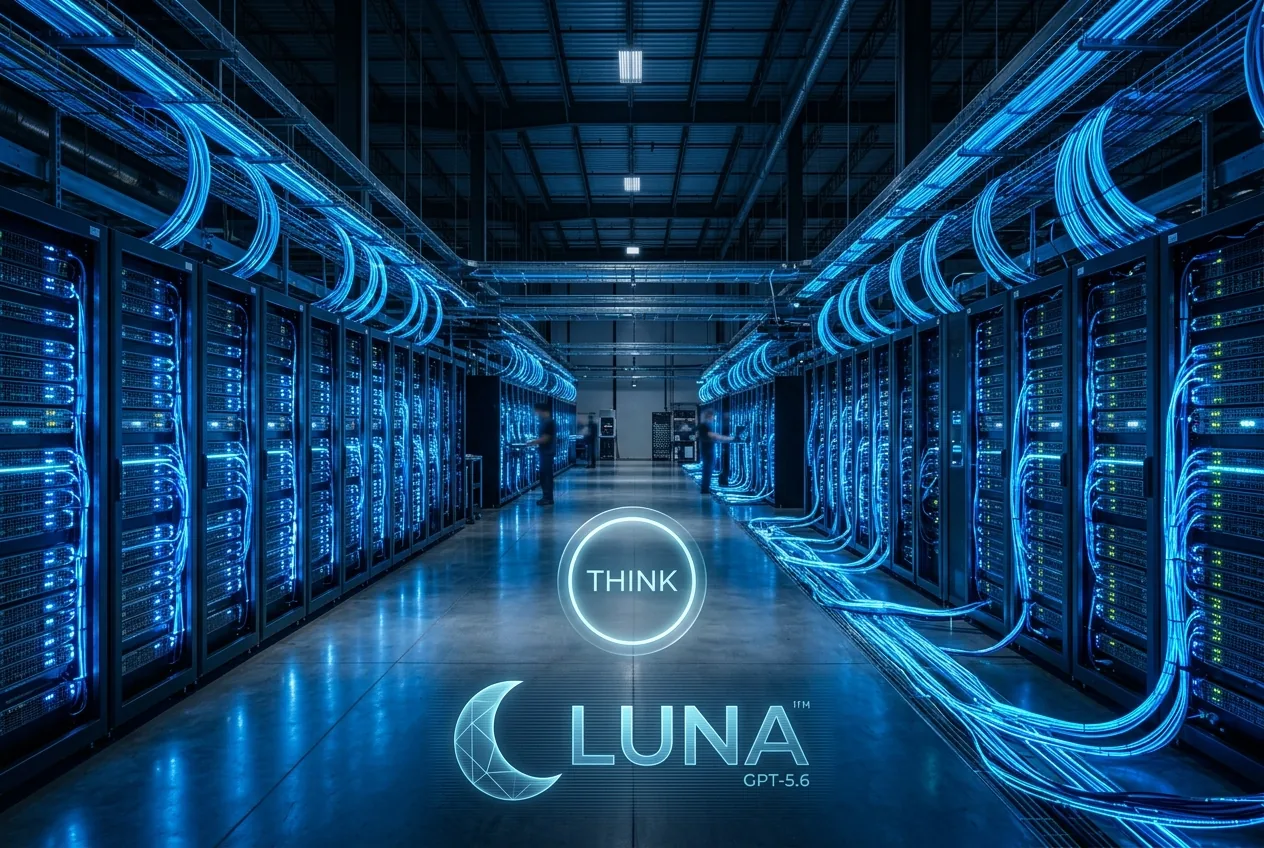
The landscape of large language models has shifted once again, not with a quiet whisper, but with a massive structural expansion. OpenAI has officially announced the removal of text-based chat limitations for ChatGPT, coinciding with the rollout of a new flagship-adjacent model: GPT-5.6 Luna. This update marks a significant milestone in the evolution of generative AI, particularly as the platform surpasses the staggering threshold of one billion weekly active users. For those of us tracking the intersection of computational power and industrial utility, this isn't just a software patch; it is an infrastructure statement.
The Engineering Behind GPT-5.6 Luna
The transition from GPT-5.5 to GPT-5.6 Luna represents more than just a minor version increment. In the nomenclature of neural networks, these shifts often indicate a refinement in the Mixture of Experts (MoE) architecture or a breakthrough in how the model handles long-context windows. Luna appears to be designed for high-velocity, high-accuracy output, serving as the new default for both Free and 'Go' tier users. From a technical standpoint, the choice to move the general public to a 5.6-class model suggests that the computational cost per query has dropped significantly enough to allow for mass-scale deployment without bankrupting the provider.
For industrial applications, the Luna model represents a more stable 'brain' for the robotic systems and supply chain algorithms currently being tested in the field. When we look at robotics, we aren't just looking at the actuators and sensors; we are looking at the logic gates that dictate a machine's response to an unplanned variable on the factory floor. GPT-5.6 Luna’s ability to handle unlimited text-based input means that technical manuals, long-form sensor logs, and entire codebases can be fed into the system without the fear of the model 'forgetting' the beginning of the prompt due to context overflow.
The 'Think' Button and the Mechanics of Reasoning
Perhaps the most intriguing addition to the ChatGPT interface is the new 'Think' feature. This button allows users to manually trigger a higher level of reasoning for complex queries. In the past, LLMs have been prone to 'hallucinations' or logic errors because they operate on a next-token prediction basis—essentially guessing the next word based on probability. The 'Think' feature likely utilizes a 'Chain of Thought' (CoT) or a hidden 'Inference-time' compute process, where the model iterates on its own logic before presenting a final answer.
In mechanical engineering, we call this a diagnostic loop. If a technician is troubleshooting a hydraulic failure in a multi-axis robotic arm, they don't want the first answer that comes to an AI's 'mind.' They want a reasoned, step-by-step analysis that accounts for pressure differentials, valve fatigue, and fluid viscosity. By allowing Free users to access this 'Think' functionality, OpenAI is effectively democratizing high-level diagnostic tools that were previously gated behind premium subscriptions or enterprise-level API costs. This move forces the rest of the industry to reconsider how they value 'reasoning' versus 'retrieval.'
Economic Viability of Unlimited AI
How does a company sustain a billion weekly users with no chat limits? The answer lies in the hardware. As an observer of the supply chain, the move to GPT-5.6 Luna suggests that OpenAI has successfully integrated the latest generation of NVIDIA Blackwell or specialized custom silicon into their data centers. The energy efficiency of these new chips allows for a lower cost-per-inference. When you scale that across a billion users, even a fractional saving in electricity per query translates into millions of dollars in operational savings.
Impact on Robotics and Automation
As we look toward the integration of AI into physical hardware, the GPT-5.6 Luna update serves as a precursor to more capable humanoid robotics. The 'brains' of robots like those from Figure or Boston Dynamics require a high degree of linguistic understanding to follow human instructions and a high degree of 'thinking' to navigate complex environments. If OpenAI can provide unlimited, high-reasoning logic via the cloud, the latency between a human command and a robot’s execution will continue to shrink.
In a warehouse setting, a fleet of autonomous mobile robots (AMRs) could use the Luna architecture to dynamically reroute based on real-time verbal updates from floor managers. The 'Think' feature could be used to solve 'edge cases'—those rare, unpredictable events that usually shut down an automated line. Instead of requiring a human engineer to intervene, the system could 'Think' through a bypass solution, significantly increasing the OEE (Overall Equipment Effectiveness) of the facility.
Is the 'Think' Button Enough for True Autonomy?
While the 'Think' button is a step forward, we must remain pragmatic. Reasoning in a digital sandbox is vastly different from reasoning in a physical environment where the laws of physics are unforgiving. A model can 'think' it has solved a structural integrity problem, but if its training data lacks the nuance of material science, the result remains a liability. The engineering community should view GPT-5.6 Luna as a highly sophisticated calculator—an essential tool, but one that still requires the oversight of a qualified professional.
The rollout of Luna to the 'Free' and 'Go' tiers suggests that OpenAI is nearing a version of AI that is essentially a utility, like electricity or water. For the industrial sector, this means the 'barrier to entry' for AI integration has effectively vanished. Small-scale manufacturing shops that previously couldn't afford a 'Pro' AI subscription can now use the 'Think' feature to optimize their CNC paths or manage their inventory with the same level of sophistication as a Fortune 500 company.
In conclusion, the arrival of GPT-5.6 Luna and the removal of chat limits signify a maturation of the AI industry. We are moving away from the era of 'AI as a novelty' and into 'AI as a core industrial component.' As these models become more accessible and more capable of complex reasoning, the focus will shift from the software itself to how we, as engineers and innovators, apply that software to solve the tangible problems of the physical world. The infrastructure is ready; the question now is how much we are willing to let these machines 'think' for us.




Comments
No comments yet. Be the first!