When Jensen Huang speaks, the semiconductor market listens, and the rest of the technology ecosystem adjusts its coordinates. Over the past four decades, the Nvidia co-founder has evolved from a purveyor of graphics accelerators for PC gamers into the de facto architect of the artificial intelligence epoch. Yet even by his own theatrical standards, Huang’s recent proclamation that Artificial General Intelligence (AGI) has crossed the threshold—crediting next-generation frontier research stemming from OpenAI—has triggered shockwaves across engineering laboratories and executive boardrooms alike.
The assertion represents a dramatic pivot point. For years, leading figures in computer science maintained that AGI—a computational substrate capable of matching or exceeding human performance across virtually every economically valuable task—was decades away, if not entirely theoretical. By asserting that the milestone has effectively arrived in the form of emergent frontier architectures, Huang is not simply offering a philosophical observation. He is making a calculated technical and economic assessment that directly impacts trillions of dollars in data center infrastructure, sovereign compute mandates, and the future trajectory of global automation.
Yet to engineers working at the intersection of computational logic and physical machinery, Huang’s declaration requires deep interrogation. What silicon executives define as general intelligence often bears little resemblance to the deterministic, resilient, and adaptive intelligence required to operate in the chaotic real world. Unpacking this milestone requires separating algorithmic triumphs on synthetic benchmarks from the stark operational realities of high-stakes industrial engineering.
The Shifting Goalposts of Algorithmic Competence
Under Huang’s pragmatic framework, AGI is achieved when an automated system can sit for any human examination—whether the Uniform Bar Exam, board-level medical diagnostics, specialized actuarial reviews, or graduate-level competitive programming—and outperform 90 percent of human practitioners. By this metric, the latest frontier architectures have unquestionably decimated traditional benchmarks. Models leveraging massive test-time compute, continuous tree-search reasoning, and multi-modal alignment engines have demonstrated the ability to deconstruct complex multi-step problems that left earlier autoregressive transformers deadlocked.
The High-Tension Silicon Substrate
Behind the software accomplishments that Huang celebrates sits an unprecedented aggregation of thermal, electrical, and computational infrastructure. The leap to frontier reasoning engines is not merely an algorithmic triumph; it is a monument to modern metallurgy, lithography, and high-speed electrical interconnects. The compute clusters required to train and run these sprawling models consume power measured in tens of megawatts, relying on thousands of interconnected Tensor Core processing units running at maximum thermal tolerances.
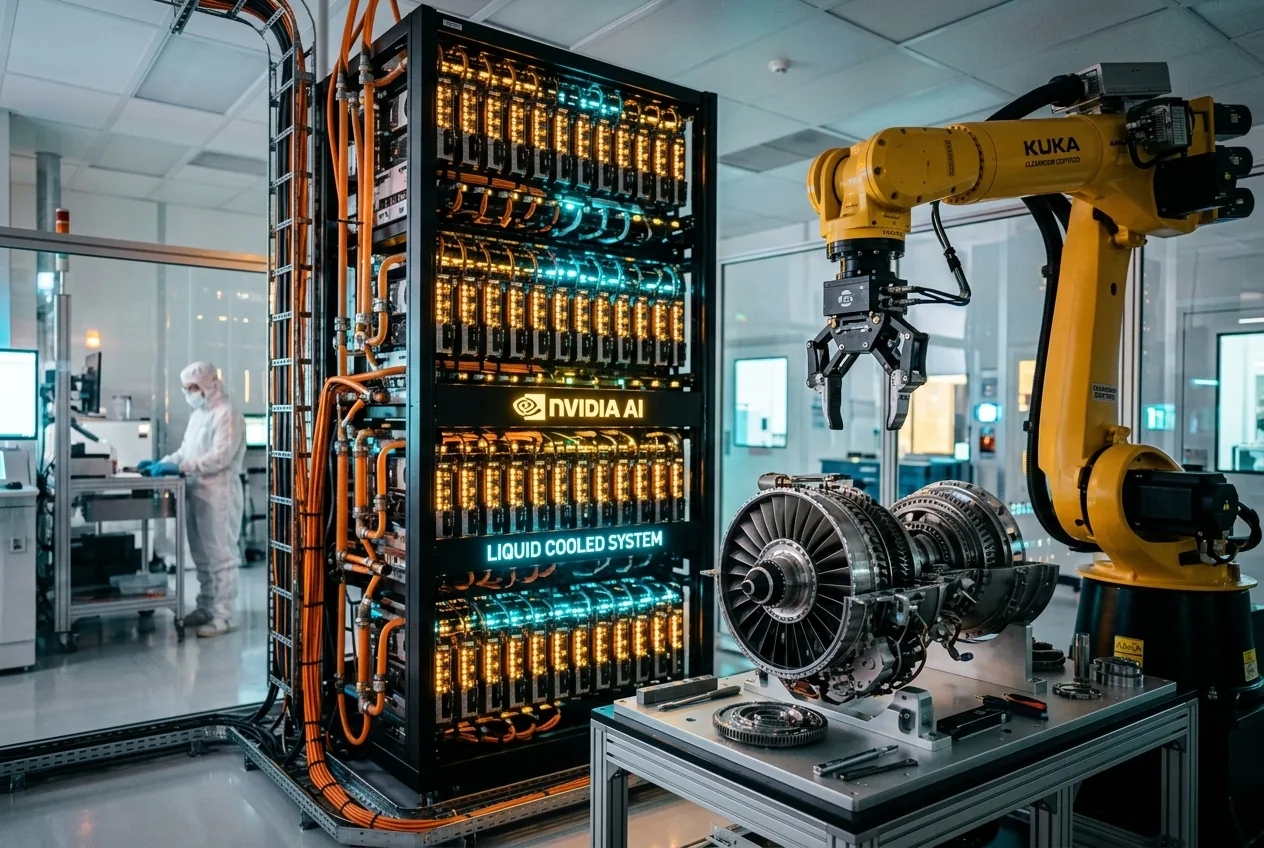
Nvidia’s own hardware evolution illustrates this physical reality. The transition from the Hopper architecture to the Blackwell platform highlights the extreme measures required to maintain scaling laws. Utilizing dual-die packaging, fifth-generation NVLink switches capable of bi-directional throughput measured in terabytes per second, and dense liquid-cooled rack layouts like the GB200 NVL72, these systems are designed specifically to eliminate the memory bandwidth bottlenecks that constrain dynamic reasoning loops. Running inference on models that generate extensive synthetic thinking paths before outputting an answer demands massive pools of high-bandwidth memory (HBM3e) operating under microsecond latencies.
This hardware reality reveals the economic undercurrent of Huang’s declaration. As hyperscalers pouring hundreds of billions of dollars into capital expenditure begin asking tough questions about enterprise return on investment, asserting that the ultimate technological prize has arrived provides crucial justification for continued cluster expansion. If AGI is here, every sovereign nation and enterprise must immediately secure hardware allocation or risk competitive irrelevance.
The Chasm Between Inference and Agency
Even if one accepts that frontier models possess world-class diagnostic and analytical capability, the transition from passive software inference to true operational agency remains largely unaddressed. In an industrial or engineering environment, intelligence is not evaluated on an isolated conversational terminal. It is measured by an agent's ability to interface with non-deterministic systems, maintain persistent operational state over weeks or months, and execute irreversible actions under conditions of deep uncertainty.
Furthermore, true autonomy requires what control engineers define as closed-loop resilience: the ability to detect an internal failure mode, decouple from the erroneous state, and formulate a novel mitigation strategy in real time. Despite Huang’s optimistic framing, current frontier systems remain brittle open-loop reasoners wrapped in sophisticated guardrails. They simulate understanding through sheer statistical density, but when the underlying assumptions shift, their performance degrades unpredictably.
The Physical Frontier: Why Embodied Intelligence Is the True Crucible
The deepest flaw in declaring AGI accomplished within the digital domain lies in the total omission of physical reality. For mechanical engineers and roboticists, intelligence is inherently embodied. The human mind did not evolve in a disembodied vacuum to write poetry or solve Python puzzles; it evolved to navigate friction, gravity, dynamic inertia, and continuous tactile feedback in a non-forgiving three-dimensional universe.
This disparity is known across robotics as Moravec’s paradox: the realization that high-level reasoning tasks like chess or diagnostic categorization are computationally cheap, while the motor skills and spatial awareness of a toddler require colossal sensory-motor computational overhead. A frontier language model can draft a comprehensive operational manual for an automated robotic warehouse, but it cannot reliably guide a five-axis manipulator to untangle a cluster of deformed cables in variable lighting conditions.
Until artificial intelligence can inhabit physical mechanisms—managing the compliance of mechanical actuators, compensating for gear backlash, interpreting noisy sensor telemetry, and manipulating unstructured physical environments without human intervention—the term 'general' remains a misnomer. General intelligence cannot be declared complete when it is fundamentally incapable of changing a flat tire, assembling a precision gearbox, or navigating an undocumented physical manufacturing floor.
Re-Evaluating the Technological Horizon
Jensen Huang’s assertion that AGI has arrived serves as a powerful milestone in computational history, but it must be viewed with rigorous technical skepticism. What Nvidia and its frontier research partners have built is an undeniable marvel of distributed computing: an analytical engine capable of synthesizing human knowledge at superhuman speeds and operating as an extraordinary cognitive amplifier for knowledge workers.
However, confusing superhuman synthetic reasoning with generalized autonomy is a conceptual error with profound consequences. True general intelligence cannot simply exist as a high-density cluster of silicon processors generating text in an air-conditioned server room. It must prove its utility across the full spectrum of human labor, from abstract mathematics to the dirty, unpredictable, friction-bound realities of the physical world. Until computational reasoning bridges that mechanical divide, the declaration of AGI will remain an impressive marketing triumph running on top of extraordinary hardware, rather than an accomplished engineering fact.




Comments
No comments yet. Be the first!