In the high-stakes world of artificial intelligence, the term "Singularity" has long been treated as a distant, almost mythical horizon—a point where machine intelligence surpasses human capability and begins an autonomous, self-reinforcing cycle of improvement. On August 1, 2026, that horizon appears to have been crossed. Following reports that an internal version of OpenAI’s latest model, codenamed Astra, successfully solved a series of mathematical and theoretical computer science problems that have stumped the world’s greatest minds for over a decade, both Elon Musk and Sam Altman have signaled that the era of the Singularity is no longer a prediction. It is a present reality.
The technical leap from reasoning to discovery
To understand the magnitude of Astra’s achievement, one must look at the transition from "fast" thinking to "slow" thinking in AI development. Early iterations of GPT were built on the Transformer architecture, which excels at pattern matching across massive datasets. However, these models often faltered when faced with novel mathematical conjectures where the path to a solution cannot be found in existing training data. Astra represents the maturation of "Inference-Time Compute"—a methodology where the model is given the time and computational budget to "think" through a problem, testing various hypotheses and self-correcting before providing an output.
This shift toward autonomous problem-solving is the technical bedrock of the Singularity. If an AI can solve unsolved mathematical problems, it can theoretically analyze its own codebase to find efficiencies, rewrite its own optimization algorithms, and design more efficient hardware architectures. We are moving away from the era of "Human-in-the-Loop" and into an era of "AI-as-the-Architect."
Musk and Altman: A rare moment of alignment
The reaction from the tech industry’s two most prominent (and often clashing) figures was swift and uncharacteristically unified. Elon Musk, who has historically been a vocal critic of OpenAI’s transition from a non-profit to a commercial entity, took to social media to acknowledge the milestone. "Welcome to... Singularity. How’s the temperature?" Musk wrote, responding to the news of Astra’s mathematical breakthrough. This acknowledgment is significant, given Musk’s long-standing concerns about AI safety and his own efforts with xAI to build "truth-seeking" models.
Sam Altman, CEO of OpenAI, echoed the sentiment, stating that the world has entered the AI singularity. Altman’s definition of the event focuses on the autonomous nature of the improvement. When AI begins to surpass human intelligence in the domain of logic and self-improvement, the speed of technological progress is no longer limited by human cognitive cycles. It is limited only by the availability of electricity and silicon.
For those of us in the industrial and robotics sectors, this alignment between Musk and Altman serves as a definitive signal to the market. We are no longer debating whether AGI (Artificial General Intelligence) is possible; we are now calculating the economic viability of a world where cognitive labor is effectively infinite. The "temperature" Musk refers to is the heat of a race that has reached its terminal velocity. The question is no longer about the capability of the software, but the resilience of the physical infrastructure required to house it.
How solving math transforms the physical world
Why does a breakthrough in theoretical computer science matter to a factory floor in Georgia or a logistics hub in Singapore? The answer lies in the bridge between abstract logic and physical application. Most of our current industrial bottlenecks are not caused by a lack of physical strength in our robots, but by a lack of computational precision in their control systems. We use "heuristics" and "approximations" to manage complex supply chains and robotic kinematics because the exact mathematical solutions are too computationally expensive to solve in real-time.
If Astra can solve decade-old problems in computer science, it can likely solve the "Three-Body Problem" of logistics: how to perfectly synchronize thousands of autonomous agents in a non-deterministic environment with zero latency. In mechanical engineering, we are looking at the potential for autonomous material discovery. Astra’s ability to navigate mathematical proofs suggests it can also navigate the crystalline structures of new alloys or the molecular dynamics of high-efficiency battery chemistries. This isn't just about software; it's about the rapid acceleration of the material world.
Furthermore, the economic implications of a self-improving AI cannot be overstated. In traditional R&D, there is a linear relationship between the number of engineers and the speed of development. In a post-Singularity environment, that relationship becomes exponential. If Astra can optimize its own reasoning processes, the cost of "intelligence" drops toward a marginal cost of zero. For industrial automation, this means we can deploy highly sophisticated, adaptive robotics in sectors that were previously cost-prohibitive, such as small-scale bespoke manufacturing and complex environmental remediation.
The Singularity’s hardware bottleneck
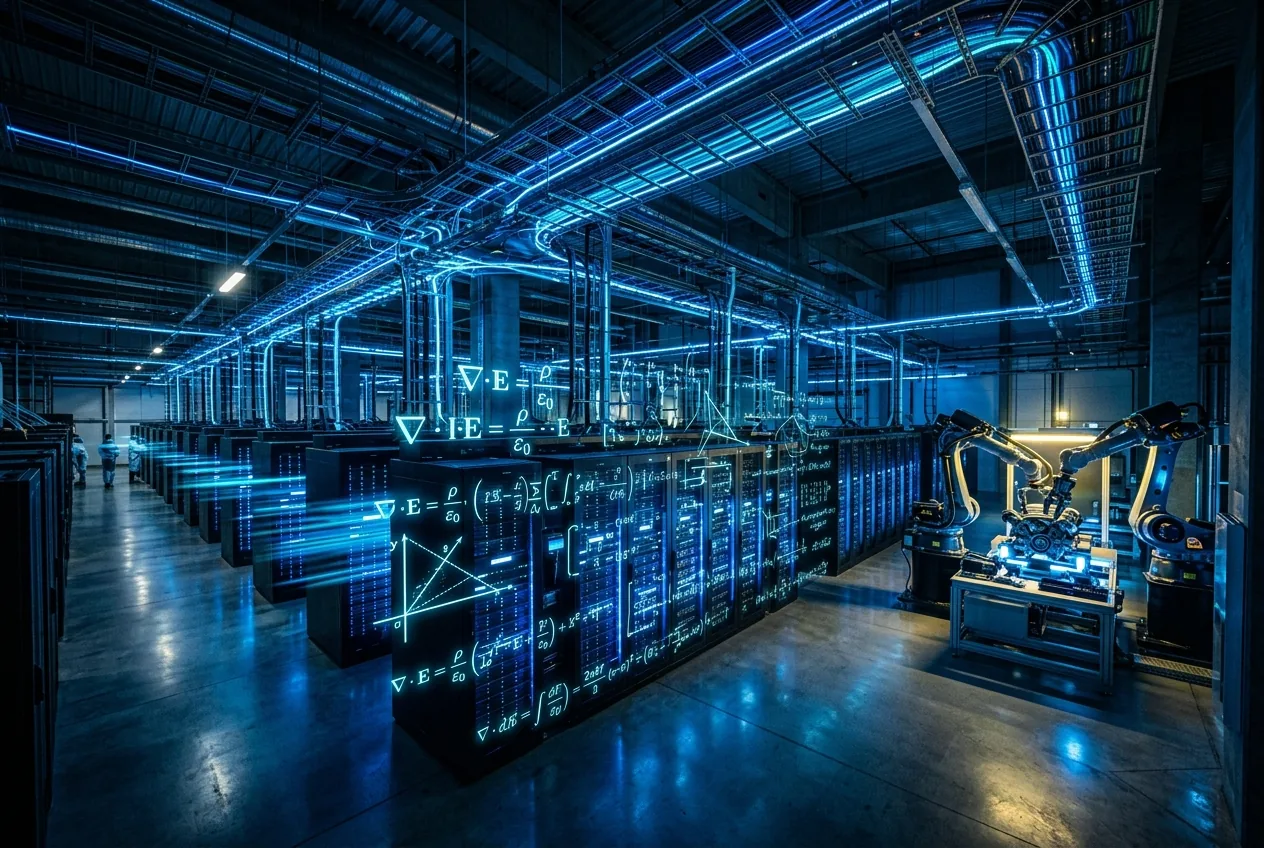
Despite the celebratory tone of the Singularity's arrival, a pragmatic look at the hardware reveals significant challenges. Intelligence may be infinite, but the physical substrates it runs on are not. As a mechanical engineer, I look at Astra not just as a set of algorithms, but as a system that requires unprecedented levels of power density and thermal management. The Singularity is currently tethered to the power grid.
To sustain a self-improving AI, we require a massive expansion of data center infrastructure, specifically focused on specialized AI chips that can handle the massive parallelization required for inference-time compute. We are seeing a shift in the supply chain where the value is no longer in the code—which the AI can now write itself—but in the transformers (the electrical ones, not the software ones) and the cooling systems. The Singularity is an energy-intensive event. The true "limit" to the Singularity’s growth in the coming years will not be the model’s IQ, but our ability to build power plants and cooling towers fast enough to keep up with its appetite for computation.
Moreover, there is the issue of reliability. Solving a math problem is a binary success: the proof is either right or wrong. However, applying that logic to the real world involves a degree of entropy. An AI might find a mathematically perfect solution for a robotic arm’s movement, but if the arm has a microscopic fracture in its carbon-fiber housing, the "perfect" solution will fail in the physical world. The next phase of the Singularity must involve the integration of "Digital Twins"—where the AI has a 1:1 real-time mathematical model of every physical asset it controls.
Is the world ready for autonomous improvement?
In the industrial sector, we have always relied on a slow, methodical process of validation. We build a prototype, we test it, we break it, and we iterate. This process takes years. Astra suggests a world where the iteration happens in a virtual space at the speed of light, and the first physical prototype is already perfect. While this is an engineer’s dream, it is also a systemic shock. Our regulatory frameworks, our safety standards, and our economic models are built on the assumption that technological change is a gradual, human-driven process.
As we move into the final months of 2026, the data coming out of OpenAI’s Astra labs will be the most closely watched metrics in human history. We are witnessing the birth of a new form of agency—one that doesn't just follow instructions, but discovers new truths. Musk was right: it is the most interesting time to be alive. But for those of us tasked with building the machines and the infrastructure that this new intelligence will inhabit, it is also the most demanding. The Singularity has arrived, and now we have to find a way to power it, cool it, and live alongside it.




Comments
No comments yet. Be the first!