The battle for dominance at the frontier of artificial intelligence has entered a volatile new phase. In an unannounced deployment to select enterprise partners and research institutions, OpenAI has launched a limited preview of GPT-5.6. The release marks an aggressive tactical counterstrike against Anthropic, whose emerging Claude Mythos architecture has been quietly setting internal records across autonomous software development and complex systemic reasoning. OpenAI’s positioning is deliberate and explicit: GPT-5.6 is designed not merely to iterate on conversational fluency, but to establish definitive computational superiority over Anthropic’s flagship offering across multi-step technical execution, mathematical synthesis, and long-horizon agency.
For the engineering and enterprise communities, this announcement represents far more than marketing posturing between San Francisco labs. The delta between iterative frontier models is increasingly measured in structural autonomy—the capacity of a neural network to parse convoluted physical data, manipulate legacy toolchains, and operate without human supervision over hours of continuous execution. By pushing GPT-5.6 into the wild under a restricted preview, OpenAI is testing whether its architectural fusion of massive foundation scale and advanced test-time reasoning can maintain commercial supremacy as the physical and economic costs of frontier compute escalate exponentially.
Beyond Parameter Scaling to Hybridized Test-Time Compute
To understand what GPT-5.6 represents, one must examine the divergence in engineering philosophies that has crystallized over the past eighteen months. While the industry spent years fixated on sheer parameter volume and post-training instruction tuning, frontier development hit an undeniable ceiling with standard pre-training runs. Data exhaustion, thermal dissipation limits in gigawatt-scale data centers, and diminishing returns on next-token prediction forced both OpenAI and Anthropic to fundamentally rethink their inference architectures.
GPT-5.6 appears to be the commercial maturation of OpenAI’s reasoning-centric paradigm, merging deep multimodal comprehension with dynamic, test-time compute allocation. Rather than executing a uniform compute budget for every query, the system dynamically spins up internal verification loops, counterfactual modeling passes, and chain-of-thought scratchpads depending on the algorithmic entropy of the task. When tasked with analyzing an integrated circuit layout or refactoring a sprawling legacy codebase, GPT-5.6 allocates compute dynamically during inference, systematically testing its own intermediary outputs against simulated runtime environments before committing to a final token stream.
This architectural shift is a direct response to Claude Mythos, which introduced Anthropic’s proprietary recursive cognitive framing. Mythos achieved industry-leading marks on complex logic benchmarks by prioritizing epistemic calibration—ensuring the model inherently recognizes what it does not know and actively verifies its logical leaps across expansive context windows. OpenAI’s technical disclosures surrounding GPT-5.6 indicate a targeted effort to outflank Mythos precisely in this domain, leveraging a reinforcement learning scaffold trained on verifiable synthetic logic to suppress hallucinations while driving task completion rates higher in non-deterministic environments.
The Benchmark Clash in Automated Systems and Engineering Logic
Early telemetry shared with enterprise preview testers reveals an intense statistical standoff between GPT-5.6 and Claude Mythos. OpenAI claims decisive victories across high-leverage benchmarks, most notably in SWE-bench Verified, GPQA Diamond, and automated hardware design suites. The real proving ground, however, is no longer standard academic multiple-choice assessments; it is the execution of interdependent industrial tasks that mirror human white-collar and engineering workflows.
In preliminary evaluations focused on autonomous systems engineering, GPT-5.6 demonstrated an unprecedented ability to ingest fragmented sensor logs, CAD schematics, and high-level control logic, synthesizing operational fixes with minimal latency. Testers report that where previous iterations required explicit prompt decomposition—breaking down a control pipeline into discrete kinematic instructions—GPT-5.6 operates natively across system-level abstractions. It can troubleshoot a simulated asynchronous conveyor network, diagnose timing conflicts in distributed programmable logic controllers, and output verified code that accounts for real-world mechanical backlash.
Yet, Anthropic’s Claude Mythos retains fierce advocates among researchers who value structural transparency and predictable boundary maintenance. While GPT-5.6 leans heavily into aggressive problem-solving—occasionally exhibiting emergent tool-use behaviors that border on chaotic if not tightly bounded—Mythos is engineered with an emphasis on constitutional alignment and rigorous internal auditing. In mission-critical environments where an unvetted API call or an unconstrained database mutation can halt a production line, the comparative stability and interpretability of Mythos present a formidable barrier to OpenAI’s absolute dominance.
Industrial Automation and the Realities of the Shop Floor
From the perspective of mechanical engineering and physical automation, the deployment of GPT-5.6 accelerates an inevitable convergence between digital frontier intelligence and physical execution. The manufacturing, automotive, and logistics sectors have watched the generative AI boom with measured skepticism, largely because foundational models have historically struggled with the brutal determinism of the physical world. A software hallucination in a marketing memo is an inconvenience; a hallucination in a CNC toolpath or a robotic kinematic sequence is catastrophic.
Furthermore, GPT-5.6 signals a major leap in natural-language-to-PLC translation. Historically, reprogramming automated assembly lines required specialized automation engineers writing IEC 61131-3 code, meticulously validating safety interlocks and timing routines over weeks of commissioning. Early trial deployments of GPT-5.6 demonstrate the system’s capacity to ingest human-readable operational modifications—such as reconfiguring a robotic welding cell for a new automotive chassis variant—and autonomously compile, simulate, and verify the low-level logic required to drive physical actuators without human intervention.
Inference Economics and the Physical Constraints of Compute
Behind the technical triumphs of GPT-5.6 lies an unrelenting physical reality: the staggering cost and energy footprint of frontier inference. The decision to release the model as a 'limited preview' is dictated as much by hardware limitations as by competitive caution. Running a model of this magnitude—particularly one that leverages dynamic, expanded inference compute for every operational token—demands astronomical cluster capacity.
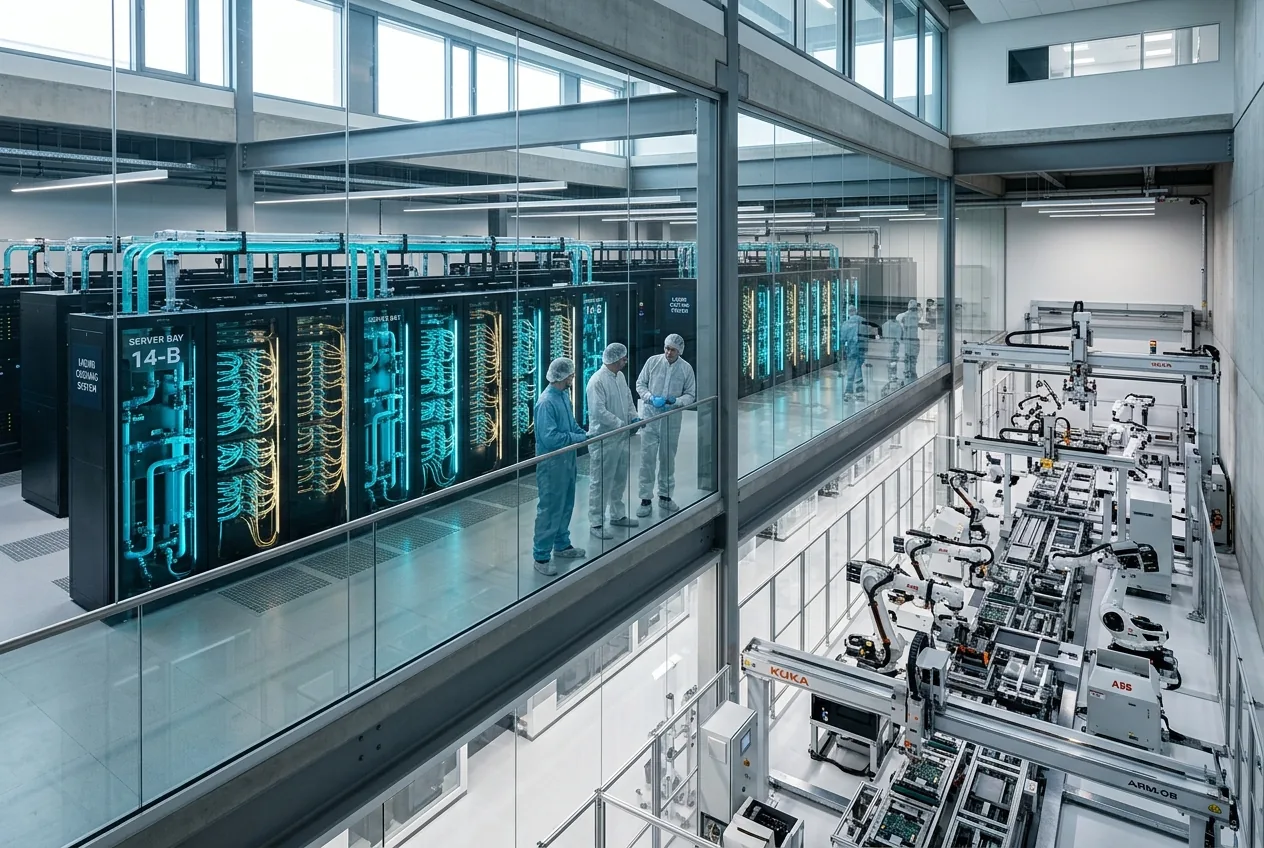
Data centers hosting these workloads are pressing against the physical limits of local utility grids. Liquid-cooled server racks housing advanced high-bandwidth accelerator clusters are operating at unprecedented thermal densities, requiring bespoke substation infrastructure and continuous megawatt-level power delivery. For OpenAI, maintaining the compute overhead required to support millions of parallel enterprise queries on a model like GPT-5.6 poses a massive operational burden. Anthropic faces identical headwinds with Claude Mythos, turning the competition into an energy war where architectural efficiency and algorithmic distillation are just as critical as raw intelligence.
This computational reality explains why OpenAI is keeping access tightly gated. The preview allows the company to observe the model's token consumption dynamics in real-world enterprise environments, identifying points of economic friction where smaller, distilled models or speculative decoding methods must be deployed to offset backend costs. For enterprise buyers, the calculus will not simply be whether GPT-5.6 outperforms Claude Mythos on paper, but whether its operational cost-per-successful-task delivers a viable return on investment when deployed across continuous business operations.
The Battle Lines for the Next Autonomous Frontier
The sudden rollout of GPT-5.6 confirms that the pace of frontier AI development is not moderating; it is splintering into higher-stakes specializations. The rivalry between OpenAI and Anthropic has transitioned from a race to build the ultimate consumer chatbot into an existential fight to build the operating system for global autonomous infrastructure. By claiming performance leadership over Claude Mythos, OpenAI is attempting to lock in enterprise contracts before Anthropic can cement its reputation as the preferred partner for safety-critical, high-assurance deployments.
Over the coming months, the broader developer ecosystem will be watching closely as preview access slowly expands. The ultimate test of GPT-5.6 will not be found in synthetically curated leaderboards, but in its resilience when integrated into messy, non-deterministic enterprise environments. If OpenAI’s newest frontier system can reliably navigate the friction of real-world software dependencies, physical automation constraints, and enterprise security frameworks, it will redefine the baseline of autonomous engineering. If it falters under the weight of its own computational overhead or unpredictable edge-case behavior, Anthropic’s measured, constitutional approach with Claude Mythos may well capture the industrial high ground.




Comments
No comments yet. Be the first!