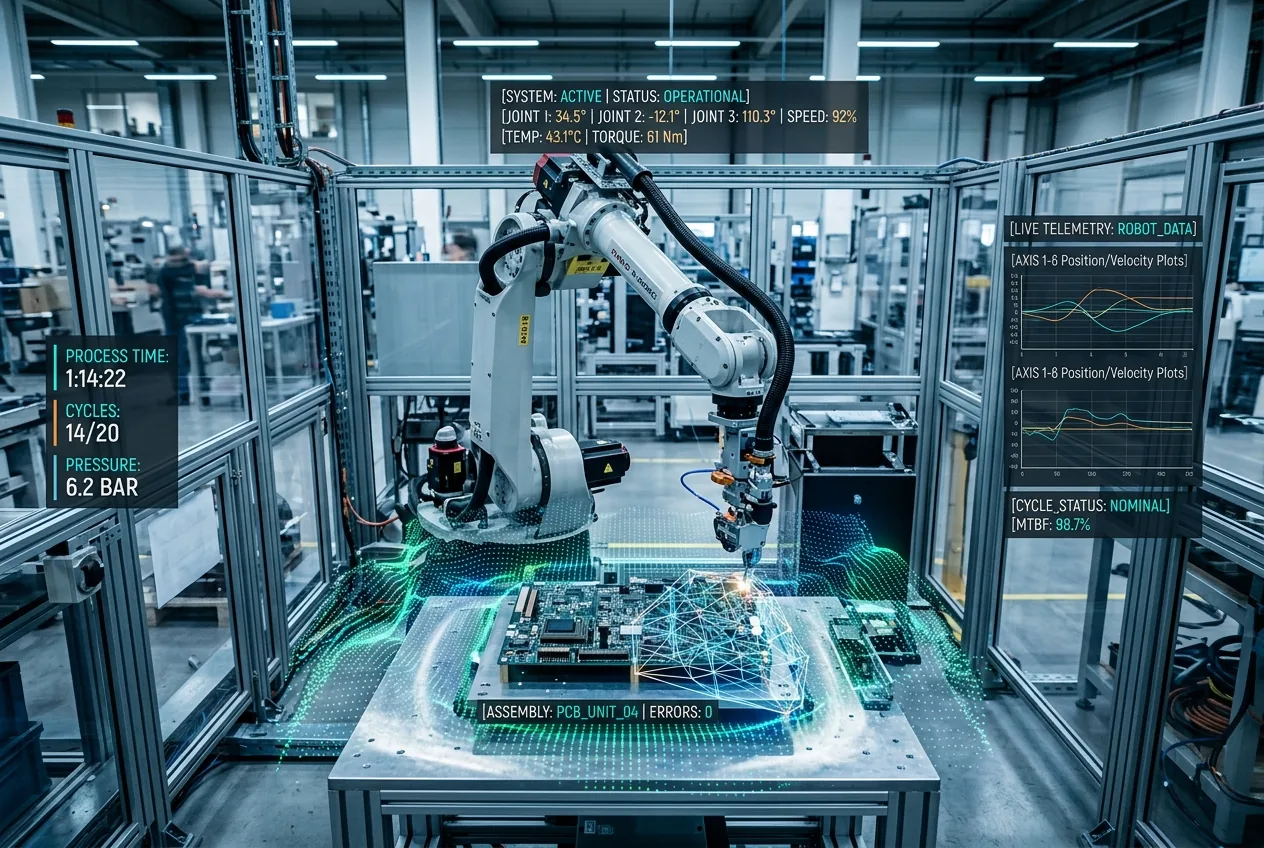
When OpenAI introduced its earliest generative text models, the technological demonstration centered around conversational fluency and stylistic mimicry. The release of its next-generation GPT-5.6 architecture in a restricted enterprise preview, however, represents a distinct pivot in mechanical objective. Rather than chasing conversational novelty, this iteration concentrates on architectural latency reduction, structured multi-agent orchestration, and the high-fidelity spatial reasoning required to interface with real-world technical systems. For engineers tasked with integrating predictive software into industrial environments, the technical specifications behind this preview indicate that foundational artificial intelligence is finally moving from the cloud dashboard to the factory floor.
The announcement, which arrived through targeted developer channels and selective enterprise partners, outlines a model family optimized for deterministic execution. In manufacturing plants, automated logistics hubs, and heavy robotic workcells, the primary flaw of prior large-scale neural networks has never been a lack of broad knowledge; it has been an absence of bounded execution and real-time reliability. If an automated assembly line relies on an agentic controller to route component inventory or diagnose mechanical wear, probabilistic variance is an intolerable liability. GPT-5.6 appears designed from the silicon up to address this boundary, offering a framework where symbolic reasoning checks and low-latency inference run parallel to generative weights.
Inference Scaling Meets Dense Mechanical Efficiency
At the architectural core of GPT-5.6 lies an aggressive refinement of hybrid inference compute. Earlier iterations in the frontier class forced developers to make an unappealing compromise: either deploy dense models that incurred punishing inference costs and variable latency, or settle for lightweight distillation models that frequently failed when interpreting dense technical documentation or multi-variable telemetry. GPT-5.6 bridges this gap by decoupling high-order systemic planning from rapid execution loops. The system appears to leverage dynamic token allocation, reserving deep test-time compute for systemic architectural analysis while offloading routine deterministic parsing to ultra-fast, sparse routing layers.
Furthermore, the memory footprint required for context retention has been overhauled. In previous generation frontier models, long-context windows often suffered from an architectural phenomenon known as context rot, where operational rules declared thousands of tokens prior were quietly dropped or superseded. GPT-5.6 demonstrates a sustained attention mechanism specifically hardened against instruction drift over sustained million-token horizons. In practical engineering workflows, this allows an entire plant's maintenance history, machinery blueprints, and dynamic wiring schematics to remain pinned within active memory without eroding the system's operational precision.
Bridging High-Level Intent with Physical Kinematics
The most consequential leap visible in the GPT-5.6 preview is its capacity for spatial telemetry translation. Software engineers have long struggled to translate the ambiguous high-level goals of human operators into the strict coordinate systems governed by modern robotics middleware, such as the Robot Operating System. Historically, models excelled at explaining how an inverse kinematics solver worked in theory, but they routinely failed when tasked with generating correct six-degree-of-freedom trajectory scripts that factored in joint torque limits and dynamic payload friction.
In preliminary technical disclosures, GPT-5.6 showcases direct support for native spatial formats, processing point clouds and volumetric mesh data alongside standard visual frames. Instead of flattening a machine cell into a 2D image, the vision-language-action layers parse spatial geometry with an acute understanding of occluded boundaries and volumetric constraints. For automated mobile robots operating within tightly packed distribution centers, this spatial comprehension allows the model to predict pedestrian and forklift trajectories seconds before they intersect with mechanical paths.
This capability fundamentally transforms automated diagnostic procedures on capital equipment. When an automated coordinate measuring machine flags a dimensional discrepancy on a cast titanium turbine blade, an engineer can feed the multi-axis inspection logs directly into GPT-5.6. Rather than simply regurgitating common tolerance errors, the model maps the dimensional variances back through the kinematic sequence of the multi-axis CNC machine that milled the part, isolating spindle runout or thermal expansion across specific machining passes. It achieves this by understanding the physical mechanics of the manufacturing pipeline, not merely predicting the next likely word in an engineering manual.
The Unit Economics of Industrial Deployment
For industrial enterprises evaluating adoption, technical brilliance remains secondary to the fundamental calculus of unit economics. Over the past twenty-four months, enterprise adoption of advanced machine learning has often stalled at the proof-of-concept stage due to unpredictably high token billing and ambiguous return on investment. Deploying a model that costs several cents per query to monitor an assembly operation that yields razor-thin manufacturing margins is financially untenable.
This economic viability is accelerating the shift toward localized hybrid deployments. While the foundational model training and high-order reasoning remain anchored in hyperscale cloud datacenters, the preview introduces dedicated toolsets for pruning operational weights to run on distributed enterprise appliances. When an automotive manufacturer can deploy a hardened, low-power inference box directly to an automated stamping plant—capable of executing GPT-5.6-class agentic safety monitoring without constant uplink dependency—the operational balance sheet completely changes. Capital equipment downtime, which routinely costs heavy manufacturing operations upwards of tens of thousands of dollars per minute, provides an immediate and undeniable ROI vector.
Deterministic Constraints in Mission-Critical Systems
The final hurdle between generative machine learning and industrial automation has always been safety engineering. In software development, an occasional hallucination produces a failed unit test or a broken web page. In an automated chemical processing facility or an aerospace composite manufacturing cell, a hallucinated command string can cause catastrophic structural failure, fire, or severe personnel injury. The culture of manufacturing engineering is inherently defensive, prioritizing fail-safe operational envelopes above all else.
Addressing this operational reality, GPT-5.6 introduces formal verification outputs, generating mathematically structured execution boundaries alongside its textual or programmatic responses. The model can natively format its outputs into strongly typed schemas that require explicit validation against safety-critical state machines before any hardware controller acts upon the instructions. If the model proposes an altered feed rate for an industrial lathe, the output is accompanied by a deterministic parameter envelope bounded by absolute safety limits hardcoded into the local runtime controller.
This strict structural encapsulation decouples the model's exploratory reasoning from the direct control layer. The neural network acts not as the ultimate physical actuator, but as an advanced supervisory intelligence operating within strict industrial constraints. As the preview expands to a broader cohort of automation vendors and hardware manufacturers throughout the quarter, the trajectory is unmistakable. OpenAI is shifting its focus away from generic software assistants toward the high-stakes, rigorous domain of industrial operations, where the value of intelligence is measured not by how convincingly it speaks, but by how reliably it builds.




Comments
No comments yet. Be the first!