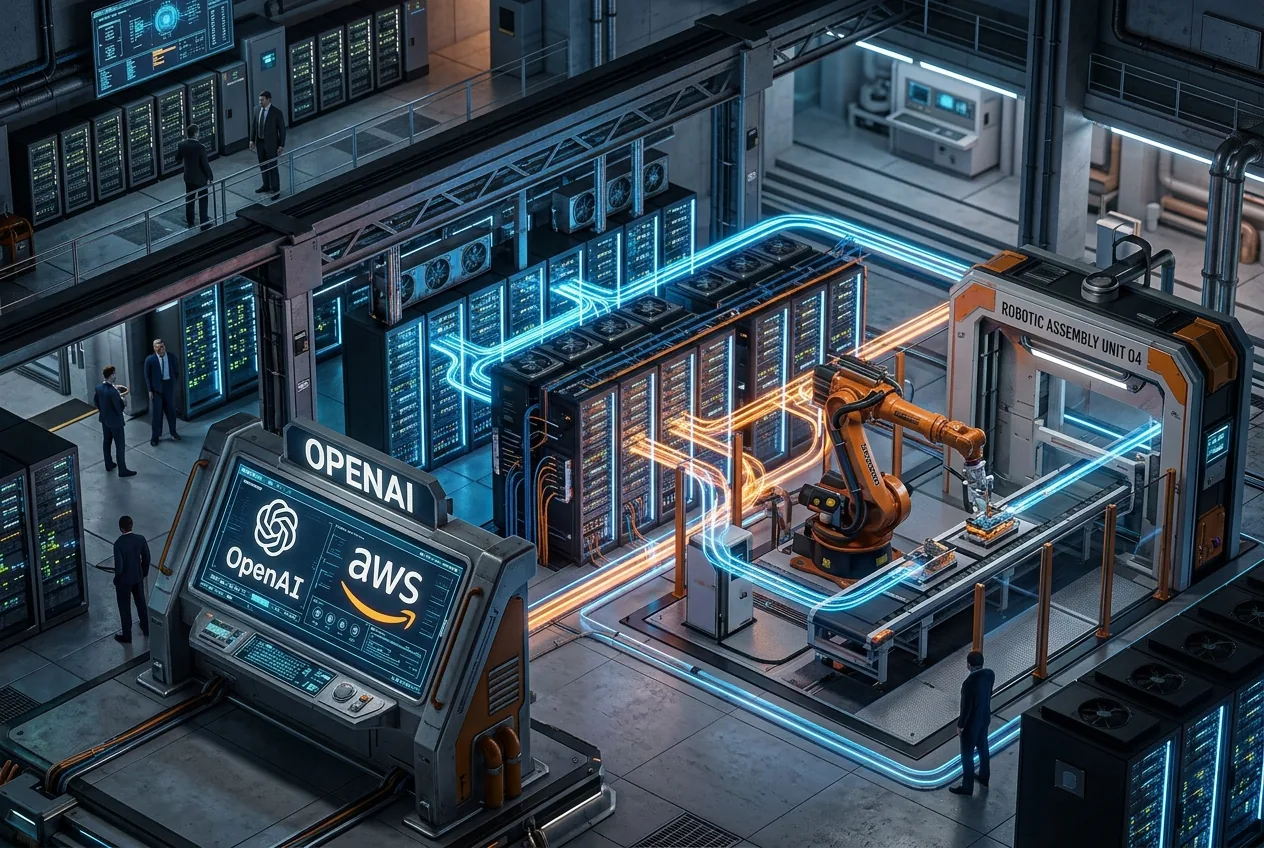
The landscape of enterprise generative AI underwent a tectonic shift this week as OpenAI officially launched its GPT-5.5 and GPT-5.4 model families on Amazon Bedrock. This move effectively ends the years-long era of Microsoft Azure exclusivity, providing industrial and tech-heavy enterprises with a choice of infrastructure for the most advanced large language models currently in existence. For those of us in the mechanical engineering and industrial automation sectors, this isn't just a corporate partnership update; it is a critical expansion of the toolset available for managing complex, data-heavy supply chains and robotic workflows.
The rollout includes not only the flagship GPT-5.5 reasoning model but also the GPT-5.4 variant, optimized for price-performance, and the OpenAI Codex agent. This latter addition is particularly significant for industrial applications where legacy codebases and specialized robotics software require constant refactoring and debugging. By integrating these models into Amazon Bedrock, OpenAI is tapping into AWS’s massive footprint in the logistics and manufacturing sectors, where data residency and infrastructure reliability are often the primary barriers to AI adoption.
The Architecture of Choice: GPT-5.5 and GPT-5.4
From a technical perspective, the availability of both GPT-5.5 and GPT-5.4 allows engineers to apply the principle of 'right-sizing' to their computational tasks. GPT-5.5 is positioned as the high-reasoning 'frontier' model. It is designed for agentic workflows—tasks where the AI must autonomously plan and execute a series of steps to achieve a goal. In a mechanical engineering context, this might involve interpreting a bill of materials (BOM), cross-referencing it with current supply chain lead times, and suggesting alternative components based on structural load requirements.
Conversely, GPT-5.4 serves the need for high-throughput, lower-latency operations. While it lacks the deep reasoning depth of the 5.5 model, it provides a superior economic profile for routine automation. For instance, in automated quality control systems where the AI needs to categorize thousands of sensor readings or image frames per hour, GPT-5.4 offers the necessary speed without the overhead of frontier-level reasoning. The models are accessible via the OpenAI Responses API, routed through Amazon Bedrock’s next-generation inference engine, which AWS claims has been purpose-built for high-availability production environments.
Codex and the Industrial Developer Ecosystem
The introduction of Codex on Bedrock is perhaps the most pragmatic gain for the industrial sector. According to OpenAI data, over 4 million developers are already utilizing Codex weekly. However, for companies operating in highly regulated fields or those with strict intellectual property protocols, the previous requirement to use external IDE plugins was often a non-starter. By hosting Codex on Bedrock, AWS allows these organizations to keep their entire development lifecycle within their VPC (Virtual Private Cloud).
Codex is now optimized for long-horizon developer workflows. In practical terms, this means it can maintain context over large, interconnected codebases. For an automation engineer tasked with maintaining a decade-old PLC (Programmable Logic Controller) integration layer, Codex can assist in translating legacy logic into modern Python-based control systems while ensuring compliance with existing safety protocols. The integration spans across the Codex CLI, specialized IDE plugins for Visual Studio Code, JetBrains, and Xcode, all utilizing the Bedrock-Mantle infrastructure.
Why Amazon Bedrock is a Strategic Win for OpenAI
Furthermore, AWS brings specific infrastructure advantages to the table. The use of the `bedrock-mantle` endpoints suggests a deep integration with AWS’s custom silicon and specialized networking stack. For enterprises, the primary draw is the data residency guarantee. All processing remains within the specific Bedrock Region selected by the customer. This is a crucial technical specification for European manufacturers governed by GDPR or defense contractors working under ITAR restrictions. Unlike consumer-facing AI products, data used on Bedrock is not used to train OpenAI’s base models, a standard but necessary enterprise protection.
Economic Viability: Tokens vs. Seats
One of the most disruptive aspects of this launch is the pricing structure. OpenAI and AWS have opted for a purely token-based consumption model. This stands in contrast to the seat-based licensing traditionally seen in enterprise software and even some of Microsoft’s 'Copilot' offerings. For a manufacturing firm, this is an inherently more scalable model. You pay for the reasoning you use, rather than the number of engineers who have the software installed.
This economic model aligns perfectly with industrial automation. During periods of high production or R&D intensity, the costs scale with usage; during maintenance windows or downtime, the costs drop to near zero. There are no per-developer commitments or seat licenses. This 'utility' model of intelligence makes it easier to justify the ROI of integrating GPT-5.5 into long-term infrastructure projects where usage patterns might be unpredictable.
Can OpenAI Maintain the Lead with GPT-5.6?
As part of this rollout, OpenAI also previewed the general availability of the GPT-5.6 series, codenamed Sol, Terra, and Luna. While GPT-5.5 is the current workhorse, these upcoming models suggest a further specialization of AI. Sol appears to be aimed at high-speed visual-spatial reasoning (highly applicable to autonomous robotics), while Terra is optimized for massive data set synthesis, and Luna focuses on ultra-low-latency edge applications.
The presence of these next-generation models on Bedrock indicates that the AWS-OpenAI partnership is not a one-off event but a long-term strategic alignment. For those of us tracking the interface of robotics and industry, this competition between cloud providers is a net positive. It drives down the cost of 'intelligence' and forces providers to offer better security and more robust SLAs. The technical barrier to entry for building complex, AI-driven automation is lower than it has ever been, and the infrastructure to support it is finally catching up to the theoretical potential of the models.
Technical Implementation and Integration
For the technical leads responsible for implementing these systems, the transition appears remarkably straightforward. The OpenAI SDK for Python now supports Bedrock endpoints with simple environment variable adjustments. By setting the `OPENAI_BASE_URL` to the Bedrock-Mantle endpoint, developers can use the familiar OpenAI library to call GPT-5.5. This level of interoperability is a clear nod to the developer community, ensuring that the migration of existing agents from Azure to AWS (or vice versa) is a matter of hours rather than months.
In summary, the launch of GPT-5.5 and Codex on Amazon Bedrock represents the maturation of generative AI from a novelty into a standardized industrial utility. We are moving away from 'experimental' AI and toward a world where high-level reasoning is just another API call, as reliable and scalable as AWS S3 or EC2. For the mechanical and industrial engineers on the ground, the message is clear: the tools for the next generation of automation have arrived, and they are now accessible on the infrastructure you already trust.




Comments
No comments yet. Be the first!