Silicon Valley has never suffered from a shortage of audacious timelines, but OpenAI chief executive Sam Altman has raised the stakes once again. Across public statements and recent writings on the dawn of an 'Intelligence Age,' Altman has posited that artificial superintelligence—and the broad technological singularity that accompanies it—may arrive in a matter of 'a few thousand days.' While dismissals of such aggressive forecasts often come quickly from conservative engineers, researchers at institutions such as Israel's Technion have taken a more measured, analytical stance. Their assessment suggests Altman’s mathematical trajectory might actually hold, provided the current rate of algorithmic breakthroughs and compute scaling remains unmarred by theoretical cliffs.
Yet moving from pure algorithmic projection to functional industrial reality introduces variables that software benchmarks routinely ignore. When computer scientists talk about the singularity, they typically measure benchmark performance on abstract linguistic tasks, symbolic logic, and self-contained coding environments. For those of us examining these systems through the discipline of mechanical engineering and industrial systems, intelligence is not an ethereal concept trapped within a server cluster. It must act, manipulate, manufacture, and integrate into a physical world governed by thermodynamics, friction, and finite power grids.
The Core Argument Behind the Accelerated Singularity
This structural shift is precisely what has caught the attention of academic computer scientists, including researchers at the Technion. When examining the rate at which automated reasoning engines solve graduate-level science and mathematical proofs, the slope of the capability curve does not appear to be flattening. Instead, autonomous systems are demonstrating early heuristics for self-improvement: writing their own unit tests, generating synthetic training environments, and identifying inefficiencies in their own underlying architectures. If an artificial intelligence can autonomously optimize the compiler, refine the silicon floor plan, and architect the next generation of model weights, the feedback loop defining a classical technological singularity transitions from science fiction to an engineering schedule.
Technion experts analyzing these developments note that the threshold for general intelligence does not require a system to mimic human biology; it merely requires functional parity across cross-domain reasoning, task planning, and error correction. If the combined algorithmic optimizations of deep learning architectures, reinforcement learning via verifiable rewards, and distributed inference maintain their current velocity, achieving a cognitive architecture that surpasses human intellectual throughput across nearly all commercially valuable work is mathematically defensible within the decade Altman describes.
The Silicon Wall and Thermodynamic Bottlenecks
Acknowledging the algorithmic possibility of the singularity is one matter; building the physical compute infrastructure to host it is entirely another. The grand visions of superintelligence articulated by frontier model developers require hardware installations on a scale humanity has never attempted. High-density training runs and ultra-low-latency distributed inference clusters already test the limits of modern photolithography and electrical grid design.
Furthermore, the energy footprint of these systems is colliding directly with civil infrastructure. Multi-gigawatt data center proposals are no longer theoretical curiosities; they are active design targets. Utility providers in the United States and Europe are already warning hyperscalers that interconnect delays for transmission lines can extend beyond five years. Altman has publicly recognized that a breakthrough in next-generation nuclear fission or commercial nuclear fusion will be mandatory to power this intelligence ecosystem. When an algorithmic timeline depends on the wholesale overhaul of civil power generation and heavy electrical grid expansion, the timeline is dictated not by code commits, but by concrete pours, turbine fabrication, and regulatory approvals.
The Critical Void of Physical Embodiment
Even if an ultra-capable cognitive core is realized in a remote data center within a few thousand days, humanity does not live or produce value solely in a text buffer. The true industrial singularity requires embodiment. A digital intelligence capable of writing complex control systems or designing novel thermodynamic engines cannot affect physical supply chains until it possesses the robotic hardware to implement them.
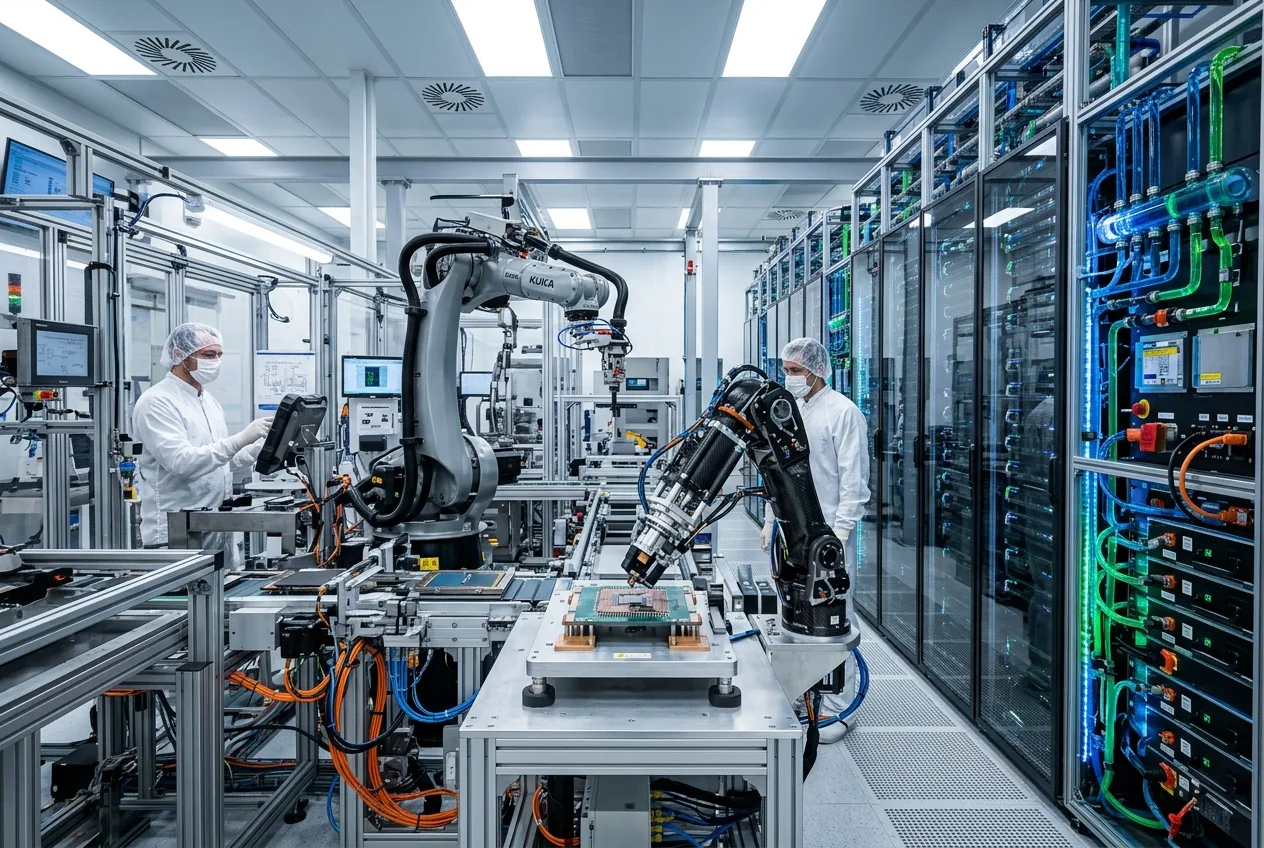
Robotics requires deterministic reliability. In a semiconductor cleanroom, a precision automotive assembly plant, or an offshore energy platform, an actuation error of two millimeters or a latency lag of fifty milliseconds can result in catastrophic mechanical failure or human injury. The probabilistic nature of modern neural networks—where edge cases result in hallucinations or mechanical twitching—is fundamentally incompatible with deterministic industrial machinery. Until the mechanical engineering behind physical agency catches up to digital reasoning, any proclaimed singularity will remain functionally severed from the global supply chain.
Economic Rationality in an Era of Massive Capital Expenditure
For Altman’s timeline to manifest, enterprise software buyers and heavy industries must see an unmistakable return on investment that justifies these colossal infrastructure investments. If a enterprise deploys a model cluster costing hundreds of millions of dollars, that system must displace entire operational overheads or unlock unprecedented productivity dividends. If economic returns lag behind the staggering depreciation cycles of short-lived GPU clusters—which often become economically obsolete within three to four years—the capital fueling this rapid push toward the singularity could easily contract before the technical milestone is breached.
Academic observers at the Technion and elsewhere rightly observe that the intellectual trajectory is undeniable. The software works, the emergent behaviors are verifiable, and the theoretical models suggest that general reasoning is a solvable mathematical challenge. But technical journalists and mechanical engineers must remain grounded in the reality of the machine shop, the fabrication plant, and the electrical substation. If the singularity arrives on Sam Altman’s schedule, it will not be because software algorithms cracked the code of general intelligence; it will be because the global manufacturing base managed to forge the physical body and generate the raw wattage required to bring that intelligence into the physical world.



Comments
No comments yet. Be the first!