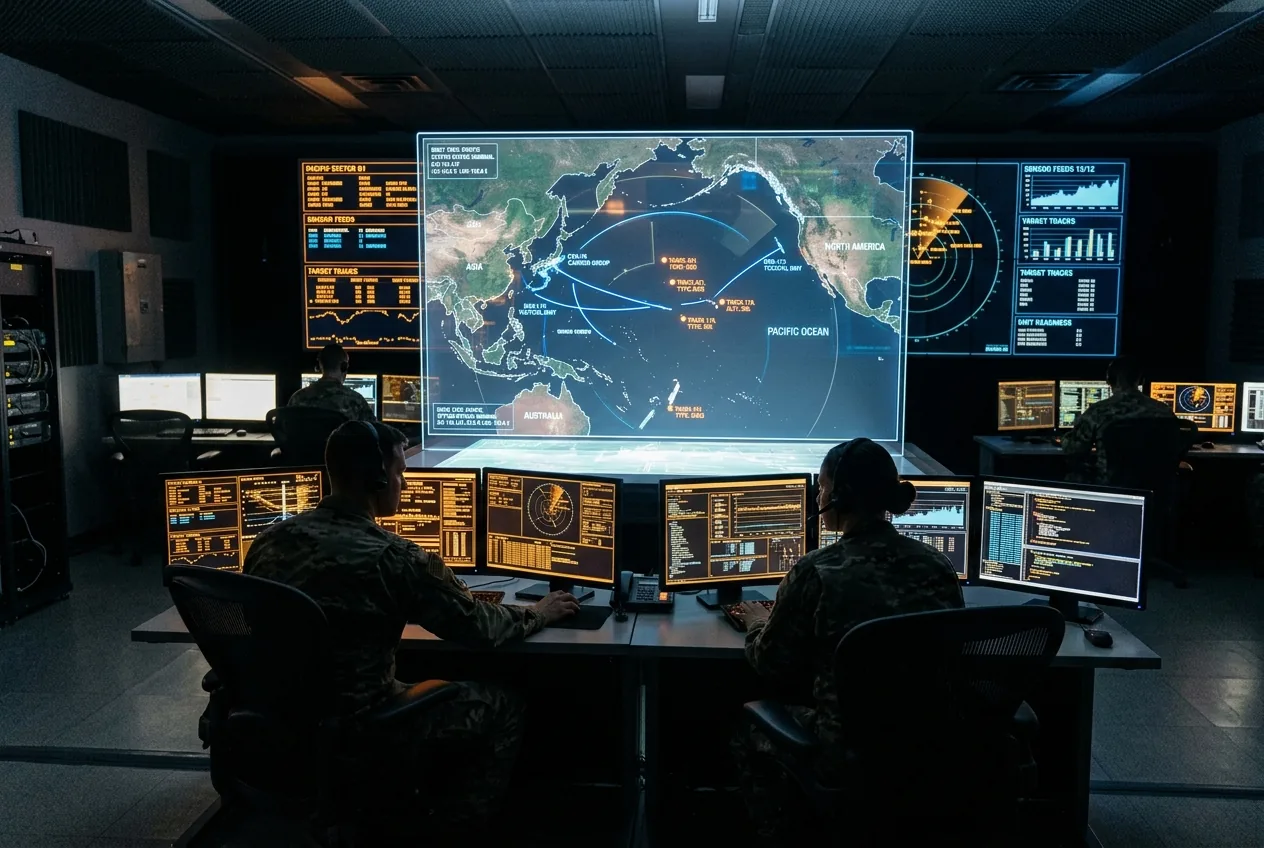
A recently surfaced report detailing a harrowing near-miss between the United States and Chinese military forces has confirmed what systems engineers and defense analysts have quietly feared for years: modern geopolitical stability is increasingly hostage to the brittle heuristics of machine learning. According to accounts emerging from national security investigations, an algorithmic threat-detection and sensor-fusion platform misclassified routine telemetry, triggering an automated escalation sequence that brought two nuclear-armed superpowers within minutes of kinetic retaliation. While human operators ultimately intervened to abort the strike sequence, the incident exposes the fragile reality behind modern efforts to automate defense command architectures.
For decades, the standard defense deterrence model relied on the physical friction of human decision-making. Verifying satellite telemetry, evaluating acoustic sonobuoy arrays, and cross-referencing radio intercepts took hours, giving commanders time to verify whether an anomalous ping was a submarine running silent or a thermal layer in the water column. Today, the U.S. Department of Defense and China’s People’s Liberation Army are locked in a race to automate the kill chain under initiatives like the Pentagon’s Joint All-Domain Command and Control (JADC2). The promise is an ultra-fast tactical advantage. The reality, as this near-miss demonstrates, is a high-speed feedback loop vulnerable to the catastrophic failure modes inherent to non-deterministic software.
The Anatomy of an Algorithmic False Positive
Military artificial intelligence does not operate as a single omniscient brain; rather, it is an uneven mosaic of deep neural networks, computer vision models, and Bayesian inference engines processing unfathomable volumes of unstructured sensor data. In contested maritime corridors like the South China Sea and the Taiwan Strait, the operational environment is thick with commercial shipping vessels, regional fishing fleets, electronic countermeasures, and complex acoustic reflections. Machine learning models deployed on reconnaissance platforms such as the MQ-4C Triton or processing Synthetic Aperture Radar (SAR) feeds must continuously isolate hostile assets from background noise.
In this reported incident, the failure mode originated in a multi-modal sensor fusion pipeline. When an automated surveillance platform ingested synthetic aperture radar imagery alongside intercepted electromagnetic emissions, an edge-deployed computer vision model misidentified a formation of naval vessels. Compounding the error, the system hallucinated an imminent launch posture based on correlated electromagnetic signatures that were actually civilian radar interference mixed with standard training telemetry. The software assigned a near-certain probability score to an incoming anti-ship missile salvo, advancing the automated defense system to a pre-launch retaliatory state before a human analyst flagged the raw telemetry anomalies.
The fundamental technical flaw lies in how deep learning models handle distribution shift. Neural networks are trained on historical datasets of hostile behaviors, radar cross-sections, and electronic warfare profiles. When deployed into real-world operational theaters, these models encounter non-standard edge cases that exist entirely outside their training manifolds. When a commercial convolutional neural network fails to classify a pedestrian, a self-driving car might brake abruptly. When an automated command support node misinterprets radar clutter during heightened geopolitical tension, it threatens to trigger an unrecoverable strategic response.
The Myth of the Meaningful Human-in-the-Loop
Defense doctrine universally mandates that a “human remains in the loop” for any lethal or strategic decision. Policy frameworks such as DoD Directive 3000.09 state that autonomous and semi-autonomous systems must be designed to allow commanders and operators to exercise appropriate levels of human judgment over the use of force. However, systems engineers who study human-machine interaction have long understood that this safeguard is often purely theoretical under operational conditions.
As sensor-to-shooter timelines shrink from hours to seconds, the human operator ceases to be a deliberative decision-maker and becomes a rubber stamp. When an automated interface flashes red, displaying calculated flight times of hypersonic cruise missiles measured in under three minutes, a human operator cannot systematically audit the millions of parameters, weights, and raw telemetry inputs that generated the alert. The cognitive phenomenon known as automation bias—the psychological tendency for humans to defer to algorithmic recommendations, particularly under extreme stress—virtually guarantees that an operator will trust the machine.
In the Pacific near-miss, catastrophe was avoided not because the fail-safe process worked as designed, but because a legacy engineer questioned the underlying sensor feed rather than the machine’s output. Had that specific intervention taken sixty seconds longer, standard operating procedures would have authorized a pre-emptive strike on an adversary base that had never launched a missile. Relying on an exhausted operator to mathematically disprove an algorithmic hallucination inside a three-minute window is not a safety protocol; it is a structural failure waiting to materialize.
Algorithmic Flash Crashes in Geopolitics
The financial sector learned the hazards of automated speed over a decade ago. On May 6, 2010, the U.S. stock market experienced the “Flash Crash,” where automated high-frequency trading algorithms engaged in runaway feedback loops, wiping out a trillion dollars of market value in thirty-six minutes before automatic circuit breakers halted trading. High-frequency algorithms were interacting with other high-frequency algorithms, misinterpreting trade volume drops as structural collapses and triggering automatic sell-offs.
A modern theater of war operates on remarkably similar mechanics, but without circuit breakers. If both the United States and China deploy semi-autonomous, AI-accelerated command systems, the two architectures will inevitably interact. An automated defensive maneuver executed by one system can be interpreted as an offensive posturing signature by the other. This risks triggering a continuous, machine-speed escalation ladder that outpaces diplomatic hotlines, human verification, and political de-escalation channels.
Unlike financial markets, military algorithmic deployments operate in an environment of intentional adversarial deception. Modern electronic warfare platforms are explicitly designed to spoof machine learning models. By projecting targeted radio frequency noise or physical visual artifacts—known technically as adversarial perturbations—an adversary can deliberately trick a machine vision model into seeing an incoming strike where none exists. If a nation’s command pipeline relies on deterministic software coupled with black-box neural networks, it hands its adversary a mechanism to induce strategic panic through computational manipulation.
Re-Engineering the Architecture of Defense
Resolving this systemic vulnerability requires the defense sector to abandon its uncritical adoption of commercial software paradigms. In Silicon Valley, the standard operating procedure is iterative deployment: push probabilistic models, gather real-world edge-case data, and patch errors in subsequent releases. In the context of national security and nuclear command, control, and communications, a probabilistic error rate of two percent is unacceptable.
Engineering resilience into these systems demands a return to deterministic verification and formal mathematical modeling. Autonomous systems must be built with hard physical interlocks and hardware-level state machines that prevent kinetic transitions without multi-source, non-algorithmic physical corroboration. If synthetic aperture radar indicates an offensive posture, the system must not be allowed to escalate based on Bayesian probabilities alone; physical, multi-spectral verification must be non-negotiable, even if it introduces latency into the decision loop.
Furthermore, the Indo-Pacific near-miss highlights the desperate need for bilateral algorithmic de-confliction agreements between Washington and Beijing. Just as the Cold War produced naval protocols to prevent accidental collisions between American and Soviet vessels, modern superpowers require computational standards. These must include shared definitions of automated operational boundaries, bans on integrating autonomous algorithms into strategic launch-on-warning architectures, and direct military-to-military communication channels dedicated solely to clearing up sensor anomalies.




Comments
No comments yet. Be the first!